Once upon a time, there was a mountain.
On the mountain, there was a temple.
In the temple, there was an old monk and a young monk.
One day, the young monk told the old monk, “Tell me a story.”
And the old monk began, “Once upon a time, there was a mountain…”
The old monk told the story to the girl each night. On top of that, he left a persimmon by her bed each night. On top of that, he spent time with the girl, doing this and doing that, sometimes doing nothing.
The girl questioned the monk vigorously, just as the monk had once questioned his old monk when he was little. The monk, for the first time in his life, realized how hard it was to answer a child’s questions.
“Why doesn’t the young monk just leave?” asked the girl.
“Maybe he has nowhere to go.”
“Everyone has somewhere to go. I’ve seen the map.” She held up her phone, the one that her mother left her.
“Maybe the mountain is where he wants to be.”
“Nobody wants to be on a mountain. People end up on mountains.”
The monk felt this one land and said nothing for a moment.
“The story needs more,” she said. “Things happen in stories. People fall in love. There are wars. Someone goes on a journey.”
“This story doesn’t have those things.”
“Then what does it have?”
The monk thought. “It has a mountain,” he said. “And a temple, and two monks. And the asking.”
“The asking?”
“The young monk asks the old monk for a story. That’s the thing that happens. The asking is the event.”
The girl turned this over. Then she said, “I think the asking is the saddest part.”
“Why?”
“Because it means the young monk already knows the answer. He already knows it’s the same story. He asks anyway.” She paused. “That’s not hope. That’s just not wanting to be alone.”
The monk said nothing. A cold pressure in his chest returned, harder this time, and he left the room before it could reach his throat.
At first, tourists came in ones and twos. The old monk brought out fresh persimmons, morning dew, and the finest rice wine to welcome them. A couple. A foreign traveler with a heavy backpack. Then, three young men in their twenties, who found out about this temple on the internet. They offered to pay the old monk some money. The old monk rejected it. He was far too old and the girl was far too young. All they needed was groceries from below the mountain. Money from selling persimmons sufficed. What would they need all this money for?
Reality convinced the old monk otherwise. More and more people came up the mountain, like ants swarming a mushroom until it sagged beneath them. The old monk erected a sign before the temple: 30 yuan per minor, 50 yuan per adult. Soon he was collecting money, more money than he could ever dream of. He didn’t know what to do with it. He piled it up in the temple’s basement.
In early 2020, news came through the girl’s phone—she had bought a better one with a fraction of the old monk’s savings—that a sickness was spreading. At first it was only a city, just a name on a screen, a place neither of them had been. Then it was everywhere.
People stopped coming to the mountain. The road at the bottom of the mountain, which the monk had watched grow from a dirt track to a two-lane highway, fell as quiet as when it was still dirt. The girl checked her phone constantly. She read the numbers to the monk, who did not know what to do with them. He grappled with them the same way he had grappled with the images of students’ bodies thirty-one years before.
The monk was fifty-two now. He had begun to cough, a dry cough that sat deep in his chest and came out like the eruption of a volcano, and the girl pretended not to notice, and the monk pretended it was not serious, and they maintained these mutual fictions through the winter because the alternative was to acknowledge that the mountain, which had kept out empires and armies and revolutions, could not keep out a virus or the passage of time.
“Tell me,” the monk said one day. He was too tired to say the full sentence. He did not need to.
The twenty-one-year-old girl sat beside his mat.
“Once upon a time,” she said, “there was a mountain. On the mountain there was a temple. In the temple…”
The monk closed his eyes. The words washed over him like water, like the rain that the first old monk had walked through on the night he left Xuan, whom neither the monk nor the girl knew anything about, and this did not matter because some parts of the story deserved to be in the story even when they were not told.
He died on a Sunday in February 2021. The ground was frozen. The girl, who was now twenty-two, could not dig a grave. She waited three weeks, until the frost broke, and buried him next to the other two graves behind the temple. Three mounds of earth.
She lived alone.
Not for long. Just for a season, one long winter that extended into spring, during which the world continued to be strange and distant and close all at once. She checked her phone. She swept the courtyard. She rang the bell, which was the third bell the temple had known: the first cast by craftsmen in the Qing, the second carved from furnace scrap by a monk with shaking hands, the third delivered by truck from the county government in 2015.
In the late spring, when the persimmon blossoms came, she found a child at the gate. The child was small and wore a mask, the disposable kind, pale blue. The child’s eyes above the mask were steady and dark.
She looked at the child. The child looked at her.
That night, the child could not sleep. The girl, who was now the keeper, sat beside the child’s mat.
“Once upon a time,” she said, “there was a mountain…”
She did not know what the first old monk’s story had sounded like. She did not know about Xuan, or the Xianfeng Emperor, or the rain that fell on the night a man decided to climb a mountain and never come down. She did not know that the second telling had been braided with the sound of airplanes and the taste of iron and a fury that had survived the breaking of a bell. She did not know that the third had been stripped of everything but endurance by a man who had watched the world transform from a cliff edge and refused to be transformed by it. She only knew her own version, which was all anyone ever knows.
The mountain was there in the morning when she opened the window. The same mountain. It had been the same mountain in 1860, when a heartbroken man walked up it in the rain. It had been the same mountain in 1926, when a boy buried his teacher and stood alone in the autumn light. In 1966, when the Red Guards came with their crowbars. In 1978, when a child arrived with a sack of rice and eyes that would not meet anyone else’s. In 1989, when a man watched tanks on a television and walked home in silence. In 2020, when the roads went quiet and the world held its breath.
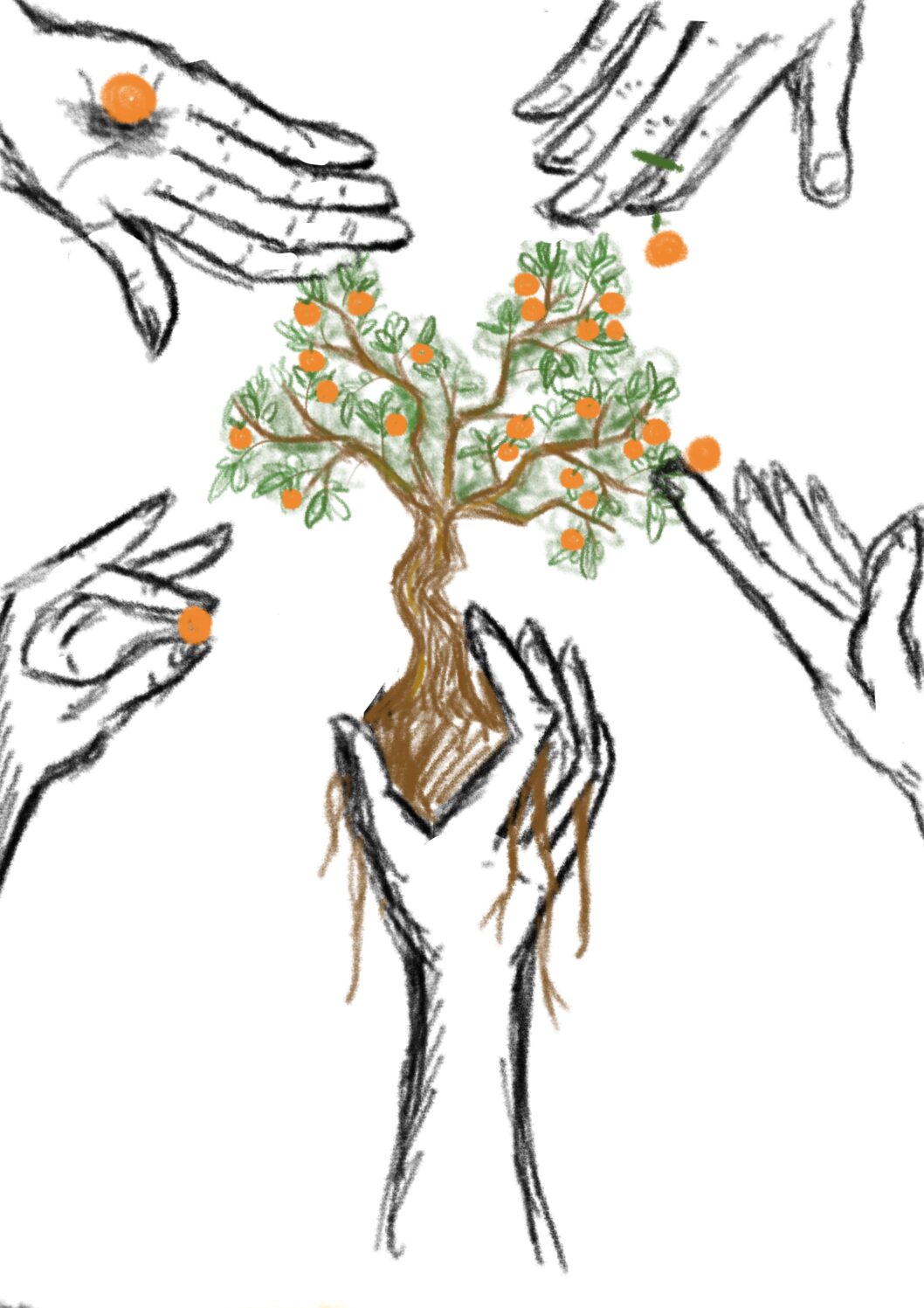
The same mountain, the same courtyard, the same persimmon tree—or the descendant of the descendant of the original, which had been cut down and replanted and was now, in its own way, a retelling. And three graves behind the temple. And a child asleep in the next room, breathing softly, going wherever children go when they sleep.
She thought about what she had told the monk before he died. That the asking was the saddest part of the story.
She no longer believed this. The asking was not sad. The asking was the whole point. It had been the point when the first old monk whispered it to a boy who couldn’t stop twirling his hair. It had been the point when a monk braided his anger into the words and a boy spoke for the first time in months. It had been the point when a girl who had walked until she found a direction heard the story and called it stupid and meant, I will stay.
Without the asking, there was only a mountain, and a temple, and silence. The asking was what made it a story. And a story—even a bad one, even one that went in circles, even one that had been told and retold across a century and a half of floods and wars and revolutions and plagues until the original was unrecognizable—was better than no story at all.
Once upon a time.
She was sure of this much.
Alpha Zhang is a contributing writer for the Nassau Weekly.