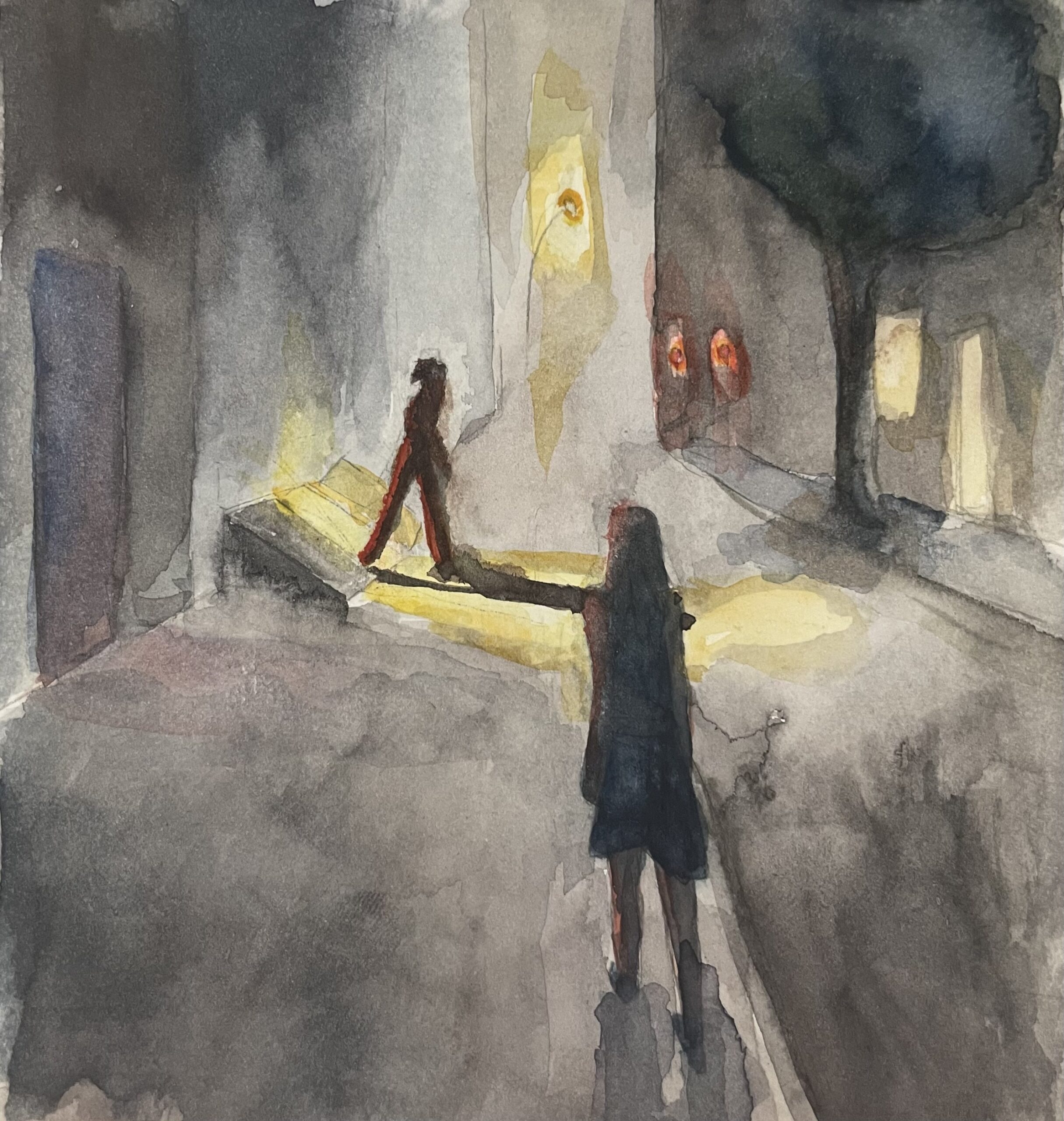
On a smoggy summer night at a quarter to nine, while the other gussied-up city girls ran to catch downtown trains, Uma had nowhere to be.
She could have been sawing at a medium-rare steak and swirling a glass of Cabernet Sauvignon at an al fresco bistro on the Lower East Side, had her dinner date, a lean-jawed trading intern, not stood her up. There was never even a reservation to begin with. That news might have been less humiliating had the host not announced it apathetically, with California vocal fry, as a mound of bubble gum rolled around in his slack mouth.
Meandering across 82nd Street in snakeskin mules and a wasted blowout, Uma felt forlorn. Couple after couple, young and old, hand in hand, moseyed past her on the sidewalk, seemingly steered in her direction by Satan himself. She had been counting on the trading intern to steal her away from her lackluster desk job and borderline monasticism. Companionship in one’s twenties was scarce nowadays. The next time Uma would slip on a pretty dress and perfume herself would be Christmas Eve brunch with her sister in Oregon.
The trek back to her studio was hampered by the stench of a distant campfire as smoke from the Canadian wildfires blew through the city. The sky had been shrouded in an apocalyptic orange haze earlier that morning, and while broadcasters attributed the air quality to climate change, Uma now saw it as having foreshadowed her miserable evening.
Maybe that’s why her date never showed. He was asthmatic and hospitalized.
The flags mounted on the façade of the red brick Hungarian House were tangled around their poles. Uma had always been in love with No. 213—a charming middle class home from the Civil War, with its wooden Italianate-style cornices and hideous iron balcony. Standing at only two stories, it was significantly shorter than its neighbors. Uma peeked between the curtains, beyond which were bookshelves, an oxblood chesterfield sofa, and two European men smoking while engaged in a contentious conversation. Uma envisioned herself between them, hosting a dinner party with her faithful husband and some close friends.
A pair of steel cellar doors ahead of Uma flopped open, and out sprung colorful soul music and a man in an orange zoot suit shimmying up the stairs. Uma was half expecting a conga line of similarly fashionable people to follow in his wake, but the man ascended solo.
Noticing her lingering, the man said, with a gap-toothed smile, “Had you come sooner, honey, I would’ve saved you my last dance.”
“What’s going on down there?”
“Go see for yourself.” He tipped his fedora courteously to her and hailed a parked taxi, the driver of which was snoozing behind the wheel. When twin spears of light shone from the car, she noticed the man’s two-toned shoes and sweaty forehead.
Uma’s apartment building was on the horizon, she was a stone’s throw from a steamy shower and reheated leftovers, but the Hungarian House cellar beckoned to her. The doors were thrown open, and it was impossible for Uma not to feel the fatefulness of her situation. She had stumbled across an opening to a life she had only ever fantasized in passing. Uma could have gone in through the front door, in daylight, with some proper invitation, with all the ceremony that such an arrival seemed to demand, but she was impatient. The only way inside the Hungarian House, however undignified, was underground. Invitation or not, she would finally be behind those red brick walls.
Uma’s moodiness petered out as she followed the soul music down through a dingy, peeling tunnel, hotter than the current Canadian woodlands, which eventually led to a low-ceilinged, cavernous venue bursting with Motown and movement.
She balked at the frenzied scene, edging back towards the cellar doors, but a gaggle of arriving guests in headscarves shoved her farther inside.
Hundreds of swing dancers in 1940s attire commanded the floor while a live band performed a Martha and the Vandellas song onstage. Partners twirled, rocked, and dropped low. Feet bounced, playful and inventive. Uma stuck to the outskirts of the venue, mesmerized by the leggy mob and vulgar bodily contact. A panic of conservativeness overcame her. Compared to this underground riot of loose, springy, sure-footed dancers, she felt prudish and inexperienced.
Uma sensed someone approaching—a short man, old enough to be her grandfather, in an all-white ensemble.
“Would you like to dance with me?” he asked with the forward politeness of a smooth talker who knew how to get his way.
Uma surprised herself with the eagerness of her nod. Had she held off a moment longer, maybe a young stud would have sought her out.
The short man led Uma deeper into the dance floor, the heart of the chaos. During a transition from Motown to jazz, she told him humbly, projecting over the din, “I’ve never danced swing before.”
“Girls always say that, and then they turn out to be naturals.”
“I’m an elephant in heels.”
“Don’t worry. The man leads. You just follow.”
Her dance partner, who Uma would later come to know as Rick from Pasadena, California, placed one hand on her mid-back while the other clasped her own. The drummer set the tempo with brushes, then the pianist slipped in, and suddenly Uma felt the hand at her mid-back nudge her forward, then back, steering her uncomfortably. She made the mistake of glancing down at Rick’s lace-up brogues, hoping to anticipate his next step, but she only confused herself, awkwardly turning right when he went left.
Occasionally, Uma’s hand on Rick’s right shoulder would slip to his upper arm, just below the shirt sleeve, where his sun-spotted skin was covered with blonde hair, damp from dancing.
“When did you learn to swing dance?” Uma asked, distracting herself from his pilosity. Given their proximity, she kept looking over his shoulder, avoiding a face-to-face chitchat.
“Decades ago. Truman was president,” Rick answered, “This was always the cool sport for me. Followed me to every city. In any corner of America, even on the bayous of Louisiana, there’s always a swing dancer, and they’ll show you a good time. I recognize some of the faces here. They bounce from speakeasy to speakeasy, West Coast to East Coast, like storm chasers but for big bands.”
Rick spun Uma and she felt like a little girl on a carousel.
“You’ve moved a lot?”
“I’ve lived my entire life out of a suitcase.”
“What do you have packed?”
“Enough for today and tomorrow!”
They shifted apart into a side-by-side promenade to travel across the slippery dance floor.
Rick said, “Folks these days are so uptight and no-nonsense. Planning eons into the future, getting married in their twenties. Whatever happened to the free-wheeling Kerouacs? Are you going to get somewhere or just going?”
Uma wasn’t well-read enough to appreciate the reference. Rather, she became aware of the weight against the Hungarian House’s beams and joists around her.
“When I’m older, I’m gonna live in this house,” Uma admitted, hoping it answered Rick’s ambiguous questions.
“How old is older?”
“I dunno. Fifty?”
“You’re ready to settle so soon?”
“That’s well over twenty years away.”
“And for twenty years you’ll be expecting the road of your life to end at 82nd Street.”
Uma resisted Rick’s guiding hand. They stopped dancing. Couples whirled around them.
“I’m not settling just because I have a vision for my future.”
“C’mon,” Rick said, embarrassed, nudging Uma back into a groove. “We’re causing congestion.”
She wrenched her hand free from his hold. The feet of a woman being flipped over her partner’s shoulder came arching through the air, within a hair’s breadth of Uma’s shoulder. The crowd of swing dancers sewed themselves together between Uma and Rick. She was glad for the intervention. Who was he to tell her how to live? If Uma let loose à la Rick and began serially dating dozens of corporate America interns, a different boy each week, she would derive no pleasure from her hasty companionships. Rather, it was Uma’s inner life, her retirement in the multimillion-dollar Hungarian House as a middle-class woman with no Hungarian descent, where she became truly spontaneous.
Tired and clammy, Uma claimed a spot along the wall again and took off her snakeskin mules. It wasn’t long before a tall bachelor gave her a once-over and offered to sweep her off her feet. Much to her own surprise, Uma politely turned him away.
The band slowed into a B.B. King blues ballad. Bodies curved into one another. Uma surveyed the expanse of swing dancers, those strangers under her roof. The appeal of the Hungarian House, it seemed, was that New York summer nights would bring unsought folk to the foot of No. 213. They would run wild like rats in her cellar. During Uma’s civilized dinner parties, she would feel their revelry through the floorboards, and later, in the dead of night, she would hear them still. Before the pair went off to bed, Uma and her husband would sway in the living room, in love and a little wine-drunk. Two bodies curved into one.
Lola Horowitz illuminates a future from the smoky haze of the present — miraculously, one where you can live in the Hungarian House even if you aren’t Hungarian. But you obviously still can’t Nassau if you aren’t Weekly.

Leave a Reply