Land of the lemon tree, of the olive
Land of the embrace, of the joy
Land of the pine tree, of the fir
Of the brave men and of love
Golden-green leaf thrown in the sea.
The unofficial anthem of Cyprus, from “Chrysoprasino Fyllo” by Mikis Theodorakis, lyrics by Leonidas Malenis
The panoramic view unfolded before me like a familiar opening shot of a Hollywoodian film. Pentadactylos’ peaks were adamantine and pristine, a five-fingered monster of antiquity and modernity. A flag plastered on its fifth and largest peak stood out like a sore thumb. It was familiar to me—the flag that turned the moonlight into a neon sign proudly inviting you to a casino on the Vegas Strip, and in the day exuded an unmatched flamboyance of patriotism and tacky historical significance.
I saw this every day of my childhood, and the magnificence was never lost on me.
The mountains are majestic. I tuck them away in my phone’s flimsy camera the way you press a leaf between the pages of a book, before I can forget. Pentadactylos darkens the way a photograph develops in reverse: sharper first, then softer, then only outline. I already know the picture will look flat later, in a city I have not yet learned to walk in. I take it anyway. I tell myself it may be the last time I ever enjoy the spontaneity of this view, the sunset unfolding with an impressionistic blur before me.
❧
It is often difficult to part with things. It is the most difficult when they have exuded an unmatched constancy throughout your existence on this little, fragmented island in a ‘geopolitically-valuable’ position in the heart of the Mediterranean, as the public school textbooks of lore like to remind Cypriot schoolchildren ever so often.
The island has been passed between empires like an heirloom nobody quite wanted: Assyrian, Egyptian, Persian, Ptolemaic, Roman, Byzantine, Lusignan, Venetian, Ottoman, and finally British, until independence in 1960 and political turmoil in 1974 turned Nicosia into the last divided capital in Europe. Conquered, Conquered, Conquered, ‘British-Empired’ (classically), Divided, Republic?… Even the half a dozen wives of Henry the Eighth would be jealous.
It is even harder to leave the last divided capital in Europe without a thought about what will happen to the communities you leave behind in a state of infinite flux and uncertainty: Greek-Cypriot, Turkish-Cypriot, or the often-forgotten minority communities, the “in-betweeners,” inhabitants of the cultural no-man’s land that are the constitutionally recognised minorities in Cyprus. Even more does it hurt when you leave behind an endangered language spoken by fewer than a thousand.
You can guess where this is going. It must really hurt for me, then.
In Cyprus, I belong to the Cypriot-Maronite minority, a community once populated across 72 villages, scattered like pinpricks on our rocky terrain; now only four remain. My village is Kormakitis, the largest and most well-known of the four, the ‘capital’, if you wish. The elders who stayed, over the years, who watched the village empty around them, I often think about as the ‘forgotten grandparents’ of Kormakitis. Always so close, but so far away.
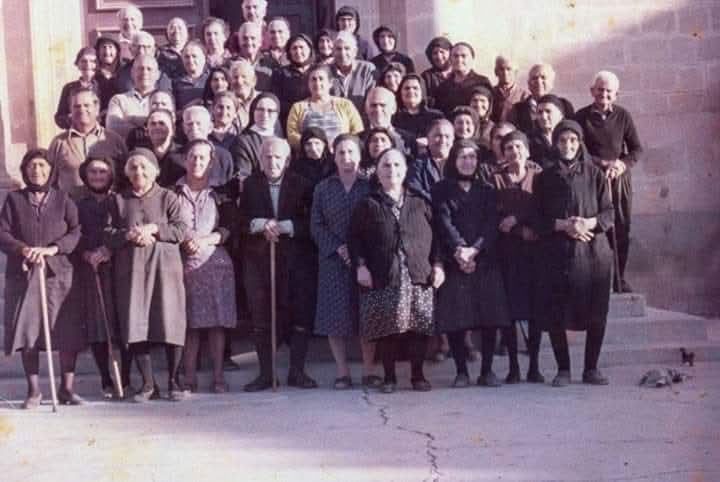 The forgotten, enclaved grandparents of Kormakitis, photographed around 1980. My great-grandfather, then 75, is pictured here.
I am the first Cypriot Maronite, to the best of my research, to attend Princeton in the history of the University and the Cypriot Maronites, and I do not take this responsibility lightly.
A great-aunt did not take it lightly either, though for entirely different reasons. At a farewell gathering, over coffee thick enough to read fortunes in upon completion, she asked me what I would tell the “Americans” I was. “Cypriot,” I said. She frowned, as if I had answered a math problem with a recipe. “Maronite,” she corrected. “First Maronite. Then Cypriot. Then, whatever else you want.” My cousin, from across the table, offered a third taxonomy entirely, and for twenty minutes my identity was passed around the room like a plate of ‘loukoumia’ (traditional Cypriot sweets), everyone taking a piece and dusting the woven tablecloth with powdered sugar. No one agreed on the flavour. Twenty minutes is a long time to hold a plate. I said nothing, which is what I do when I am boiling inside.
But I have thought about it endlessly since. My grandfather, who speaks Sanna (the endangered language spoken in Kormakitis, formally known as Cypriot Maronite Arabic) the way other people breathe, did not join the debate. He only said, in that language of fewer than a thousand speakers, that I should come back. That, at least, required no translation.
Perhaps to be an in-betweener is precisely this: to be a loanword, declined differently in every mouth, and to remain somehow whole regardless.
Trace the map of Cyprus with your finger and you will find the whole argument written in relief. In the north, Pentadactylos, where legend insists the Byzantine hero Digenis Akritas, defending the island from Saracen raiders, gripped the ridge to vault himself across the sea to Anatolia, and left the print of his five fingers in the rock. Hence, “Penta-dactylos.” The ‘five-fingered’ mountain and beautiful sentinel of my childhood. A man protecting his island, holding onto it so hard he carved his grip into it. I understand him better every day. In the south-west, Troodos rises darker and gentler, older than any of the empires that came to name it. Byzantine monasteries have been tucked into its slopes for a thousand years; the saints painted on their walls have faded to a rust-red that could be mistaken for the mountain’s own colour bleeding through the plaster. All pine resin and cool air, it is where the whole island retreats in August to remember what breathing feels like.
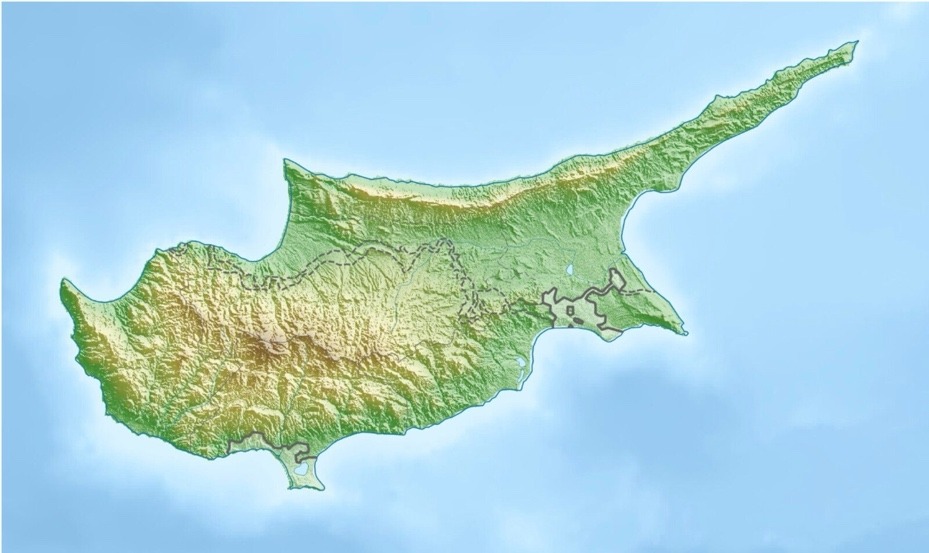 Relief map of Cyprus: Pentadactylos runs along the northern coast; Troodos rises in the south-west. Wikimedia Commons.
And in Troodos sits Platres, a village that collects writers the way other villages collect saints. On one taverna wall, a plaque commemorates George Seferis, Greek Nobel Laureate, who complained in his poem “Helen” that the nightingales of Platres would not let him sleep. Imagine that: a man honoured with the highest prize in literature, undone by birds. Cypriot nightingales, in fact. A few streets away, the old Forest Park Hotel boasts that Daphne du Maurier stayed there while writing Rebecca in 1938, that great English novel of a haunted, unreachable house. I find it deliciously improbable that Manderley was partly conjured under Cypriot pines, amidst nightingale song. Perhaps I am myself a reincarnation of that unreliable narrator, identity-in-flux, ready to embark on her journey of Bildung.
‘Last night I dreamt I went to Manderley again,’ the novel begins, and I already know the shape of my own version: ‘Last night, I dreamt I went to Kormakitis again.’ The dreamer in Rebecca can never return to her house; it has been engulfed by flames at the sleight of hand of the cunning Mrs. Danvers. I intend to have better luck.
❧
Still, leaving an integral part of your identity behind on a golden-green leaf floating like a shattered raft in the Mediterranean (that everyone, literally everyone, wants a piece of) feels like ripping out a chamber of your own heart, or tearing a corner from a golden-green leaf and letting the sea take the rest.
I think of the morning I was shadowing at a modern clinic in Nicosia and my own grandfather, walking-stick in hand, shuffled in through the sliding doors, entirely by coincidence, blinking at the fluorescence, and then at me, standing there in baby blue medical scrubs two sizes too big. He looked at me as though the future had arrived early and was wearing his granddaughter’s face. I have not forgotten that look. It is, I think, the entire job description.
Behind that look sits a much longer story. There is a joke among Cypriots that the island has never quite been ruled by us, only leased, always to larger tenants. The Assyrians and Egyptians took the deposit; the Persians, Ptolemies, Romans, Byzantines, Lusignans, Venetians and Ottomans all took their turns; the British handed back the keys in 1960 and left their red pillar-boxes standing at street corners as a parting gift. They left something more consequential, too. It is said that a British officer, in the early 1960s, drew a ceasefire line through Nicosia with a green chinagraph pencil, and the border still runs where he drew it. The Green Line. My city has been divided by a stationery choice for longer than I have been alive. And now, of my own volition, I am the one leaving; the pencil line stays where it is. I do not pretend the ironies resolve. I only carry them, along with everything else.
What I take with me is what cannot be conquered. I take a language spoken by fewer than a thousand people, a great aunt’s taxonomy of self, a grandfather’s instruction to come back. I take the “loukoumia” and the loanwords, the nightingales of Platres and the print of Digenis’ hand in the rock. I take the sunset over Pentadactylos, sore-thumb flag included, because the mountain outlasts the flag, and the leaf survives the sea.
Last night I dreamt I went to Kormakitis again. In the morning, I packed a bag.
Leave a Reply