(if God is with us, consume him)
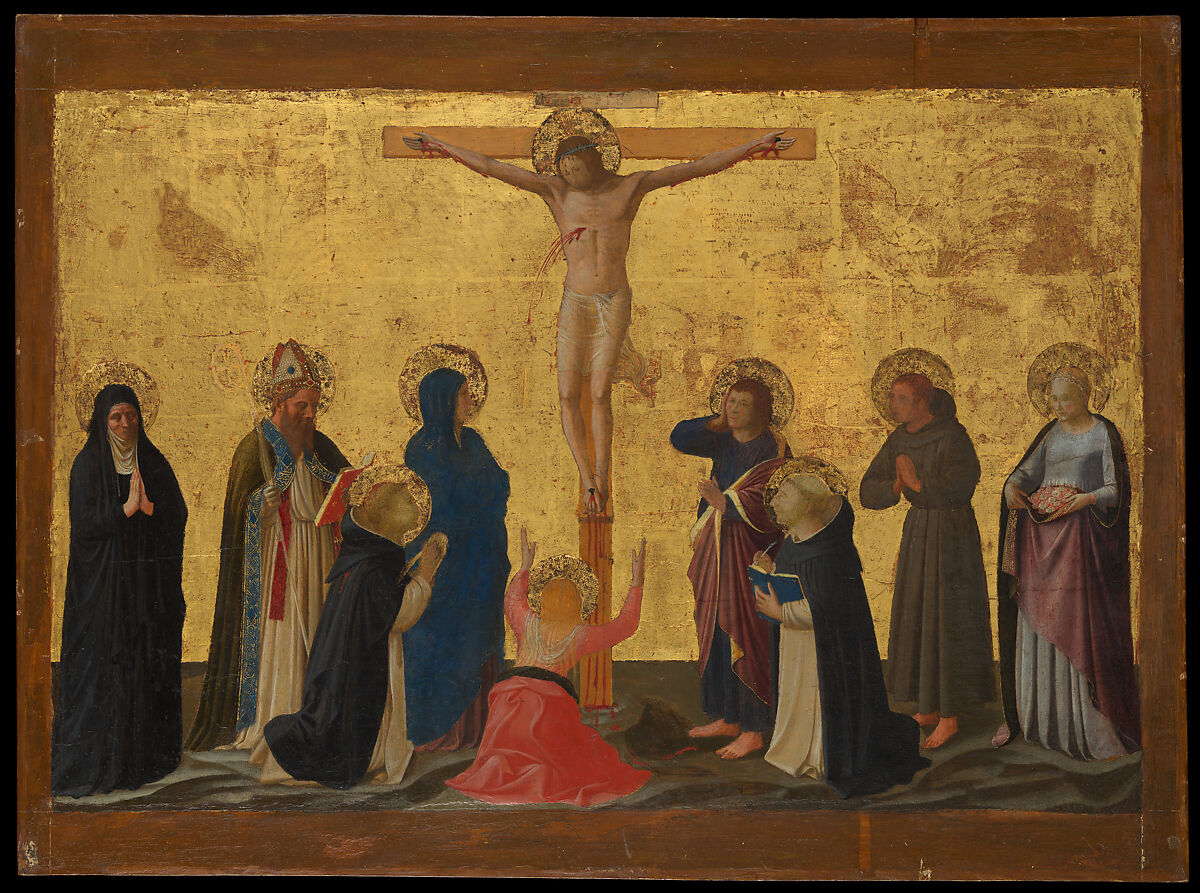
Contemplate Fra Angelico’s The Crucifixion; depicted is Jesus nailed to the cross, clothed in nothing more than a translucent sheath thinly veiling his groin, which Angelico rendered discreetly yet rather graphically. His naked torso reveals his chiseled abdomen. His blood, fresh and red, continues a feeling of youthful vibrancy, even fertility, as is fitting for a man only thirty-three years old. His skin is clear and pale, unburnt or blistered. He is more beautiful than he ought to be after spending hours nailed to the cross.
Around him, saints, demarcated by golden halos, fall to their knees, praying for their Messiah, weeping in despair. They are clothed. Covering all but their heads and hands. With knees pressed to the hard soil of the fallen earth. They are clothed. Yet, Christ is naked.
The saints were the first to fall to their knees in reverence to Christ. Like the saints, the pious of future generations would too fall to their knees—not before Christ, but rather, before his image. This painting of Christ’s body was a cult image; a vessel for prayer, an object of devotion for the faithful: it hung in the San Marco Monastery during the 15th century. The monks of San Marco, like most others, took a vow of celibacy, relinquishing human sex to pursue a closer relationship with God. In prayer, they revere his body, closing their eyes, whispering, “What has passed our lips as food, O Lord (Quod ore sumpsimus, Domine), may we possess in purity of heart, that what has been given to us in time may be our healing for eternity…May Your Body, O Lord, which I have received, and Your Blood which I have drunk, cleave to my innermost being…Amen.” In devotion, through communion, they consume him, taking his blood and body in their mouths. This routine of piety falls closer and closer to the physicality and emotions of desire present in mortal sex. They are covered in garbs of modesty; they forsake the mortal sins of sex, and in doing so open their body and soul to a new form of sexuality: that with Christ.
One might equate the substitution of sex with Christ with Jacques Derrida’s discussion of masturbation. In Of Grammatology, Derrida explains that masturbation provides a replacement for copulation with the partner (or mother)—allowing the subject to affect themselves with the “chimera” of presence. This “dangerous supplement,” as Derrida describes it, “leads desire away from the good path, makes it err far from natural ways, guides it toward its loss or fall, and therefore it is a sort of lapse or scandal (scandalon). It thus destroys Nature.” Masturbation “destroys Nature” or the full experience of sex, denying the masturbator true intimacy with another and affecting their ability to do so in the future. Such destruction is to be regarded as a “scandal”—a shameful, corrupting act.
However, it seems the act of supplanting sex is not shameful in itself. The pious, too, substitute Nature—good ol’ martial copulation—with something else. Instead of auto-eroticism, their supplement is Christ. This supplement interacts with Nature differently: In Sexuality, Marriage, and Virginity in the Early Church, scholar David G. Hunter speaks of “nature” in gender and sexuality in 5th century Christianity. “Christian writers developed new notions of human ‘nature’ that decentered binary categories such as ‘male’ and ‘female’ and relegated all sexual activity (heterosexual as well as homosexual) to an ancillary, even ‘unnatural,’ aspect of the human person.” Celibacy, then, afforded an escape from the norms of a monogamous, conservative, religious lifestyle. Amma Sara exemplifies this: in an early Christian anecdote, she transcends humanity by abstaining from sex, marriage, property, etc., thereby gaining “a level of spiritual discernment that enabled her to adopt a ‘male’ role in ancient monastic society.” Her sexlessness, paired with her renunciation of other “earthly” effects, effectively functions as genderlessness; her sexual purity afforded her avenues for power in the human world as well as the spiritual world. Hunter explains, “Female monasteries offered a viable alternative to life in a patriarchal household and new opportunities for the education of women and the exercise of female leadership.” Monasteries functioned similarly for men, offering institutional support for the celibate that individuals might normally find within a marriage, allowing the celibate to comfortably establish a close relationship with God. Rather than a rejection or degradation of the heterosexual patriarchal norms of society, celibacy garnered real-world, as well as spiritual power, through a kind of genderlessness.
While Hunter and Derrida might not mean the same thing by Nature, both use the term to define a moral, pure, human existence. Christ, as a supplement functions inside nature to ascend past its traditional conventions, rather than decay it, as masturbation might. The pious are then allowed to virtuously exit “the good path,” assuming a position outside of Nature or a religiously endowed societal order.
But what is left for the rule-abiding married couple who copulate? Even within a marriage, Christians cannot escape the filth of their conjugal duties. In the Acts of Thomas, Paul interrupts a married couple during intercourse, urging them to “‘raise spiritual children rather than worldly offspring.” Here Paul marks a distinction between “worldly offspring”—biological children—and “spiritual children”—the couple should they choose to pursue a closer relationship with God. When the bride listens to the prophet, “She… [sat] unveiled and unashamed,” implying there was shame to be had before her biblically approved intercourse: shame for devoting herself physically to the lesser creature that is man. The Bible positions sex and reproduction within a holy union as an obstacle to the faithful’s spiritual proximity to God. Paul argues this more explicitly, advising that within marriage, couples should take moments of abstinence to deepen themselves in prayer: “husband and wife should not renounce sexual intercourse except if they agree to do so for a limited time devoted to prayer.” Even while abiding by the structures of the bible, there is something “unnatural”—decrepitly “worldly”—attached to the act of sex. Those who have physical sex are pulled away from their relationship to God, almost as if a conjugal relationship is a form of adultery in relation to a primary relationship with God.
Zupančič speaks to this in What is Sex?: “Even the ‘purest’ sort of procreative sexual copulation is connected with sin. Or, as Saint Augustine has famously pointed out: Sexuality is not the original sin (the latter refers to the original pair’s disobedience when eating from the tree of knowledge). The eating of the apple was not explicitly sexual, but rather a bite from the “tree of knowledge.” The human couple may never escape the knowledge that sex is sinful. Knowledge in the structure of religion is subjective, malleable to the orienting force of desire. What we know as sexual in human relations—bodies, knees, whispers—do not, somehow, apply to the individual’s relation with Christ. Sin, then, circumscribes to a subjective definition of sexuality, one that only regards physical acts between mortals. Sin is what we know to be sex, even if other things replicate sexual desire.
This only works because knowledge and fantasy function differently. Zupančič goes on to quote Lacan in his Seminar XX: Encore, On Feminine Sexuality: The Limits of Love and Knowledge, 1972–1973. He writes, “Christ, even when resurrected from the dead, is valued for his body, and his body is the means by which communion in his presence is incorporation—oral drive—with which Christ’s wife, the Church as it is called, contents itself very well, having nothing to expect from copulation. In everything that followed from the effects of Christianity, particularly in art… everything is an exhibition of the body evoking jouissance—and you can lend credence to the testimony of someone who has just come back from an orgy of churches in Italy—but without copulation.” Instead of sex, the pious perform communion, an incorporation of the body of Christ into theirs. They substitute the action of sex with that of eating Christ’s figurative body, but the drive that pushes this movement—the desire to consume and incorporate that is present in human sex—continues to be satisfied; it does not disappear. Lacan uses communion to bridge his larger point, asserting, “If copulation isn’t present, it’s no accident.” At the core of all sexual experiences, Lacan supposes, is fantasy—sexual relationships always function past the secondary human that copulation is performed with. A partner cannot be separated from what they represent, from the lens through which their partner becomes attractive. Moreover, as sexual relationships are structured through religion—its laws—even godly sex may never be separated from the knowledge of sin. Sexual fantasy that exists with another human, then, will always include subconscious guilt. In a relationship with Christ, guilt dies, but the fundamental fabric of human sexuality—fantasy—is amplified. A fundamental aspect of faith is fantasy: believing in Christ without evidence of his existence. Take our earlier topic, communion: one must imagine they are consuming the body of Christ while eating a cracker. The foundation of faith, then, is the same as human sexual relationships. To supplement Christ with sex is not a perversion of religion but a natural extension of its foundation. Christ is the first and only constant object of fantasy; human objects are secondary.
Knowledge, then, is only of a physical body (your partner’s or your own) and cannot be applied to pure fantasy. Thus, the structure that created sin in the first place has made a caveat to ascend itself: by fully submitting to a fantasy relationship, one can remove oneself entirely from sinful aspects of sex that subjugate humans in the earthly world; the pious can assume a role that exists outside of their gendered social capacity and is still sanctioned by religious institutions that guide collective morality on the whole. But for what goal?
Christ’s body—the worship of his near nudity in cult images—evokes pleasure beyond that of simple enjoyment. Lacan uses the term jouissance to invoke an excessive, somatic pleasure that exceeds the symbolic order and yet is produced in display and contemplation rather than through the act of sex. This fantastical sexual exploration allows a full enjoyment of humans’ sexual reality, resulting in the continued obsession with Christ on the scale we see today. This is the manifestation of jouissance. But jouissance is institutional. The celibate reap the pleasure of life beyond the confines of ordinary life. In committing to God, they transcend regular human structures, feeling enjoyment from a freer, yet socially accepted, lifestyle.
Christian celibacy, then, does not repress sexuality so much as reroute it into sanctioned forms of erotic fantasy centered on Christ’s body. In refusing copulation while preserving desire, Christianity reveals what Lacan insists on all sexuality: that fantasy, not physical union, is what structures enjoyment. The sin, then, was never sex itself but the knowledge of sex. Without desire, the psychological desire will not become legible enough to threaten the sanctity of the fantasy. Perhaps heaven is not an effect of the afterlife but rather jouissance.
Livia Shneider expertly regales the Nassau Weekly with an analysis of sexuality on a detour… I do think we might have taken a wrong turn at the last intersection, look at the GPS… rerouting… rerouting…

Leave a Reply