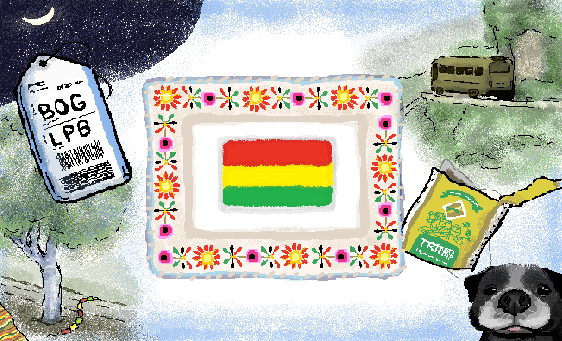
I spent nine months in Bolivia, and I don’t know how to write about it. I don’t know how to explain it, either, not to the sea of well-meaning acquaintances who ask impossible questions like, “How was it?” and not to myself.
*
[My homestay at night. Brick walls bristling with green and brown shards of broken glass to discourage intruders. Doña María’s spasmodic coughs, which entered my room through the foot-long gap between the door and its outsized wooden frame. Darkness punctuated intermittently by the yellowish light of passing cars. The cries of the neighbors’ baby when he woke up hungry, or was jolted from a nightmare.]
*
I spent nine months in Bolivia, and there I learned many things, including Spanish, how to wash clothes by hand, the utter incommunicability of everything, the situation of women’s rights in Cochabamba, and the importance of scrapbooking.
I entered Bridge Year already determined to scrapbook. Several alums of the program had advised me to do so, and beyond that I thought it would be conducive to my two main goals for the year—Self Discovery and Collecting Interesting Stories to Tell My Progeny. But once I reached Bolivia, keeping a scrapbook became a necessity. I was thrust abruptly from a life that at least loosely followed convention into one that was totally inconceivable to nearly everyone I knew. My friends and family did not share, and could not not comprehend, the most everyday parts of my life in Bolivia. As a result, each thing I did seemed very precious and very singular. I felt an extraordinary pressure to remember as much as possible. Scrapbooking became a safeguard against my terrifyingly fallible brain, an archive of otherwise forgettable moments.
*
Two months ago I returned to the United States. Already, Bridge Year feels estranged from my life: a string of static, disconnected scenes.
[Buses with cracked windows that, due to some distantly concerning mechanical issue, tilted too far to the right as they drove. Interminable night buses full of snoring passengers whose limbs spilled out into the aisle. Buses with air conditioning and Mennonites. Buses populated by an ever-rotating cast of vendors who boarded and unboarded at unmarked junctures, selling chicken with rice or the cure to colon cancer. Buses that wended along mountains; buses that squeezed between mountains; buses that sputtered over mountains. Buses surrounded, invariably, by an endless sea of mountains—awkward, hulking things, carpeted in green, and round in the strangest places. Above them: the stars, innumerable and dim.]
[That festival in Tiataco where hundreds gathered to celebrate their dead with games and dancing. Children darting over the hard earth, candied apples stickying their fists. Around them: carob trees, their thick branches curling upward like fingers, the grove like a hundred hands lifted in supplication to the flat sky.]
[The horizontal moon, suspended over the mountains like a shallow bowl from which the stars spill out across the sky.]
*
A scrapbook cannot contain everything, or even most things. To me, scrapbooking became practice at paring down the world, at choosing which bits of reality to keep and which to discard. Each kept object was memorialized, creating a collaged narrative of my life, of myself.
*
And then there are the images in negative, which I remember only as absences, things already forgotten. [Spare words in Spanish. The texture of the sidewalk outside my favorite corner store. The face of the street dog who walked me to work. The weight of cutlery.]
If we are lucky, we get to hold onto the scrapbooked details; often we keep nothing at all.
*
I spent nine months in Bolivia, and I don’t know how to write about it. I can’t help but feel that in trying to, I am documenting things already half-lost to me—and that the act of writing, like scrapbooking, only distances me further from the thing itself. I try to write, and I excise my own memories; I omit details; I smooth out a vast, complicated reality into a single narrative. Someday, I worry, these Arial-font simulacra will be more real to me than my actual memories.
I hate the idea of it, but I am unable to write about anything else; my words circle a geographical center like water circles a drain. I have unfinished business; I excavate the past unceasingly, overturning the same patch of earth in search of something still unknown to me.
That same compulsion often leads me back to my scrapbook, too. I take it out from where it’s stowed in the bottom drawer of my bedside table, and I comb through it looking for clues: there, underneath the baggage claim check (BOG to LPB, 20Aug 21:25). Between the disintegrating leaf of a carob tree and the green teabag packet (Mate-cito, Calidad Superior, Cont. Neto 1.5g, PRODUCTO BOLIVIANO). In the crinkles of the foil wrapper of the single chocolate egg I managed to find during my homestay family’s Easter egg hunt. Or among the forty-odd pages of similar things, glued or taped into the warped pages of my gray book. But it—whatever it is—eludes me. I am left only with a sense of loss, an absence I feel but cannot name.
*
My mother (herself a writer) visited me in Cochabamba at the end of May. She was enthralled by the minutiae: [convoluted bus routes, dark tangles of telephone wire, my homestay sister’s shorn head]. “Are you writing this down?” she asked me constantly. “You should write this down!”
*
I am still trying to follow her advice. But all of my jotted observations and essays and crumbling scraps of things are not enough. We approximate what we can; the rest, unpasted or unpasteable, falls noiselessly through the gaps between pages, the gaps between memories, the gaps between words.
For the Nassau Weekly, Annabel Thomas chronicles an attempt to chronicle, deftly navigating the sinkholes of memory to grasp at the few still-aboveground items that improbably remain scrapbook-able, and, thus, remembered.
Leave a Reply