Once upon a time, there was a mountain.
On the mountain, there was a temple.
In the temple, there was an old monk and a young monk.
One day, a man from the county’s people’s government climbed the mountain to inform the monks that the temple was classified as a cultural heritage. Meaning: it belonged to the people in a different way than before, one that involved a small stipend and a laminated certificate. The old monk hung the certificate on the wall, next to the persimmon tree.
Below the mountain, things were shifting again. The old field boundaries, which had dissolved into collective plots, now dissolved again into something else entirely that the old monk could not name. Roads, like capillaries, spread and stretched and reached every corner. Factories sprouted up like bamboo shoots after a spring rain. New sounds from the village: construction, engines, vendors. All that was solid had melted into air; all that was static had taken on a new shape.
The boy grew up too, fast and fierce. The old monk remembered his own childhood as having lasted an eternity, as if there had been endless time for chasing butterflies and playing with the fat orange cat. But the young man put on muscle and hair in the flash of a white horse. Yesterday his hand was a small round persimmon the old monk could wrap his hands around; today it was the boy’s hand that wrapped around the old monk’s fist.
“You little rabbit whelp, I can’t even keep you in line anymore,”said the old monk and laughed.
The young monk went below the mountain more frequently. First they were just grocery runs. Then he stayed for longer and longer, sometimes lodging at a friend‘s place or at a hotel. The old monk, having exhausted his methods of disciplining the young monk, now turned a blind eye. As the old saying goes: If the sky wants to rain and your mother wants to remarry, let it be!
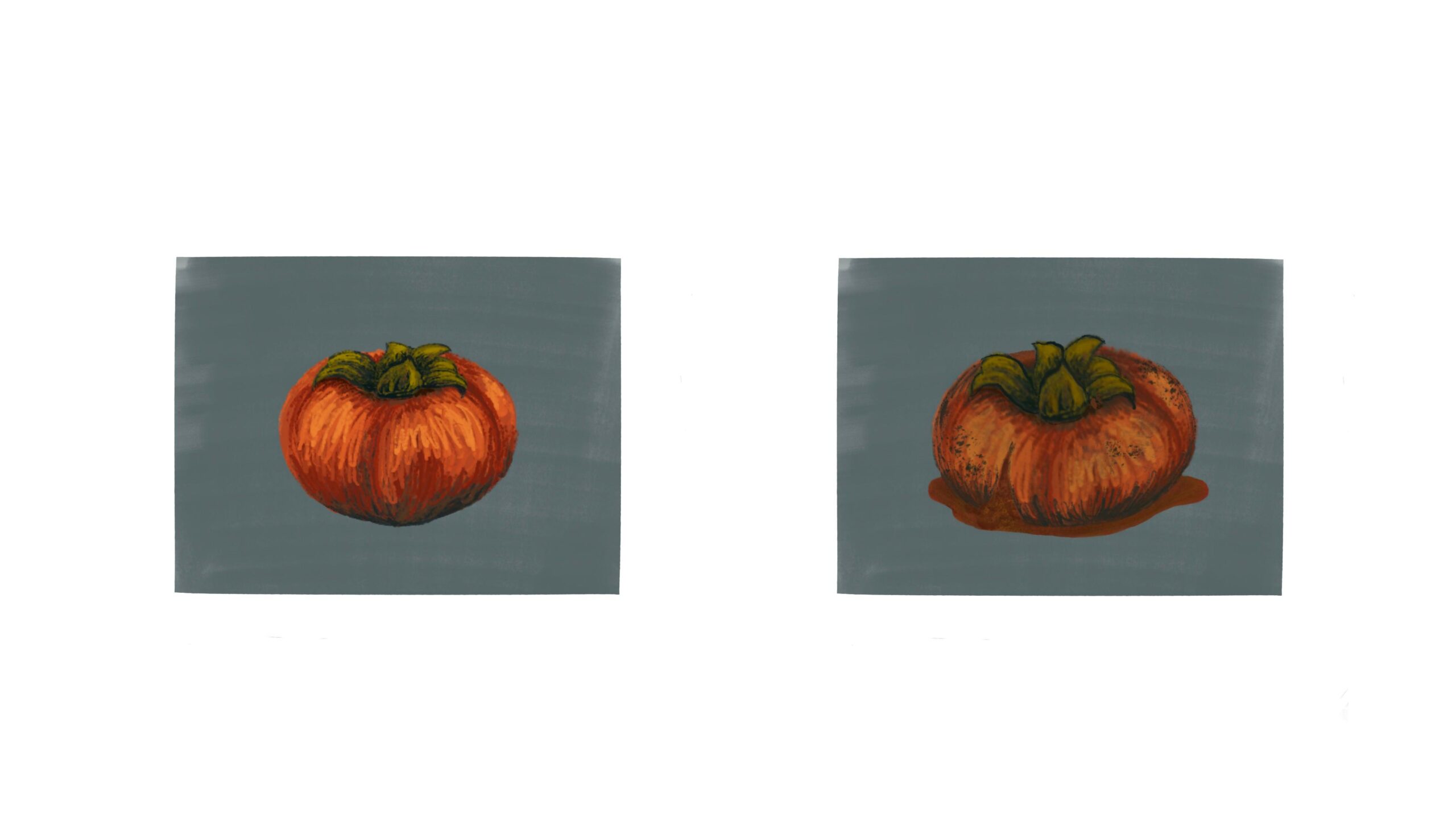
Instead he would leave a persimmon by the young monk’s bed every night, after the young monk had fallen asleep, just how the previous old monk had told him a story each night. Sometimes the persimmon was eaten; sometimes it rotted. The old monk threw away the rotten ones and set out new ones. That was the extent of his vocabulary of love.
So strange: though the old monk had lived alone before, for fifty years, he had never felt an emptiness like this. It was as if there were a hole inside him that had gone unnoticed all along, papered over, concealed, but now it had opened up, and when he looked inside, there was nothing there at all. He had been loved, he knew very well. But he felt none of this love stored inside him. Alas. He was eight and five and there could be no change anymore, not even the possibility of change.
The young monk, who’d just turned twenty-one, walked down to the village on one rainy day to buy salt. The year was 1989. The grocery store, which was located next to food stalls, had a public television, which the large crowd would gather around and watch. That day the young monk felt something was strange. Usually this place was full of bustling noise, so how had it become so quiet? As he pushed his way into the crowd, on the screen were students, statues, and tanks. Everyone watched. No one spoke.
He bought his salt and walked back up the mountain and wanted to ask the old monk some questions, like he had done many times before. He knew these questions would not yield good answers, and he knew the old monk wasn’t good at answering questions anyway.
Then, after a second thought, he chose to remain silent. Some things are better not said—this he understood.
Instead, he walked to the old monk that night and said, “Tell me a story.”
Surprised at this request, the old monk looked into him with his watery eyes. He was frail and short. It was hard to tell which trembled more, his voice or his hands.
The old monk faltered for a moment, then began:
“Once upon a time, there was a mountain.”
The young monk closed his eyes and listened, without interrupting.
It was the same story: the mountain, the temple, the two monks, the story. The young monk pictured this world in his head. Then he pictured what he had seen earlier that day—the blood, the gore, the limbs. He pictured the small world again: two monks, one mountain. Then the television scenes. He began to feel a creeping dread, the dread that the world outside was so vast while his own world was so small. He was not soothed by the old monk’s story. On the contrary, he was horrified.
The old monk passed away in the spring of 1997, the same year the British gave back Hong Kong, which was an event that meant a great deal to a billion people and nothing at all to the young monk, who was now a man of twenty-nine. He buried the old monk next to the other grave behind the temple. Two mounds of earth. He stood between them and wondered what would become of him when he became the third.
That night he sat in the hall and wrapped in his hand the persimmon that the old monk had handpicked for him the night before he passed. He understood that the old monk’s passing wasn’t forever. He would once again return to this earth and reincarnate into a boy, or a girl, or a fat orange cat. A sudden whim struck him: what if he planted a rotten persimmon and a monk grew out of it? He abruptly stood up, felt the urge to tell the old monk something. But the old monk wasn’t there anymore.
All those days, all those runs down the mountain, all that restless searching for friends, the monk had been chasing something, fleeing something. And now, turning around suddenly, he found what he had sought, standing quietly where the lights thinned to almost nothing.
So he chose to stay in the temple. Alone. The world below continued to accelerate. The factory at the river bend became two factories, then five. The village became a town. The town acquired a main street, a bank, and a school with a rubber track. The road was widened and then widened again. At night, the monk could see lights from the cliff edge, a pale orange glow as if the valley were slowly catching fire.
Yet the monk’s own life seemed to have decelerated, if not come to a halt. He went to the village less frequently, then stopped going at all. Like the old monk, he swept the courtyard, took care of the persimmon trees, and remembered in his heart the story without telling anyone because there was no one to tell it to.
A girl arrived at the temple gate in the autumn of 2008. She was nine or ten, barefoot, her feet thick with hardened skin and scaly with sores. She sat down in the courtyard and looked at the monk with the peculiar weatheredness of a child who has lived through things that did not belong to her age.
“I’m so tired.”
He let her stay. He felt prepared for this moment, indeed had rehearsed it in his mind numerous times. It was a calling. A meant-to-be.
He learned the girl’s story, piece by piece, over months. Her parents had gone to the coast to work five years ago. “Shenzhen,” she said, “or maybe Shanghai.” She could not remember which. It didn’t matter. They had never come back. They were probably dead. She had been left with a grandmother who had also died. Then with nobody at all. She had walked for a long time. She did not know how long. When she had gotten to the mountain, she said, she had just kept going up. “Because that was where Grandma would be. When I go high enough, I will be able to reach Grandma.”
At night, she could not sleep. He heard her pacing in the hall, her feet pressing the floorboards into creaks and groans.
He stood in her doorway.
“There is a story,” he said.
She looked at him.
“Once upon a time,” he said, “there was a mountain. On the mountain there was a temple. In the temple there were two monks…”
He paused here. He knew where the story would go. But the loop felt too easy, almost like a joke. He didn’t want the girl to think he was brushing her off. So he went on and said:
“In the temple there were two people who were trying very hard to be enough for each other, which is the only thing anyone in any temple on any mountain has ever tried to do. One of them was old and the other was young. The old one knew a story, just one, and it wasn’t a very good story, honestly, it was more like a question disguised as a story, or a story disguised as a question. The young one asked to hear it. Not because it was a good story. Because asking was better than silence. And the old one told it. Not because it was a good story. Because telling was better than forgetting…”
The girl’s eyes went wide, round and large as bronze bells.
The monk sensed instinctively that he had betrayed something. He felt an urge to apologize. Suddenly, he blushed.
So he said, “What… what was I saying… scratch that. You didn’t hear this story. What was I talking about? Here’s the story: Once upon a time…”
“But I like this story.”
“Huh?”
“I like this story, Shushu,” said the girl. She called the monk “Shushu,” or uncle. “I especially like the part where the two monks tried very hard to be enough for each other. It reminded me of stories my Mama used to tell me. Love is not one direction. We ought to all care for each other, no?”
The monk felt as though his brain had been struck by lightning.
He had stayed on this mountain alone for eleven years out of a sense of redemption. He had felt he owed the old monk something for his love, that remaining on the mountain would bring peace to the dead monk’s soul. Now he realized that what he had been doing was not love. It was pressure. It was obligation. It was anything but love. Love was cracking open his mouth the first time the old monk told a joke, his wide grin as sweet as a red persimmon. Love was asking the old monk question after question until the old man nearly lost his mind. Love didn’t have to be grand gestures, like leaving one persimmon a day by someone’s door. It could be, but it didn’t have to be.
Love was trying very hard to be enough for each other, knowing that we would never be, because none of us were good enough.
In that sense, he was loved. And in the same sense, he loved.
The monk threw back his head and laughed toward the sky, unable to stop himself. The little girl watched from the side, struck dumb with wonder.
Alpha Zhang is a contributing writer for the Nassau Weekly.