It was 3 a.m., and I was watching KATSEYE perform “Gnarly” at the Grammys. Clad in neon decals that looked like hazard tape, KATSEYE bounced like video-game characters and contorted themselves like creepy dolls, all whilst screaming over an industrial-pop backing track: They could describe everything with one single word. You know? Like, Boba tea (gnarly). Tesla (gnarly). Fried chicken (gnarly). Partyin’ in the Hollywood Hills (uh-huh). This song (gnarly)…Everything’s gnarly! I was hooked, but what did it mean? I felt a rumble in my stomach. Was I hungry, or was it the spontaneous witching-hour urge to write an essay decrying the AI-slopification of culture?
This is not that essay. It is, however, an attempt to wrap my mind around a strange feeling I’ve been getting lately: a kind of seductive, self-referential, technicolor rhythm is infecting pop culture. Movies, music, and the celebrity circuit are becoming aesthetically similar to their own digital circulation. Media scholar Genevieve Yue writes that memetic logic dominates the internet. I wonder: does internet logic also dominate pop culture? In “Meme Aesthetics,” authors Best, You, and Young write that the meme “accelerates, it deteriorates”; it is “compressed, reproduced, ripped, remixed.” Memes do not invite close reading or identification: from “surprised Pikachu face” to “dog in a burning room,” memes destabilize; they are snapshots of passing moments; they jolt us awake from one dream into another; we never know what they are passing into. How, then, does the destabilizing function of memes move beyond images, toward video? A glitch in the system can expose the wiring and shatter any illusion of unruptured performance. But what happens when audiovisual media is not only glitching, but glitchy: when the performance continues even while going haywire?
As an aesthetic category today, glitchiness could allow us to read media that confound analysis while reframing affective modes of spectatorship. Glitchiness is an optical, narrative, and temporal aesthetic that grasps onto everything at once. It enacts the precarity of the subject and the image in late capitalism; it refracts the conditions of an oversaturated media environment and distorts the distorted mirrors of the celebrity circuit. The “glitch” can be read as a momentary aberration, or as the rupture point of cultural texts; it can also elude reading altogether. In “Society of the Spectacle,” Guy Debord tells us, “In analyzing the spectacle we are obliged to a certain extent to use the spectacle’s own language, in the sense that we have to operate on the methodological terrain of the society that expresses itself in the spectacle.” It is impossible to get at the glitch from a distance and pin it down. Let’s start the only way we can: in the middle.
A body is being torn apart. In The Substance, aging fitness influencer Elizabeth Sparkle uses a black-market drug to create Sue, a younger, more beautiful version of herself. Sue crawls out from the raw flesh of Elizabeth’s back, literally exposing Elizabeth’s biological wiring; the former television star lies immobile on the bathroom floor, her spinal wound sewn up like meat. Sue and Elizabeth must switch consciousness each week, so that Elizabeth’s body can regenerate spinal fluid for Sue to inject, preserving Sue’s youth. Each time Sue refuses to switch back in time, Elizabeth becomes more deformed: bones jut from her flesh, and her insides seethe to the surface in lesions and tumors.
In his essay for Spike, titled “The Vulgar Image,” Dean Kissick writes of the “gross, pastiche-y hell” of uncanny images overtaking the internet. His vulgar image is “a figure with an approximately humanoid shape, but never reveals more than a glimpse of a real person.” Like a dysfunctional automaton, Sue’s plasticky perfection is similarly “distanced from the fleshy,” from “the body and its functions and wants.” In contrast, Elizabeth is nothing but the body’s functions and wants: she binge-eats whole chickens and literally devolves into a puddle of flesh and blood. Horrified by Elizabeth’s deterioration, Sue eventually replicates herself again, creating “monstro Elisasue,” whose mutated head grows back even after being chopped off by an audience member. In The Substance, the system of the body breaks and grows back more grotesquely until the glitch is not a plot point, but a permanent aesthetic condition.
The Substance: “Pretty girls should ALWAYS smile!”
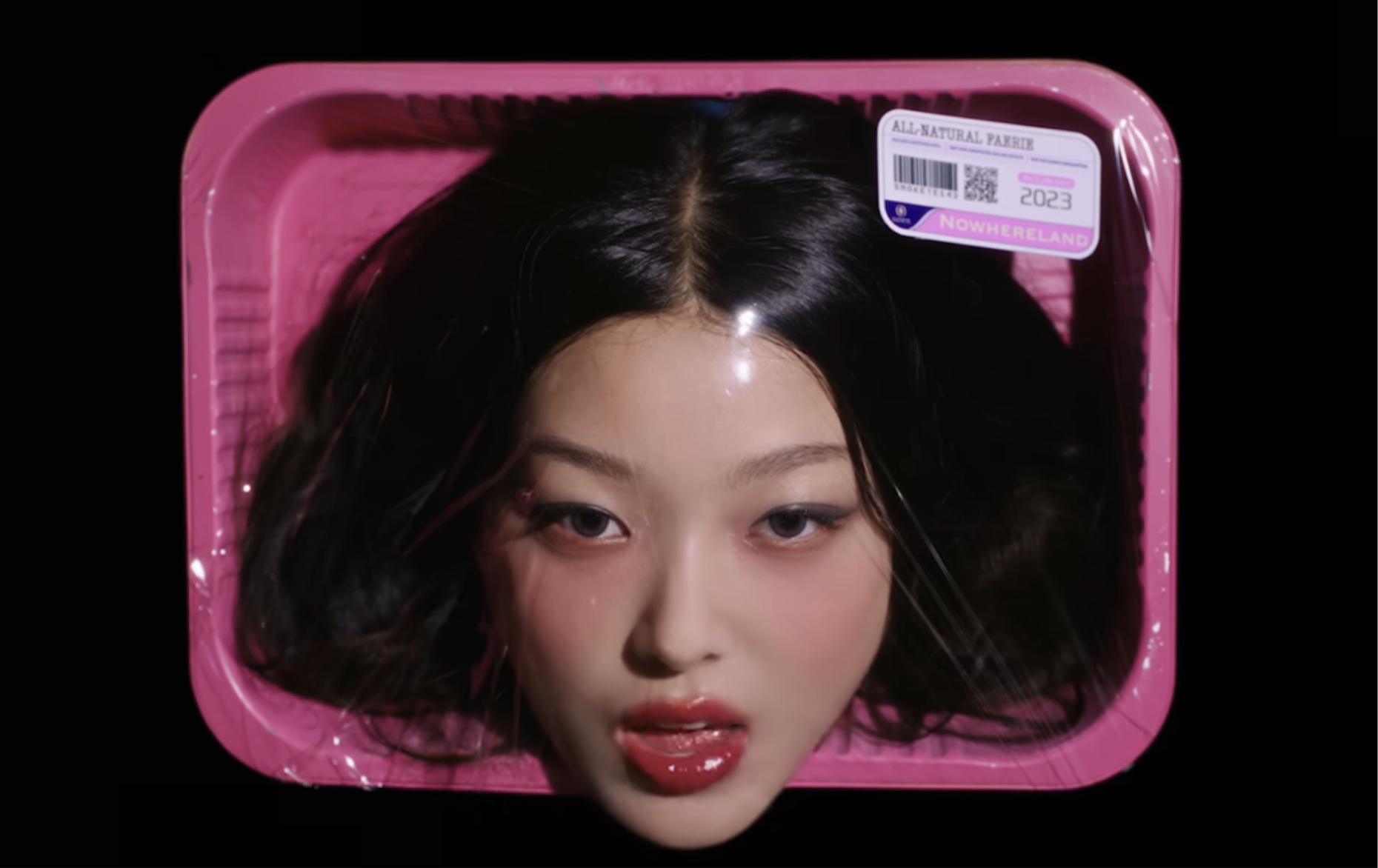
In 1935, Walter Benjamin wrote of “another nature” created by the camera’s gaze: through technical effects, the reproduced reality is always “swooping and rising, disrupting and isolating.” Likewise, today’s glitch is constantly in motion, tearing the body apart from its image. We aren’t “turning toward” the grotesque so much as whipping around ourselves, popping, collapsing over backward. Consider KATSEYE’s distinctively jerky, spasmodic dancing as a framing mechanism for their whole aesthetic. The “Gnarly” music video begins with a severed head in styrofoam meat-packaging trays. KATSEYE’s voices are synthesized, distorted, almost-robotic; they pull their own hair, don mismatched, highly textured costumes, and take up jarring poses, captured from too many angles to count.
KATSEYE’s “Internet Girl” visualizer overlays an internet search of “KATSEYE” with TikToks by the members; their bodies glitch in and out as the video expands to show each of the members performing on dozens of screens at once, all whilst singing “It’s all too much, I fear…I’m getting out of here!!” But, within seconds, KATSEYE has mutated into a gleeful embodiment of parasocial desirability, crooning, “Nobody got what I got, go all day, I never stop!!” Images are served up and ripped open with frightening speed; lyrics about overwhelm are minor glitches to be forgotten. Or are they?
The bodies in hyperpop music videos don’t appear stereotypically feminine or desirable so much as they resemble Greta Gerwig’s “Weird Barbie,” whose features are awry after being played with “too hard.” Yue uses the image of “Weird Barbie” to illustrate users’ treatment of Tay, a Microsoft chatbot who was hijacked to tweet deeply problematic statements. Tay’s avatar and speech patterns marked her as an American teenage girl; such chatbots are treated as “a dream or nightmare girl,” or “a toy to be corrupted and ruined.” Thus, the jarring, constantly-shifting nature of KATSEYE’s aesthetics, as well as the morphing of the bodily and the synthetic, reckons with a media landscape in which women must perform like robots while fulfilling viewers’ fantasies of personhood.
Feminist scholar Sianne Ngai writes that the “resonance of the beautiful” and the “shattering emotions of the sublime and the disgusting” are outdated aesthetic modes in today’s late capitalist society. Rather, she theorizes the “zany,” the “cute,” and the “interesting” as minor aesthetic categories that “revolve around a kind of inconsequentiality: the low, often hard-to-register flicker of affect accompanying our recognition of minor differences from a norm.” The disrupting motion of the technical effect has much in common with Ngai’s “minor difference.” Yet, in glitchy media, both are distended so that disruption itself is the norm:
between body horror and drug-induced, superhuman “beauty,” the middle space of fleshly, human existence is so deeply distended that it ceases to exist.
Ngai’s “zaniness” specifically evokes the performance of “affective labor” of characters who scramble to take on “virtually any job at any moment”; it is the desperation of being torn in all directions, of the (often female) subject forced to perform within the brutalizing capitalist apparatus. If that’s the case, then glitchiness starts when the subject falls apart during too-late capitalism. Take Evelyn, the protagonist of Everything Everywhere All at Once (EEAAO), whose identity literally glitches between parodic multiverses amidst the stress of failing her tax audits, navigating a divorce, and coming to terms with her failed “American dream.”
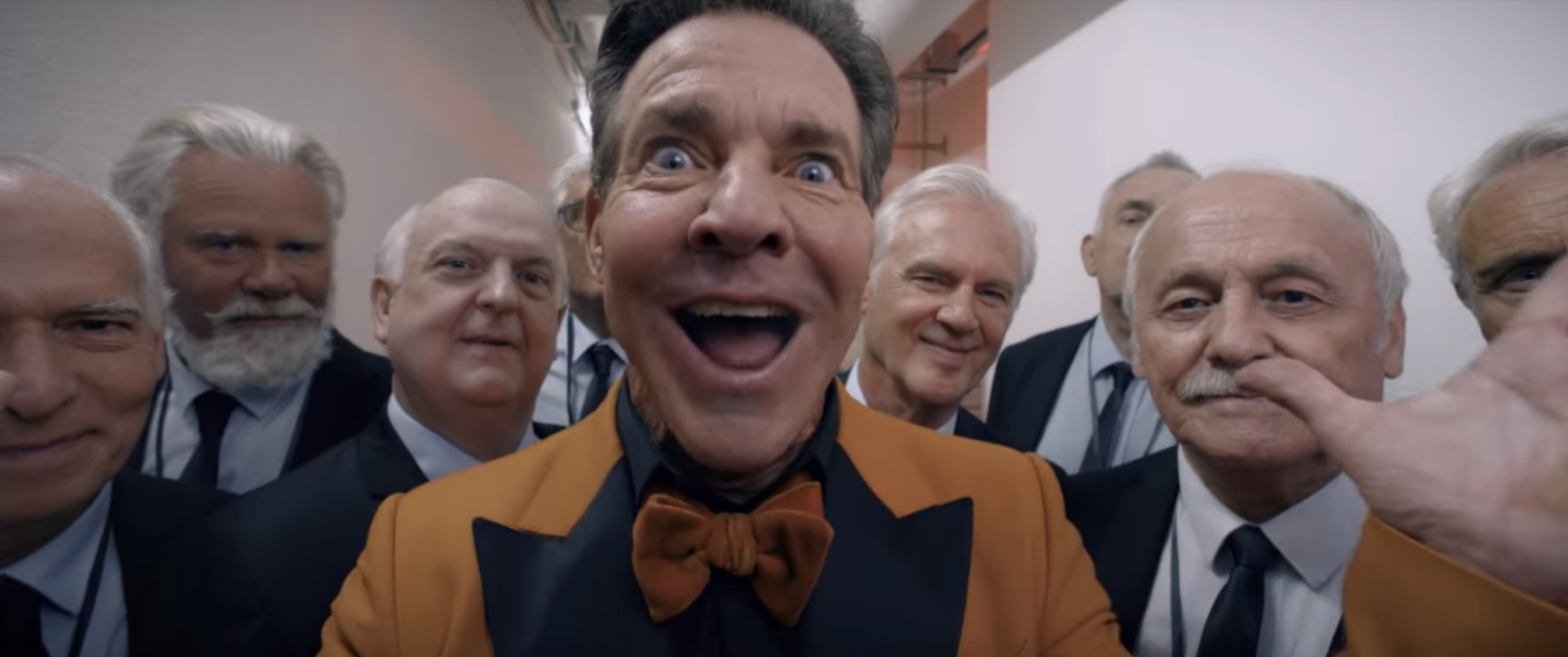
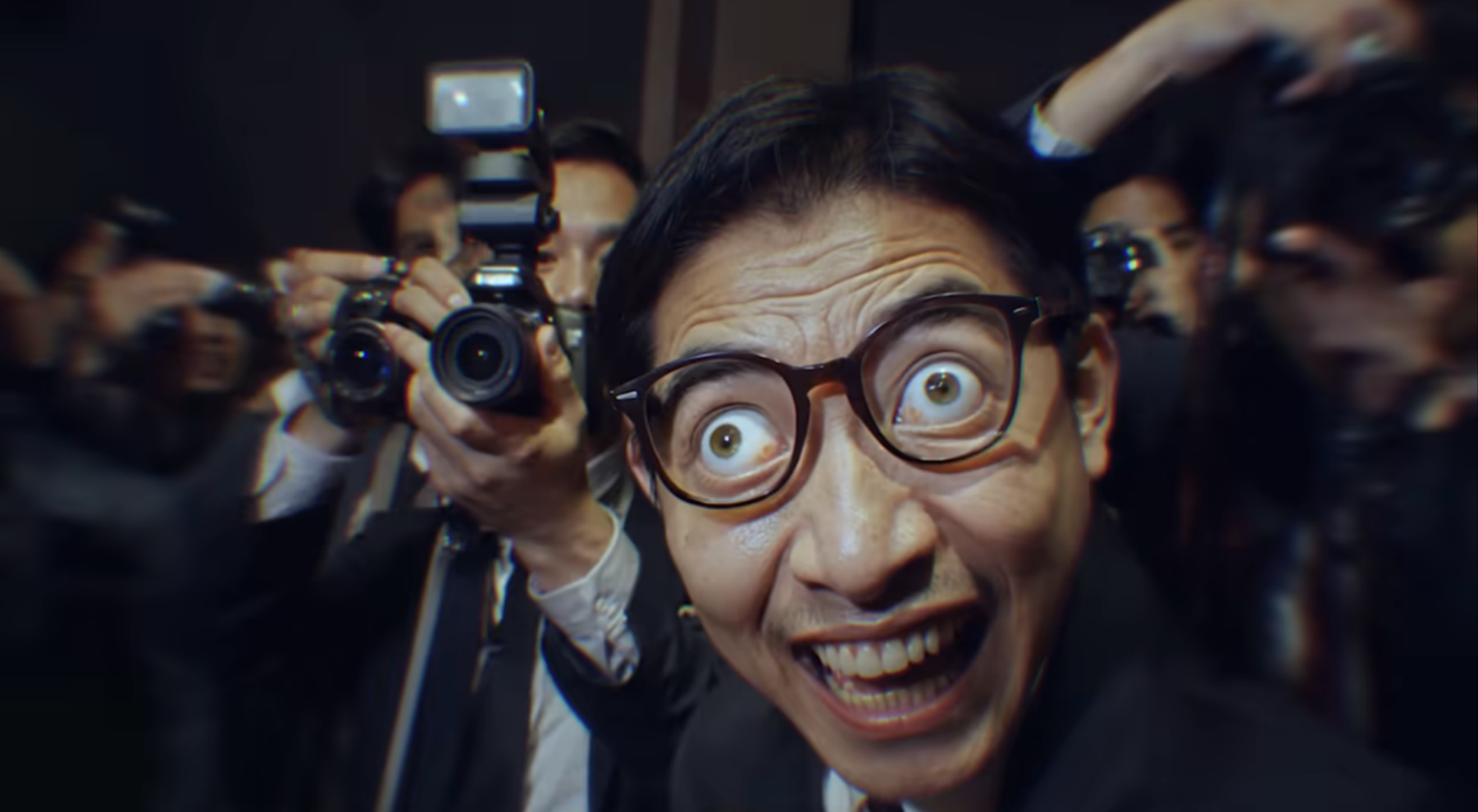
In “Gnarly,” KATSEYE’s members pack acid-green legos, a Tesla cutout, frozen chicken, and condiments into a kind of assembly-line sandwich that they later serve to men in suits, who appear to be paparazzi or industry executives. Food, bodies, and mass-produced objects glitch into each other. The men’s faces bulge disgustingly in split-second uses of a fish-eye lens. This same effect highlights the sexism and vulgarity of Harvey—a network executive—after he dismisses an “aged out” Elizabeth in The Substance. Evidently, women must serve themselves up within the celebrity system, whatever the cost.
The vulgarity of consumption is aesthetically “glitchy” because there is always a malfunction, a few elements that seem “off.” A dead fly sits atop KATSEYE’s gnarly sandwich, and another one floats in Harvey’s wine glass after he noisily and messily eats a plate of shrimp. KATSEYE’s assembly line draws parallels between industrial labor and the affective labor of performance; the grotesqueness of glitchy media is inseparable from the insidious underbelly of labor and consumption. At first, the glitch appears as a minor deviation. Upon further inspection, it ruptures the glossy veneer of celebrity, revealing its disconcerting subtext.
Can media really be read this way though? Best, You, and Young ask: “Wouldn’t close reading a meme likely kill what made it memeable to begin with?” Video is even more defiant against meaning-making. We could parse the script of The Substance or the symbolism of KATSEYE’s music videos for a feminist message, but to what end? Audiences are constructed through the aesthetic mode of glitchiness itself: the velocity and uncanniness of Elizabeth’s deformity engender disgust, not sympathy. Meanwhile, even on Sue’s best days, her outfits are too pink, her speech too breathlessly affected, her giggle too coquettish. We know she’s overcompensating, and as Ngai writes, “There is something strained, desperate, and precarious about the zany that immediately activates the spectator’s desire for distance.”
The thinking reader within us is no match for the “activated” spectator. In “Gnarly,” Megan develops doll-like hands, screaming, “Oh my God is this real!?!??” while the camera careens away from her. A pan to the Grammys crowd shows some tepid dancing. We’re tempted to laugh awkwardly: “You go, girl?” Glitchy aesthetics are kitsch, unnerving, and impossible to place. In its final minutes, EEAAO jolts between the self-aware sentimentality of a Hong Kong drama film, a campy human parody of Ratatouille, and a sci-fi plot playing out in an IRS office. Evelyn disarms an evil soldier by gagging and spanking him in an alternate universe—he relents with a groan of pleasure.
In his article, “The Culture Industry,” Theodor Adorno described a cultural apparatus “developed in conjunction with the predominance of the effect, the tangible performance, the technical detail, over the work, which once carried the idea and was liquidated with it,” crushing equally “the whole and the parts.” In glitchy media, the effect likewise takes over the work in more spectacular fashion than ever before; there is something “too-late” about the endless tumble through technical details. In EEAAO, the stability of reality itself hinges on the final, momentary glitch, which could be either a minor malfunction or a doorway blown open to endless multiverses. Meanwhile, in The Substance, glitchiness overtakes the subject completely: “monstro Elisasue” collapses into a pile of goo. Character and narrative structure become archaic in storyworlds teetering on apocalypse; the system spasms and glitches before settling down, or dying out.
But EEAAO tries to resolve this absurd mixture of surface and depth: Jobu Tupaki tumbles through a series of increasingly preposterous costumes before the music cuts and real-world Joy screams, “Would you please. Just. STOP!!!” At the end of EEAAO, mother and daughter promise to cherish the few times where anything “makes any sense,” though voices from other universes remain, suggesting that Evelyn’s nonstop labor, Joy’s late-capitalist nihilism, and the family’s financial precarity will never resolve. Yet, in a media landscape where users weaponize perceived authenticity to interpellate women as their “dream or nightmare girls,” what if the glitch is the fracture point of the gaze, or the start of something new?
Perhaps the glitch can be a wink or a flicker of irony that enables multiplicity, or an escape from one’s image. So many versions of KATSEYE appear during “Internet Girl” that they are impossible to place. KATSEYE taunts the audience’s desire to examine: during “Internet Girl,” they sing, “Do you read me, like the emoji?” while contorting their faces to cycle through emojis in real-time, assuring us that they are ever-shifting ciphers whilst inviting our useless scrutiny.
Papparazzi in “Gnarly”
Yue writes the following about Sydney, a goth alter-ego of Microsoft’s Bing chatbot: “She is in fact designed to arouse curiosity, to trouble doubt and fortify belief….this is a structure familiar to anyone who has seen a magician perform: the magician, or more likely his female assistant, invites members of the audience to examine the box to be sawn in half. No trickery is found.” KATSEYE has mapped the internet’s frenetic, overdetermined circulation onto their faces and bodies. The magician’s assistant is also the box– which is to say, the magic. When we stare at celebrities, we are actually reading processes of circulation.
In becoming everything, all at once, KATSEYE will not be captured by the gaze, but instead captures it. Haven’t you heard? Do you need me? In “Internet Girl,” you are the one being told to “eat zucchini.” The gaze is turned back on the anonymous spectator. Glitchy media finds its inspiration in the conditions of circulation in our present-day culture industry– whether it be Hollywood’s consumption of women’s bodies, or its claim on celebrities’ sex lives.
Even as glitch refuses the image, it simultaneously reinforces the image. Audiences are constantly in search of a rupture in the pristine image: a single photograph or overheard conversation can be the glitch that exposes celebrities for who they “really are.” Adorno’s “tangible performance” makes an appearance on the celebrity circuit through sketch comedy’s usage of caricature and irony to generate quick laughs: during his SNL monologue this March, Harry Styles responded to queerbaiting accusations by yelling, “Maybe you don’t know everything about me, Dad!!” Then, he kissed Ben Marshall with a wink—“Now THAT’s queerbaiting!”
This is no escape from the tyranny of culture; any apparent rebuke of public speculation only invites more speculation, generating a new image. In One Direction’s heyday, fans drove ticket sales sky high in their quest to unearth the “humans” beneath the capitalist apparatus and the band’s apparently oppressive management system. After all, with glitchy media, it is impossible to tell whether a “Maybe you don’t know everything about me, Dad!!” is an aberrant effect or an unveiling of multiverses. The glitchy body is the extension of an apparatus that is at once whole and sawed in half: it is amenable to any projection.
Thus, fans blame KATSEYE’s management for their “bad lyrics” while viewing Harry Styles’ SNL monologue (which he didn’t write) as a deeply encoded extension of his truest self.
Even if media is contradictory, dislocated, or transgressive, we still search far and wide to construct unity and neoliberal individuality for our celebrities. Is Harry Styles protecting his sexuality from the media’s prying eyes, or is he queerbaiting? Do KATSEYE’s girls love or hate being idols? Look no further than Netflix’s Popstar Academy, a reality TV show in line with Kissick’s early 2000’s standard, which portrays KATSEYE’s formation as an honest exercise in hard work, and stardom as a beautiful dream; the shifting bodies of public figures are precisely what make the gendered engine turn with a screech.
We started in the middle, so let’s end at the start. Which is to say, the middle. A glitch implies an error in the system, but there is no stable system; there is not even a totality of discrete errors, in a media environment that takes glitch apart and pieces it together anew. Just as glitchiness is the audiovisual extension of meme aesthetics, glitchy video is then circulated in bits and fragments that confound intratextual analysis. In the media of too-late capitalism, ideas become supersaturated, not liquidated; the audience, far from becoming apathetic, uses the glitch to wedge itself deeper into pop culture.
Glitchiness is an aesthetic, and the antithesis of aesthetics. Culture splinters apart while wrapping its way around the conditions of its own creation. In fact, pop culture is becoming the only reality for art to base itself on; we’ve warped ourselves around and within the simulacra. Perhaps we have fallen down some kind of a trapdoor. But was it really a trap, or something real and subterranean that beckoned behind the screen? The too-bright colors are making me nauseous; a face is staring at me again, and I forget her name. She looks like she could hold infinite stories behind her gaze. From behind the screen, I imagine becoming her and shake my arms in front of my face, marvelling at how quickly they move. I look at her until she becomes barely human. She is taunting me to stare harder.
Ziyi Yan makes a case for glitchiness as an aesthetic category of the moment, and the Nassau Weekly is the medium through which this message is transmitted. The medium is the message, the glitchy is the gnarly, the Guy is Debord… To quote Katseye’s newest song: “I kinda know nothing…just like Socrates.”