When I was 17, I would ride my bike to the edge of the neighborhood at dusk. It was usually foggy, and droplets of water would hit my calves and spring up from the pavement. The slick road under my tires made a sound somewhere between the dry peeling of painter’s tape and the scrape of a cat’s tongue when it mistakes a human hand for fur.
Most times there was a gloomy gray hue in the sky, and I would see the last of it go down over the mountain ridge right when I’d reach the train tracks. The street came over a hill, where the last of the houses trailed off, then terminated at a dead end, the kind with a little circular nub of a road that is overgrown at the edges, dry in the summertime and muddy when it rains. Around that nub was a dense and shadowed forest, and parallel to the dead end were the train tracks. Further down, a rusty chain-link fence emerged in a confident line from the trees, dividing the dead end from a hollowed sewage pit beyond. It was a pit like the inside of a rectangular take-out container, a geometric indentation in the earth, carpeted in wild grasses and the last three feet filled with sludge. A few tires, cans, and one old car, rusting and half submerged in wastewater.
I’d been biking at dusk like this for a few weeks when I first saw the bird. Coasting down the street, growing somewhat bored with the dead end, I saw something slender and stick-like standing on the tracks. It did not move as I approached, and instead of using my brakes, I dropped my feet rhythmically to the street and slowed gently. I could see its lonely gray body clearly now; it was a heron. We stared at one another for a long time. In the gloomy light, I felt too reverent to disrupt his dusk with words. There would have been something condescending in speaking to it like one might to any other animal. After a few minutes, it gave me a look and disinterestedly pumped its broad wings in the air. I biked home.
I did not see the heron for another week. The second time, I came over the hill, the houses breaking off at my sides and turning into chain-link fences and dry shrubs, and coasted to the tracks. I was sitting between the curb and grass, picking at gravel, when it stepped from the woods. Unbirdlike, it walked to the tracks like a nimble acrobat. It ducked its head and rustled its feathers, preening, making me remember it was an animal, then it settled into its imposing stance and dignified stare. I looked down at
the orange rubber bracelet around my wrist. It was from summer camp, last year. At the town lake there was a swimming section, marked by a rope line of buoys and accompanied by a rectangle of imported sand. I was a lifeguard that summer but felt like a phony in the chair because my certification was nearly expired. I didn’t really want to earn it back, though, it would just be another week-long course of learning how to heimlich a baby or zap a person back to life with electricity, and I’d never needed to use those skills anyway. Sometimes I would sit, watching a kid play in the sand. The kid would dig too deep and get to real dirt, churning up mud. I’d look up over the horizon line, and see the twin spires of the asylum. It was very small in the distance. When it was foggy, it was obscured. My dad worked there, as a teen. He said it wasn’t actually that bad.
It was a few weeks later that the bird started bringing me things. There was no other way to explain it. One night, in that gray dim dusk, the only bright thing was an iridescent flower, placed on the ground before the tracks. The bird stood a few steps back, surrendering ownership. I dutifully took the flower and thanked the bird. There was an alien texture to the petals, like they were made of interwoven, leafy flesh, purple and bright aquamarine, pink and glowing yellow. The flowers trembled in my hands and I couldn’t tell if it was because I was shaking, or if they had some life of their own, pulsing within their petals. I imagined that the bird could see the flower’s reflection in my eyes.
The bird brought me many flowers. There was something attractive and appetizing about them. I thought of lotus eaters, but didn’t get up the nerve to actually eat a flower myself. I tasted one, with my tongue on a petal once, and its chilly, velvet flatness startled me. I never tried it again. The bird grew comfortable. It would stay close to me, and I would see the same interwoven iridescence in its feathers, too. In its pupils, I saw my own reflection, gray and dull.
Long ago, they shut the asylum down. Sometime after my dad stopped working there, the place was abandoned, its inhabitants moved, locked up and forgotten. The two gray spires like great tree trunks rose into the sky with no branches, dark against the horizon. They hid behind the fog, and I preferred not to look at them when they were visible.
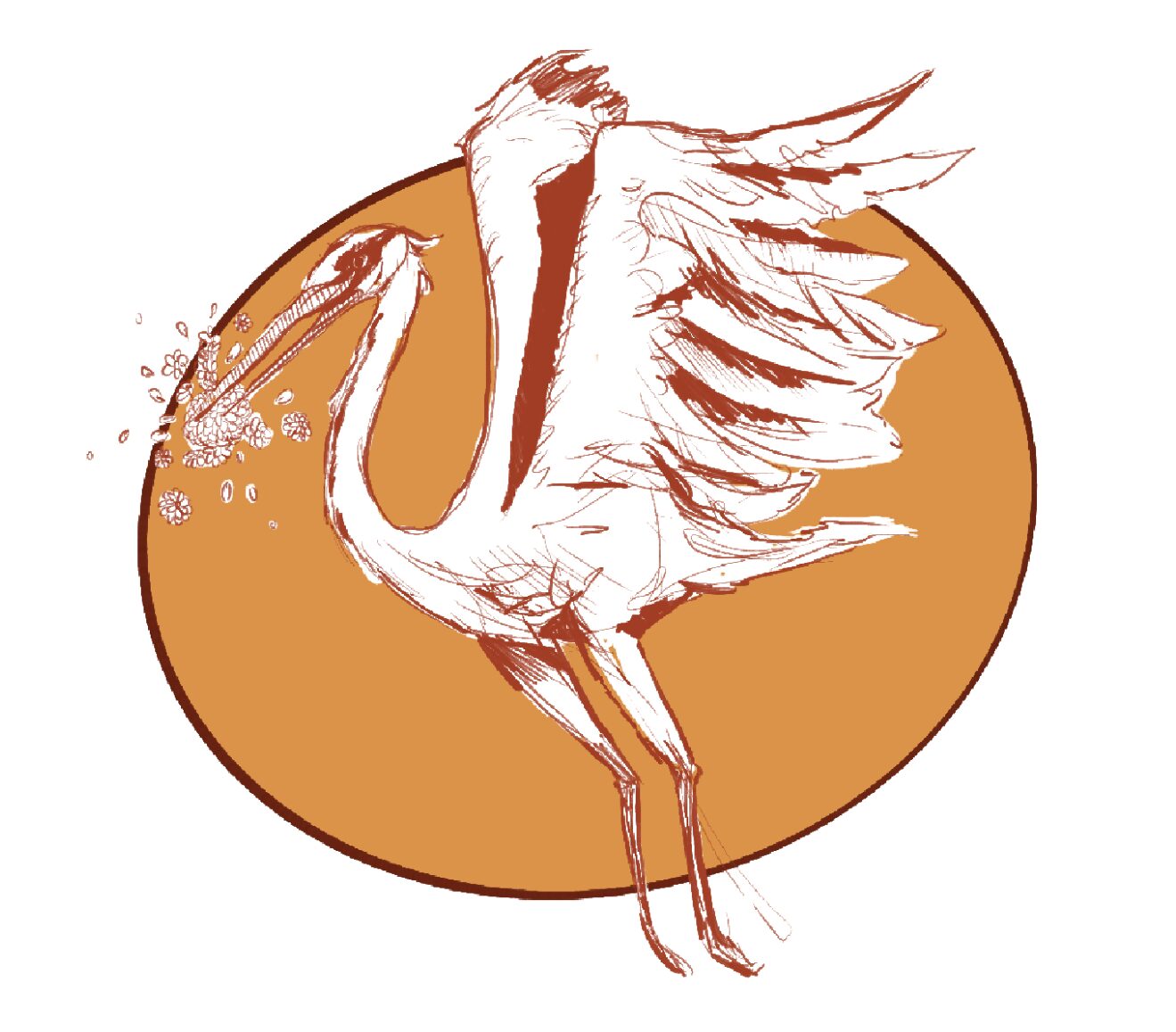
The bird began to prepare for something. It ruffled its feathers and preened more frequently, stood taller and brought me more flowers. Different kinds: like marigolds, with rows of spiraling, tight petals. Glowing roses, daisies, and lupines. Instead of being the natural marigold and daisy color, they were all blue, aquamarine, glowing from sinuous veins inside the petals, brilliant under velvet leafy skin. The lupines were my favorite, they formed columns of luminous purple and teal, grapelike buds nestled against one another, spirally decreasing in size. The bird urged me to eat them. It dropped them from its beak into my lap, then, when I didn’t eat, snatched them up one by one, and tossed them into the air, catching and dramatically swallowing them, implicating me to follow suit. I did not. The bird never made a sound, but it would paw the ground with one leathery foot, duck its head and cock it to the side, staring with one brilliant eye. I blinked like a human. It would fly, frustrated, and leave me with its glowing tokens. I did not take these flowers home; I dropped the petals one by one into the wind behind me, and by the next day they would be gone, but they always left a spot of radiance in the street, a residual glow in the shape of the petals, pummeled and pressed into the pavement. Soon, the whole street was covered in the paste. It glittered, but only at dusk, and I glided nightly on the glowing trail.
I arrived one night and the bird was on its side, with bugs swarming its legs. It had a faint smell to it, like something old and stale. I sat by its side on the edge of the curb and picked at the gravel in the crease between road and concrete, checking the bird for movement intermittently. Its feathers did not glitter as much as usual, and as the night wore on, the gloom of the world at dusk time seemed to overtake the bird. It had brought flowers, and they lay on the ground around us and glowed, but dyingly. I looked at the bird and hated it, for a second, for appearing and giving me useless, permanent flowers. I wished I could enjoy my dusktime rides again. I felt bad. I offered a flower to the bird, and it peered from the corner of one wild eye, but in trying to jerk itself up, sapped itself of energy and lay still. It did not move.
The bird closed its eyes, and for the first time I touched one of its feathers. It shifted aside and revealed individual iridescent fibers beneath like downy feathers, only each was a different color and magnetic, metallic. It was like a bird made of glittering metal; he was a mechanical creature, but more natural than myself. I saw my pale white arms before me as I made contact with his feathers, and pulled back, repulsed at my greyness. The bird was still breathing but shakily, and I could not sleep. I stared at the sky until it turned white and divided into blinding fractals within my eyes, and somewhere in the morning hours, I fell asleep.
The bird was gone when I woke up. I found one feather wedged under a piece of gravel the next morning, but it didn’t look like the glittering metal that had shone brightly the night before. The day that followed was tentative. I decided not to bike that night, I did not want to know if the bird would return. Instead, I walked to the lake and sat in the lifeguard chair, high up on the peeling white-painted wood. It began to rain, the ripples on the lake widened. I knew the sand below me was not turning to mud, but as it dampened, it grew dark and muddled and it looked as though the beach had become a patch of ugly sand and puddles. The sky cleared, the rain caught the fog and forced it down to the ground. The mountains in the distance grew darker as their trees caught rain and dampened, and I looked out and up, toward the sky and the horizon and the mountain’s ridge.
Far away, the twin spires of the asylum were glowing. Slowly, a cloud of iridescence spread over the sky, floated and expanded overhead and coated the heavens from every corner. I saw the glitter land on the world around and coat everything in a layer of my bird’s flower petals. I saw the petals land on my own gray skin and melt into it, then I rotated my arm and watched the line of shimmer shift along it with the failing light. I knew the flowers would all be dissolved by the morning, only ever visible again in the blue light of dusk, and only I would know to look for them on everything. I did not miss the great big iridescent bird, I saw him spread his wings over the world and scrape through the gloom with long legs dragging heavy across the sky, raining lavender and gold and shifting metallic light over all of it.
Ellen Kramer is a staff fiction writer for the Nassau Weekly.