I. DKTIGER61
On the morning of August 29, 2018, David Kahn ‘94—who lives minutes away from Princeton University, his alma mater—learned, to his horror, that he owed $29,742 to the payment platform Square.
Kahn, who did not have a Square account, stared in disbelief at the letter he had just opened. It was a mistake; it had to be. When Kahn called Square to flag the transaction, he learned that it was authorized by an email address he did not recognize: dktiger61@gmail.com. Immediately, something clicked.
“Son of a bitch,” Kahn remembered thinking, “I bet it’s Ford.” That is, Ford Graham, Kahn’s neighbor, fellow Princeton alum, and former business partner. Kahn had heard rumours that Graham conned multiple people in town, but he hadn’t fully believed it. Now, Kahn thought, it made sense: only Ford Graham, who proudly bleeds orange and black, would steal money using the alias “dktiger.”
Eventually, Kahn would learn that Graham’s web of deceit spun even wider.
Since graduating Princeton in 1986, Ford Graham has repeatedly been sued over allegations that he failed to deliver promised payments—and, more recently, Graham was sentenced in Federal District Court for orchestrating three criminal schemes between 2012 and 2018, when he resided in the Princeton area: a Ponzi-like investment scheme, in which he siphoned at least $2.6 million from unsuspecting investors; a payment processing scheme, in which he transacted with stolen credit cards using false credentials, including Kahn’s; and a business email compromise scam, in which he attempted to defraud investors of close to $6 million dollars, according to numerous court records and interviews with over a dozen of his former classmates and acquaintances.
Graham was charged with 29 counts of fraud in a 2024 federal indictment. His charges were ultimately reduced: in August 2025, he pled guilty to 14 counts of wire fraud, one count of conspiracy to commit wire fraud, and one count of securities fraud; his counts of aggravated identity theft and money laundering were dismissed. In total, he was held responsible for stealing around $2.5 million from investors.
On May 13, 2026, nearly eight years after Kahn opened the Square letter—and nearly twelve years after two other victims began their legal battles—Graham was sentenced by Judge Robert Kirsch to 33 months in prison in Federal District Court in Trenton, New Jersey.
Ford Graham declined comment for this article.
II. A PREPPY PRINCETONIAN
Ford F. Graham arrived at Princeton in the fall of 1981 from Covington, Louisiana, with a southern drawl, a trove of cable-knit sweaters, and a family reputation to uphold. Graham’s father, John J. Graham ‘61, had been a member of the Cannon Club and a class delegate; he later made a fortune in the oil industry.
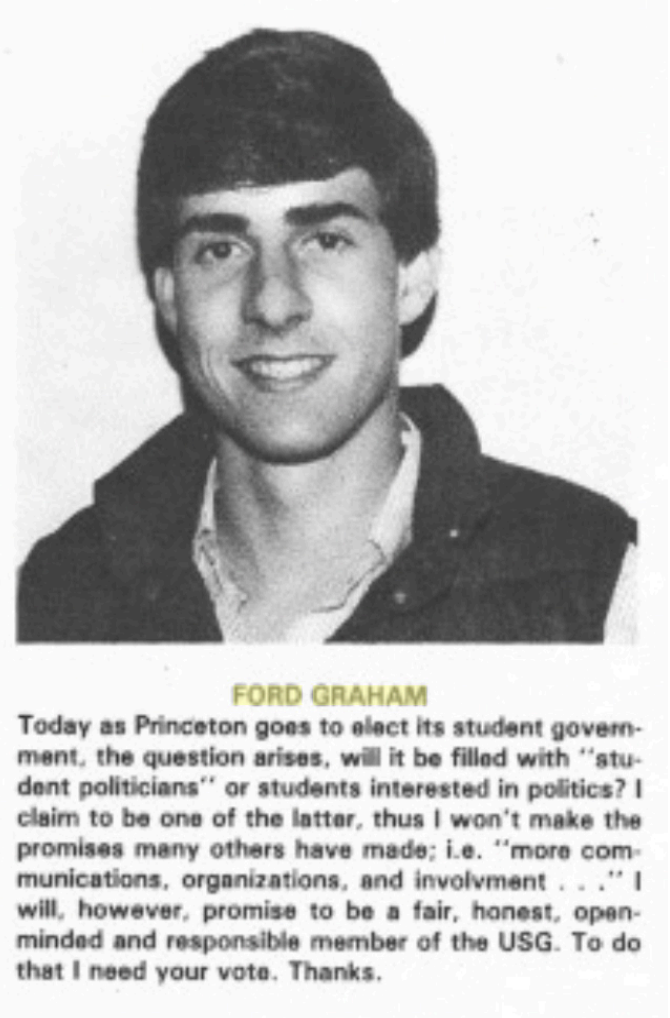
At Princeton, Graham was on the swim team and dabbled in DJ-ing on old reel-to-reel tapes, according to a former roommate. In October of his freshman year, Graham ran for class delegate of USG. He lost the election, receiving three votes despite having five roommates, as another former classmate told me.
I spoke with dozens of Graham’s classmates, all of whom were shocked by the extent of his criminal record. One told me that Graham was “perhaps clueless, but not evil.” Another said he was a “gregarious, outgoing guy, easy to get along with,” adding, “if he could help you out, he would—he was a decent guy.” His classmates remember him, by and large, as a type: a preppy southerner. Many described him as charismatic; others said “charming” or “slick.”
Several told me that Graham, who initially pursued an engineering degree, struggled with his heavy math and science courseload. After sophomore fall, the University suggested he take some time off, according to the former roommate. That spring, he interned in Washington, D.C., for then Vice President George H.W. Bush.
He came back to campus as a Geosciences major and joined the eating club Colonial.
Graham’s father seemed to loom large over his Princeton experience. In October 1985, Graham was involved in an ultimately unsuccessful fight to revive Cannon. (The club closed its doors in 1973 and only reopened in its original building in 2011, as Cannon Dial Elm.) Graham’s thesis, entitled “The Caddo-Pine Island ‘oil mine’ project: an economic, geologic, and technical review of the venture,” suggested his interest in his father’s industry of choice.
In his yearbook photo Graham smiles wide, displaying the blindingly white, square teeth that his classmates remembered; he’s handsome, with dark hair and plain features. In addition to Colonial and swim, he’s listed as a member of band and a USG delegate. His yearbook quote is taken from Luke 12:48: “Where man has been given much, much will be expected of him.”
III. LIKE FATHER, LIKE SON
Many of Graham’s former acquaintances and coworkers told me that Graham’s unscrupulous business habits echoed those of his father. John Graham was connected to the Prudential securities scandal of the 1980s, in which over 300,000 investors were defrauded out of $8 billion tied to risky oil-and-gas investments sold by Prudential’s brokerage arm.
According to Kurt Eichenwald’s 1995 book Serpent on the Rock, Graham Resources—a Louisiana-based resources fund run by John Graham—invested more than $1 billion raised through Prudential-Bache partnerships. Eichenwald reported that John Graham consistently misrepresented information to investors and misappropriated funds.
The Prudential-Bache scandal resulted in sweeping civil litigation and criminal investigations, culminating in major settlements in the 1990s. John Graham was never criminally charged. He “continue[s] to insist that nothing improper ever occurred,” according to Eichenwald.
John Graham is still alive and resides in Louisiana. He did not respond to multiple requests for comment.
Ford Graham navigated his first few post-college years just as Serpent hit shelves. He worked as a financial analyst in Texas before going to law school at Tulane, where he met his wife, Katherine. Over the next few years, he worked at a number of companies. In 1994, he and Katherine moved into their home on Prospect Avenue in Princeton. In 1997, Graham founded Vulcan Capital Management, a private equity firm specializing in energy and natural resources investments, with another Princeton alum. (Graham’s Vulcan Capital Management and its subsidiaries are in no way related to Paul Allen’s Vulcan Capital.)
In October, I first spoke with Robert Lane ‘94, one of the other Princeton alumni who worked at Vulcan. During the time he was at the company—from 1998 to 2002—Lane described the two as “very close.” Lane was an occasional guest at the Grahams’ house in Princeton.
When Lane worked at Vulcan, the company mostly invested in energy projects in Wyoming. But they would continue to grow. The company’s website, likely last updated two-ish decades ago, boasts that Vulcan completed over 35 transactions world-wide—spanning Nigeria, Iraq, and Bangladesh—worth over $800 million. Vulcan employed dozens of people over the years. Ford was ever the professional: he showed up every day freshly shaven wearing a suit and tie and braces. He looked the part of a successful businessman.
“Ford had sound business ideas at the time, and he felt that as long as he could bring them to fruition, everybody would make a lot of money,” Lane told me.
“I didn’t see the behavior that he’s being accused of right now when I was working for him,” he said, “but I saw him starting to go down a path.” Lane occasionally felt that Graham obscured information from his team. In one deal, for instance, with the private market investment firm Siguler Guff, Lane said that Graham hid that the capital he presented as equity was actually puttable debt—money that could be demanded back. And when it was, the investment blew up, according to Lane.

Graham “felt they took the investment away from him unjustly,” Lane said, even though the deal collapsed because Graham had misrepresented funds.
Graham, he recalled, always felt like others were preventing him from succeeding. “When people feel they get screwed over, again and again, there’s certainly the temptation to say, ‘Well, I guess this is how the game is played, and I’m going to play the game this way.’ Everything that he had been accused of doing afterwards—it almost felt like, to me, that they were some of the things he felt had been done to him,” Lane said.
Lane left the company in 2002 and moved from New York to Texas, where he currently resides. In late 2003, Lane sued Vulcan Capital Management in a Texas District Court for breach of contract. The suit, which was acquired by the Nass, alleges that Vulcan ceased paying Lane on August 1, 2002, without actually terminating his employment. The case was settled between the two parties.
In retrospect, Lane said that Graham did things that were “less than professional”—including denying him payment—although he never noticed anything outright criminal.
Lane also mentioned that Graham frequently recorded his phone conversations with people. While technically legal—New York is a one-party consent state for recording—it left a bad taste in Lane’s mouth: Graham seemed to be constantly preparing himself for litigation.
And litigation came.
IV. FORD’S TOY
In 2003, shortly after Lane parted ways with Vulcan, President George W. Bush promised to turn the lights on in Iraq. To modernize the Iraqi power system, the U.S. government contracted with several companies—including Washington Group International (WGI). Vulcan AMPS—a subsidiary of Vulcan Capital Management—enlisted a saleswoman named Susan Flannigan to sell two mobile electric generators to the government, through WGI, for a total of $22 million dollars.
But Vulcan did not have two mobile electric generators—they had one, and it was incomplete. The generator didn’t work when it got to Baghdad, where it was ultimately blown up by an insurgent bomb just after being repaired, according to Marc Stadtmauer, Flannigan’s lawyer.
Vulcan “did not tell the government or Susan that the generator was not complete and that they did not have the technical ability to build the additional generators,” said Stadtmauer. Vulcan was also unable to fulfill a related sale of eight gas turbines, which were meant to be paired with the generators as mobile power plants. A Defense Contract Audit Agency’s audit report of WGI found over $11 million in questioned costs related to the sale of the turbines, meaning that Vulcan billed the government for more than their products were worth.
Not only did Vulcan allegedly misrepresent the project—Flannigan never received her commission, valued at around $4 million, for her work as a negotiator, according to numerous court documents. “They had the money. They just refused to pay,” said Stadtmauer, who Flannigan began working with in the aftermath of her initial suit back in the early 2000s. A federal jury in the Southern District of New York ruled in her favor in 2014, a judgement that was reaffirmed in appeals. She has yet to receive the money she was promised.
Flannigan was in and out of Vulcan’s New York office while she was working on the deal. There, she crossed paths with David Kahn. Kahn, who was introduced to Graham by his good friend from Princeton, Robert Lane, collaborated with Graham on a company called Princeton Technology Partners starting in 2002. The company shared an office with Vulcan.
Throughout my reporting, I kept learning of individuals who—like Robert Lane and Susan Flannigan—allege that Graham simply did not pay them, in violation of contractual agreements. One of these individuals, who asked to remain anonymous out of fear of retaliation from Graham, also told me that Graham often moved money around without alerting bookkeepers. “The bookkeepers would call in payroll, and he would empty the account because he wanted to do something else with the money,” they said.
Two other individuals who worked at Vulcan similarly described the company’s culture. One said, “I think he lied a lot about money. It seemed like he was always making excuses about paying one person, waiting for money from another.”
After 2006, Vulcan hired someone to streamline finances, and after that point Graham had less control of the books, according to the other anonymous source, who ceased contact with the company in 2008. “Vulcan was actually a good [private equity] company,” they told me, but “Ford used it as his own toy. He made some questionable decisions.”
“If there was ever an example brought before me on a witness stand to typify what I believe Wall Street and the general business community do not want to put forward as how business should be run, Ford F. Graham has played that role,” wrote Judge Samuel Fredman in his decision in Norwest v. Vulcan Capital Management in 2007. Fredman ruled that Vulcan failed to pay Norwest funds connected to an investment in Bangladesh—one of the many instances in which the company was accused of failing to make promised payments.

Again and again, Graham found himself in court. Beginning in 2004, Graham and his co-founder were sued by Vulcan board members Michael R. Stewart and Daniel J. O’Hare, who alleged that the defendants improperly controlled the company and denied them their decision making rights, according to a November 2011 decision in the Fifth Circuit Court of Appeals. The parties entered a settlement, but Stewart and O’Hare alleged that they did not receive all of the money they were promised, according to the document. They argued that Graham used a number of unsavory tactics to avoid payment, including creating new corporate subsidiaries to shield funds and putting other subsidiaries in bankruptcy to delay litigation.
A jury trial ruled in the plaintiffs favor; they were awarded almost $8 million in total damages. The judgement was later reduced but the decision reaffirmed, according to the 2011 document.
In 2010, a Vulcan executive testified as a part of the O’Hare and Stewart trial that the company was essentially out of business. Vulcan was evicted from their office due to outstanding rent payments, according to a July 2011 deposition of Graham.
Although Vulcan was defunct, Graham’s investment days were far from over.
V. THE SCHEME
If you were part of the Princeton country-club scene in the 2010s, you may have known Ford Graham. He lived about a mile down from Princeton’s eating clubs. He golfed at Bedens Brook, attended Princeton University football games, and hosted frequent cocktail parties. At P-Rades, he went all out in orange and black, pulling a cart with his son, Jackson, behind him. One photo of him, taken during reunions not long before his arrest, pictures him smiling alongside his wife, an ‘86 emblazoned on his shirt.
Around 2012, Graham began making investments on behalf of his acquaintances in the Princeton area. According to Graham’s federal indictment, he ran a Ponzi scheme, shuffling Victim-1’s money to Victim-2 and so on. Graham would approach an investor with an offer, cajole them into pledging their money—often by falsely telling them that he, too, was investing in a given asset—and later provide fake documentation to justify delayed payments, according to the indictment.
According to the 2019 civil complaint—filed against both of the Grahams by the New Jersey Attorney General on behalf of the New Jersey Bureau of Securities—Katherine collaborated with Ford by acting as a “cheerleader” for his investment projects, and, in at least one instance, made misleading statements to investors. Katherine is also referred to as a co-conspirator, but not a co-defendant, in Ford Graham’s 2024 federal indictment. She is not currently facing any charges. Katherine did not respond to requests for comment.
Sometimes, the investments that Graham orchestrated yielded profits for investors. But other times, returns never came through, according to the federal indictment, which states that Graham raised millions of dollars from high-net-worth investors, “including, but not limited to Victim-1 and Victim-2,” and demonstrated a pattern of fraud.
John Pecora—“Victim-1” in case files—told me that he thought “there were many other people in Princeton that were burned, but they were more worried about their social status than justice,” deterring them from legally pursuing Graham.
“I was not,” he added.
Pecora first met Graham around 2008; both men’s sons played in the same Pop Warner Football league. He told me that Graham presented himself as a successful oil and gas investor. In late 2009, Pecora invested in a company that Graham introduced him to called Miller Petroleum—a massively profitable endeavor for Pecora, but not Graham. This, Pecora told me, infuriated Graham. “That’s why he kept chasing me,” he said—to recover money that he viewed as his.
According to Graham’s federal indictment, in 2013, Graham induced Pecora into investing $1.5 million in Speciality Fuels Bunkering (SFB), an oil business in Alabama. But the money went straight into Graham’s pockets. Graham eventually extracted hundreds of thousands more by soliciting legal fees purportedly related to SFB, according to the same document.
Pecora started pursuing Graham legally in 2014.
“I laid the civil case in their lap,” he said. He had sent an abundance of evidence to the IRS and FBI; he felt as though “they fumbled for years.” In the meantime, Graham continued to defraud others.
Pecora won almost $2.8 million in his civil suit against Graham, according to the final judgment of the case, filed in 2017. He has yet to receive the money he was promised.
Unbeknownst to Pecora at the time, Graham was using his money to make payments to the individual referred to in USA v. Ford Graham as Victim-2, portraying those payments as investment returns, according to the indictment.
I met Victim-2—whom I’ll call Bob—at the Nassau Club for lunch in December. In the lobby of the Club, which requires membership or a direct invitation to enter, he told me about his family’s legacy in the town of Princeton.
Bob recounted his history with Graham—they’ve known each other for over two decades. Their now adult children were in the same baby group; they frequented the same social circle.
Given their history, when Graham came to Bob and proposed an investment in an oil and gas company, he was inclined to trust him. His investment prospectus seemed legitimate. And Graham was persuasive. “He definitely had a silver tongue, almost too silver. And his father was polished the same way,” Bob told me.
In two deals with Graham, he made over $100,000. Eventually, though, around 2014, Graham stopped providing returns at all—and Bob realized the money was never going to come.
“He bullshitted like crazy,” said Bob. For a year and half, he remembered Graham insisting, “Oh, it’s coming. Don’t worry, everybody’s gonna do well.”
Bob assumed that the company Graham had bought into was simply a losing proposition—he had messed up. “I think he didn’t really know what he was doing, and he lost money on that [investment], which cascaded and escalated to his fraudulent deals,” he told me.
Eventually Bob began to confront Graham. He recalls telling him, on one occasion, “You’re not getting away with this. Pay me back, and we won’t have any problem. But if you don’t pay me back, I’ll take you down.”
Soon after this conversation, Bob was watching his son swim in the pool at the Bedens Brook club when Graham approached him.
“Guys smarter than you have tried to take me down,” said Graham, leaning over Bob, who was sitting on a lounge chair.
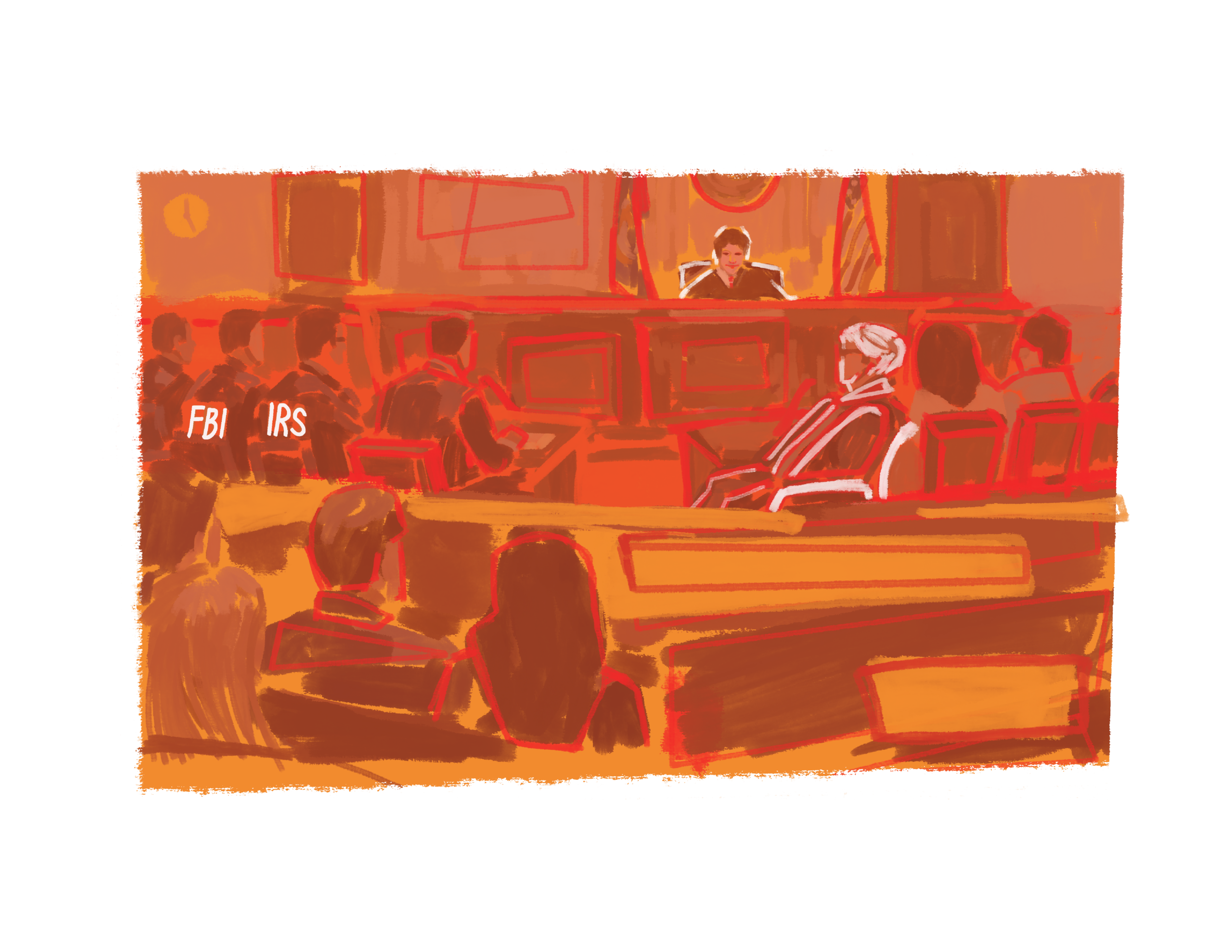
The latter remembers responding: “They went after you civilly, and I’m not doing that, Ford—I’m going after you criminally.” Bob went to the FBI and IRS around 2014.
“I was shocked that anybody would do anything like this in this community. Especially being a Princeton grad—and a very active Princeton grad,” said Bob, who described Graham as very “rah rah rah” about Princeton.
“It’s a shame that it took so long,” he said, lamenting that law enforcement didn’t “nip this in the bud sooner.” He reflected how humiliating it was to know that Graham was essentially living off of stolen money, including his own, for years. According to the 2019 civil complaint, Graham spent investors’ funds on expensive vacations, his country club membership, and his daughter’s Lawrenceville tuition.
Reading over Graham’s legal files, I am reminded of the portrait Eichenwald paints of his father in Serpent on the Rock. A lifestyle full of languid hunting days and luxurious dinners was “a lifestyle Graham craved,” Eichenwald writes, describing how John Graham hosted Prudential-Bache executives at a club called Longleaf and funded their lavish vacations—all the while billing his unsuspecting investors.
Chasing Graham for over a decade was “nauseating,” Bob said. “I just want to know if he thought it was worth it.”
By 2017, the Grahams were effectively socially exiled in Princeton due to swirling rumours about Graham’s investment activities, as Graham noted when given the chance to speak during his sentencing. That year, they moved to Nellysford, Virginia, to care for Katherine’s ailing mother. The family kept their Princeton home until 2019.
VI. GOOD FENCES MAKE GOOD NEIGHBORS
David Kahn is a standup neighbor. Clean-cut, with cropped white hair, Kahn lived a few houses down from Graham for over a dozen years. Kahn took Graham’s son under his wing, even teaching him Krav Maga. When the Grahams travelled, he watered their flowers, shoveled their driveway, and brought in their mail.
Professionally, Kahn specializes in “defensive tactics training and hand-to-hand combat training,” consulting with law enforcement and military and running classes for civilians along with writing patents and developing technology projects. Around 2016, he began writing a patent creating a blockchain technology to help people vet others—with the goal of preventing fraud and identity theft.
Graham “thought it was a great idea,” Kahn said laughing. At one point, he told me that Ford even pledged financial support to the project, but never delivered.
Kahn formally parted ways from Graham professionally in 2008, after Princeton Technology Partners closed. “I did not leave him on bad terms. I did not suspect anything was off,” Kahn said.
They remained neighbors. According to Kahn, around 2012, he began sporadically supporting Graham’s kids financially, contributing to costs like food and basic necessities. Despite the family’s appearance of obvious wealth, Kahn did not think much of these requests. Graham always said he was “asset rich and cash poor,” Kahn recalled. “I didn’t want [his kids] to feel the financial pressures that Graham was facing.” He lent Graham around $30,000 over the years, none of which was repaid, he said.
At one point, Kahn, like many others, made a successful investment through Graham—a profit of $5,000 for investing in an oil company in Alabama.
Before the fraudulent Square transactions, Kahn was Graham’s occasional defender. Around 2016 and 2017, “People were hurling accusations at him—I said I can’t see him doing that. I wanted to believe in the better of him,” he said, on a phone call with me in October. Bob told me that when he first met Kahn, he warned him about Graham—and Kahn stuck up for him.
“Everything’s black and white to him,” Rob Lane said of Kahn, whom he affectionately calls Davey. Whereas Graham, he said, “played the game,” operating in an ambiguous legal and moral zone, Kahn is a straight-shooter. After learning about the fraud, Kahn sent the FBI 183 color-coded files to support their investigation.
Kahn did not lose money as a result of Graham’s identity theft, but he said that the investigation into fraudulent Square transactions conducted in his name cost him an FBI contract before he cleared himself.
“The damage goes beyond money,” he said at Graham’s sentencing—Graham undercut Kahn’s reputation and shattered his trust.
Soon after receiving the Square notification, Kahn confronted Graham in the latter’s living room. The two sat chatting, Graham “in his typical jovial bullshitting mood,” Kahn told me. The mood of the conversation soon shifted.
“I received a bill from Square for almost 30,000,” Kahn recalls telling Graham. He accused him of being the force behind dktiger61@gmail.com, which Graham denied.
When recounting the story, Kahn, who emphasized that he’s trained to read body language, said that Graham “gave every kinesthetic indicator that he was the fraudster.”
“You better make things right with everybody,” Kahn told him before walking out.
The two exchanged a series of emails over the subsequent years; Graham consistently denied any wrongdoing. “Your words of anger are misplaced and your facts are simply wrong,” Graham wrote to Kahn over email in 2021.
“It’s great to see that this day has come,” Kahn also said when given a chance to speak at the sentencing. “I hope there is a reckoning for Ford and family.”
VII. WHERE’S THE DELOREAN?
On November 21, 2019, Ford and Katherine Graham appeared in Judge Loretta Preska’s courthouse in the Southern District of New York to fight a subpoena request in the Susan Flannigan case. For years, the Grahams maintained that they were unable to pay her commission and consistently avoided financial disclosure. Unbeknownst to them, Judge Preska had ordered the Graham’s arrest that day for their failure to comply with discovery requirements. When they entered the courthouse, U.S. Court Marshals arrested them.
“I remember his face. He was speechless,” said Stadtmauer, who was present as Flannigan’s lawyer.
The Grahams served a short stint in the Metropolitan Correctional Center, placing them in the distinguished company of former MCC inmates Bernie Madoff and Jeffrey Epstein. During this time, Graham filed for bankruptcy. On the very day he filed, a DeLorean—the silver, spaceship-like car associated with “Back to the Future”—worth almost $100,000 sat in the garage of his house on Prospect Avenue, according to a deposition of Katherine Graham from January 2020.
Graham’s bankruptcy paperwork reveals dozens of LLCs associated with his name. What is lacking is also revealing: Kahn, Bob, and others told me that Graham bragged about having money in offshore bank accounts, which does not appear in his bankruptcy tallyings. (At the sentencing, Saverio Viggiano, Graham’s attorney, stated that during the federal authorities’ investigation of Graham, subpoenas were sent to foreign companies, but no word was heard back.)
Absent also is the DeLorean—which Kahn told me he has a particular interest in, as it was promised to him as collateral for his loaned money and then later as restitution, through a civil lawsuit Kahn filed.
“I thought putting him in jail would make him do the right thing and provide financial disclosure, but it didn’t. He’s one stubborn guy,” said Stadtmauer. Graham’s bankruptcy filing was ultimately unsuccessful since he was not transparent about his assets, as Judge Kathryn C. Ferguson decided in 2023.
Katherine Graham was released from MCC shortly after her arrest, on November 27, 2019. Graham was released two months after, in late January.
Christopher Olsen, Graham’s attorney at the time—he and Graham have not spoken in several years—told me that, despite all his preppiness, Graham fit in well enough in jail.

“Ford can get along with just about everybody. When he was in jail for the Flannigan case, he got put in jail for contempt of court, which is extraordinarily rare. When he was there he got along with hardened criminals,” said Olsen.
After MCC, Graham went home to Virginia, where he was later arrested again—this time, on criminal fraud charges—in March 2021. He has been on pre-trial release since April of that year.
VIII. THE SENTENCING
Almost a year after he pled guilty to 16 counts of fraud, Ford Graham was sentenced by Judge Robert Kirsch in Trenton, New Jersey.
Graham was brought into the courthouse in a wheelchair pushed by a slim young man with a mustache—his son, Jackson—alongside Katherine, who wore a dark skirt and animal skin-patterned shawl.
Present in the courtroom as well were Kahn and Bob. Outside the courtroom, we met with John Pecora. Pecora’s disgust towards Graham was palpable. He stormed off before the official proceedings began, after the prosecutor privately told the victims that he was recommending a 33 month sentence for Graham. When I later spoke to him on the phone, he described Ford’s lenient sentence as a “travesty,” pointing out that each of Graham’s wire fraud charges carry a maximum of 20 years in prison.
He said that “this is a double travesty” since Katherine was not charged. Ford Graham continues to deny her involvement in his criminal actions.
Throughout the proceedings, Judge Kirsch emphasized the sophisticated nature of Graham’s crime. At one point, he pulled out a piece of paper with a visual representation of Graham’s fraud scheme: criss-crossed lines mapping money transfers from account to account, through U.S. institutions and international ones, and through various LLCs and shell companies that Graham set up throughout the years.
He declared it “Court Exhibit 1,” saying that the diagram “demonstrates the complex, intricate web spun by Mr. Graham—and presumably his co-conspirators—better than any prose could.”
At one point during the proceedings, Viggiano, Ford’s attorney, suggested that one may or may not believe that Graham is a fraudster. The judge interrupted him. “The facts are the facts,” he said: Graham committed fraud.
(Both Viggiano and the prosecutor present in the courtroom, Richard Shephard, declined to comment for this article.)
When given the opportunity to speak, Graham apologized to his victims. He told the court that he was “deeply shamed and humbled by my mistakes.”
“I apologize most of all to my wife and family, who had no knowledge of my criminal actions,” he said. He expressed a desire to focus on a life of service.
Around two dozen character letters were submitted on Graham’s behalf before the sentencing. Nicolas Tétrault, a former Montréal politician, also attended the trial as a family friend. He told me over the phone that Graham saved his son’s life after a 2025 drowning incident. Canadian doctors scheduled a date to unplug him from life support—but the Tétraults had been told by experts in the United States that he could be saved. Tétrault reached out to a litany of people for help—and he was led to Ford Graham, who used his Louisiana connections to help the Tétraults move their son to a different hospital. He recovered in a Louisiana clinic.
“I heard everything in court, but there’s always two sides to the story, and I know this person has a lot of good in him as well, a lot of generosity,” Tétrault said.
Graham and his attorney asked for leniency given Graham’s medical conditions; his mobility was severely impaired following a tractor injury he sustained in September. He said that his doctors gave him a 60 percent chance of never being able to walk again. He described it as already the worst punishment he could face.
“I watched how handicapped people at MCC were treated,” Graham said, claiming that he will have no chance of recovery in jail. He and his lawyer requested home incarceration, prompting Judge Kirsch to ask a court attendant to find Graham’s mother-in-law’s “palatial estate,” which he resides in, on Zillow: a 6,300 square foot home worth over $1 million. Judge Kirsch was sympathetic but firm: he said that prison time seemed necessary to deter Graham from further criminal acts.
He also noted that Graham’s sentencing was initially scheduled for December 2025, and has been delayed multiple times. “I will not entertain an application to delay [Graham’s jail time] for additional orthopedic surgery,” he said, “if there is any plan afoot to do so.”
“If he’s not stopped, he will continue. There’s no doubt in my mind,” said Bob when the judge gave victims the opportunity to speak.
Judge Kirsch described Graham’s crime as one of privilege. He repeatedly underscored that Graham is not only a Princeton graduate, but also holds a JD and MBA, both from Tulane. Someone with his credentials is “too clever, in common parlance, for a ‘straight rip,’” he said; Graham traded on his relationships and affiliations to defraud those closest to him.
After the sentencing, Jackson Graham sent me a statement on behalf of his family. “We are thankful and deeply humbled for the outpouring of support from close friends and family. Their prayers and unfailing kindness through these dark days have sustained us. We will forever remember and cherish their love and compassion. We look forward to the day when we can thank each of them in person. In the meantime we respectfully ask for our privacy,” he wrote.
Judge Kirsch, for his part, reflected that sentencing is the most difficult part of his job. He’s sentenced thousands of people, but he would characterize few as truly evil. “I’ve seen it a handful of times,” he said. “You’re not in that category for sure,” he told Graham, “But you created a labyrinth of fraud that did cause harm.”
Judge Kirsch sentenced Graham to 33 months for the 16 fraud charges he pled guilty to, with supervisory release for three years after his time in jail. He was given 90 days to voluntarily surrender to the Bureau of Prisons. Victim compensation has yet to be determined, as of May 17.
When leaving the courtroom, Kahn and Bob looked glum.
Bob lamented wasting his day—and 12 dollars on parking—to attend the sentencing, just to find out that, according to him, Graham “got off easy.” Yesterday, he said, Graham caused him yet another sleepless night. It added insult to injury: more stolen money and more stolen time.
Sofia Cipriano is a contributing writer and co-section head for Second Look.