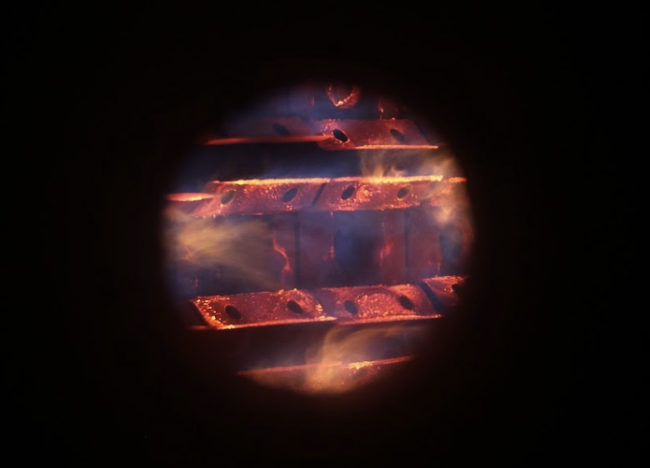
A purple-hot flame pulses in a combustion chamber at the heart of Princeton’s power plant. Superheated exhaust air screams out of a General Electric LM-1600 aeroderivative turbine and fills the chamber. A nozzle spurts in natural gas at up to 2,450 cubic feet per minute, meeting the incoming exhaust heat and producing a burst of flame. The reaction boosts the temperature inside the chamber from 800 to 1,100 degrees Fahrenheit and fills it with a purple glow. Hot air from the blaze roars past water ensconced in pipes, which vaporizes instantly; resulting steam is shunted through a subterranean network of pipes throughout campus. By the time the steam reaches the radiator of the average dorm room, the process of expansion and heat transfer has stepped hundreds of degrees Fahrenheit of heat down to about 90.
“Since the 1740s, Princeton has been burning stuff to deliver energy,” said Ted Borer, Princeton University’s former Energy Plant Director. This power plant, a steel gray building wedged between Theater Drive Garage and Elm Drive, is just the latest way the University has chosen to deliver that energy. The “cogeneration” plant powers and heats Princeton’s campus via a joint electricity-generating and steam-producing system. Hired to build the plant in 1994, Borer and his team have kept the cogeneration plant running for over three decades, trying—and mostly succeeding, barring a few exceptions—to balance safety, reliability, regulatory compliance, carbon footprint, and financial cost.
Although Princeton hired Borer to manage the cogeneration plant, he spent much of his time at Princeton building a system to replace it. During his tenure, Princeton built 16.5 megawatts of solar panels, a water-based thermal energy storage system to reduce the University’s peak heating and cooling demand, and the beginnings of a “geoexchange” system of electricity-powered heating and cooling. Meanwhile, Borer preached the gospel of sustainable energy systems to anyone who would listen. He gave lectures on and off campus, advised undergraduate theses, and even briefed the U.S. Senate on energy infrastructure. A headshot in a New York Times profile on Princeton’s energy transition portrayed Borer as an engineer of the future. Wearing a red flannel and a Princeton-orange hard hat, he looked to the sky: chin up, eyes squinted behind spindly brow-lined glasses, and jaw set under a bristly whitish beard. But Borer will not oversee the next stage of Princeton’s energy transition, having retired in January 2025.
Instead, David Weis, Borer’s successor, will carry on the decarbonization projects that Borer helped plan. A tall man with salt-and-pepper hair and a slight New Jersey accent, Weis worked on digital control systems at Princeton’s plant for over two decades. This background will suit the needs of the digitalized and largely electrified system that will replace the one that Borer was hired to construct. “He was here when they built cogen,” Weis said. “I guess I’m here to take it out.”
***
Since humans first learned to control fire, combustion has powered millions of years of human history. But it was not until the Industrial Revolution that it became domesticated. European manufacturers squeezed fuel and flame into small chambers to breathe artificial life into machinery, powering industrial output and intensifying labor exploitation in the process.
Princeton took a while to harness this kind of industrial combustion, relying on a decentralized system fueled by biomass and coal for its first century of operations. Fireplaces burned wood harvested from 200 acres of forest set aside in a 1754 land grant to the University, before coal entered the picture around the turn of the 18th century.
Princeton began to centralize its heating system in 1876, when it installed boilers and a “district” steam heating system in its Collegiate Gothic Dickinson Hall (which burned down in 1920). In 1889, the boilers were transported to the “New Dynamo Building,” a building commissioned for the experiments of electrical engineering professor Cyrus Fogg Brackett (a collaborator with Thomas Edison and Alexander Graham Bell, Brackett rigged up his classroom to use an incandescent bulb: tradition has it that this was the first electrically lit classroom in America). There, they were combined with a new steam-driven generator that could generate electricity: Princeton’s first cogeneration system. This was new technology. Edison’s Pearl Street Station in New York City, the first commercial power plant in the country, had pioneered cogeneration only seven years earlier. “You can imagine my peers from centuries before going up to New York and saying, ‘this is nice—we should bring this back to campus,’” Borer said.
During the beginning of the electric age, local district models of combined heat and power were common. But they soon fell out of fashion. As the national electrical grid centralized production to fewer, larger, and more distant power stations, small generators serving local buildings declined in popularity. Nevertheless, Princeton continued to operate its cogeneration system, replacing the Dickinson Hall plant with a “university gothic” power station at 200 Elm Drive in 1923 (Public Safety offices now occupy the building). Over the next 60 years, this plant burned coal, and then natural gas, to heat and power the campus.
By the 1990s, Princeton was looking for a change. Deregulation of the natural gas sector caused an oversupply of natural gas that lowered gas prices, making it cost-effective to build a new natural gas plant and purchase fuel rather than buying electricity from the grid. Degraded machinery from the 1920s required some kind of replacement. Looking to replace machinery from the 1920s, the University took advantage of this environment to build a cogeneration plant. Borer was hired to make it happen.
Installed in 1996, Princeton’s plant operates with 15 megawatts of capacity—enough to power a small town. To generate electricity, the plant powers a turbine which operates on a Brayton gas combustion cycle. The system compresses air, shoots it into a combustion chamber, combines it with natural gas, and sparks an ignition. This combustion produces a hot, high-pressure gas mixture that expands rapidly through a turbine, causing it to spin a generator. The turbine-generator combination transforms that rotational motion into an electrical current.
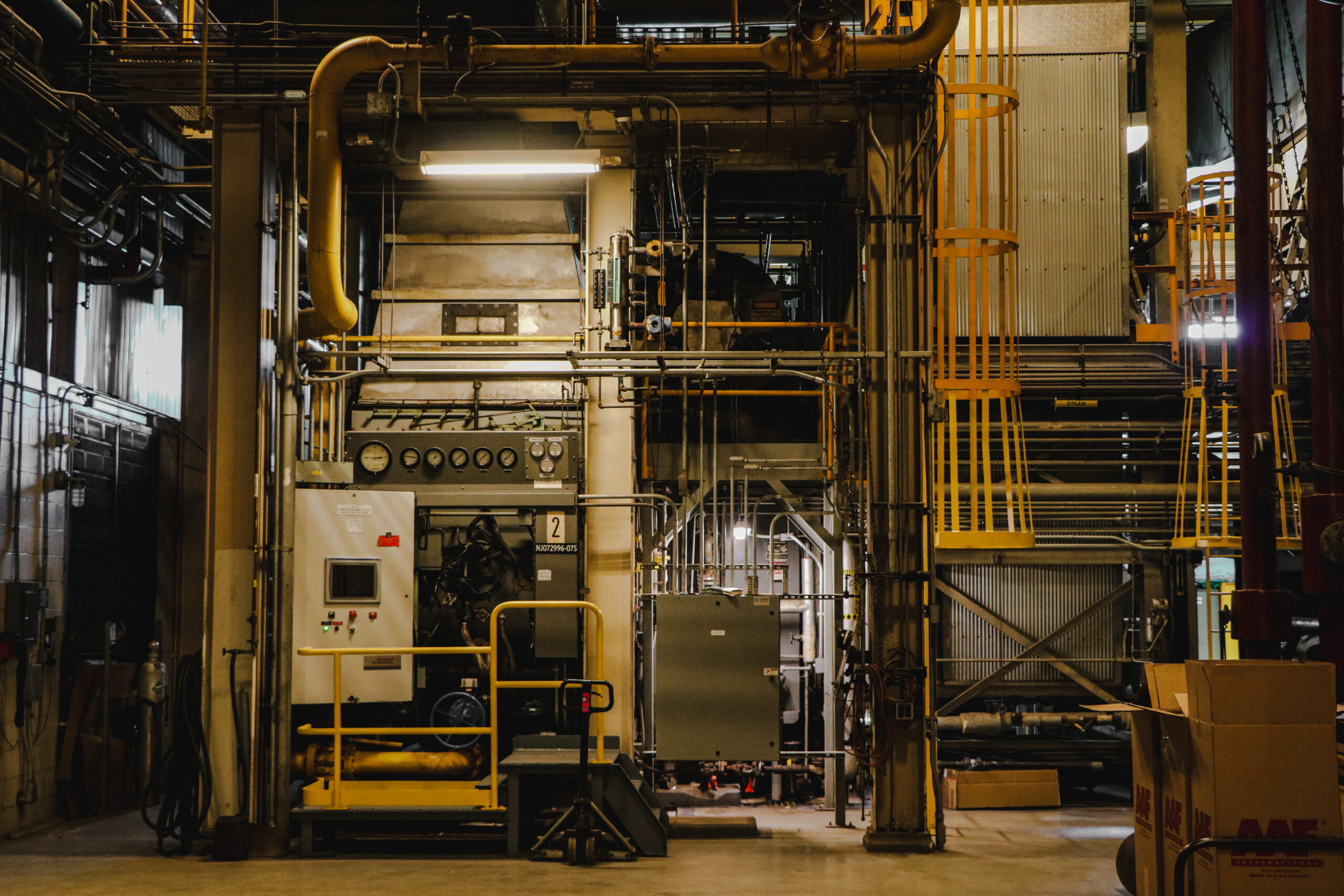
The cogeneration plant opened in 1996 and has provided heat and power to campus since then. As it is nearing its retirement age, the main combustion system may be replaced by a set of smaller generators.
This process is relatively inefficient—the energy released through combustion is far greater than the energy captured by the turbine. Mathematically, Brayton cycles could capture above 80% of energy expended through combustion. Real-life Brayton turbines only capture about 35-42%. The rest of the heat energy is typically released into the atmosphere.
Not so with Princeton’s cogeneration plant. The exhaust gas is heated further and then used to boil water into the steam that the University uses for heating. By cogenerating heat and power, the total system achieves about an 80% efficiency rating—an impressive conversion rate compared with most fossil fuel-burning systems.
The cogeneration plant has kept Princeton powered for three decades almost without interruption (save for 20 minutes during Hurricane Sandy in 2012). But power is not the only thing that the plant generates.
***
Think of Princeton’s power plant as one cell in the multistate organism known as the Eastern Interconnection, itself the cell of a cross-continental organism of synchronized electricity. As a cell, the power plant has a metabolism: it eats matter, converts it into energy, and produces waste. Power generation is the plant’s most important metabolic function. But operators are equally concerned with managing another step in the process: waste production.
Combustion always produces undesirable emissions. When natural gas is burned, impurities in the fuel react to produce byproducts that can be harmful in high enough concentrations. To mitigate Princeton’s plant emissions, the U.S. Environmental Protection Agency and New Jersey’s Department of Environmental Protection (DEP) have set emissions limits on the University in what is known as a Title V air permit. This permit limits the amount of various types of pollution, from carbon monoxide (CO) to Nitrogen Oxides (NOx) or Volatile Organic Compounds (VOCs), that Princeton can release from the cogeneration plant.
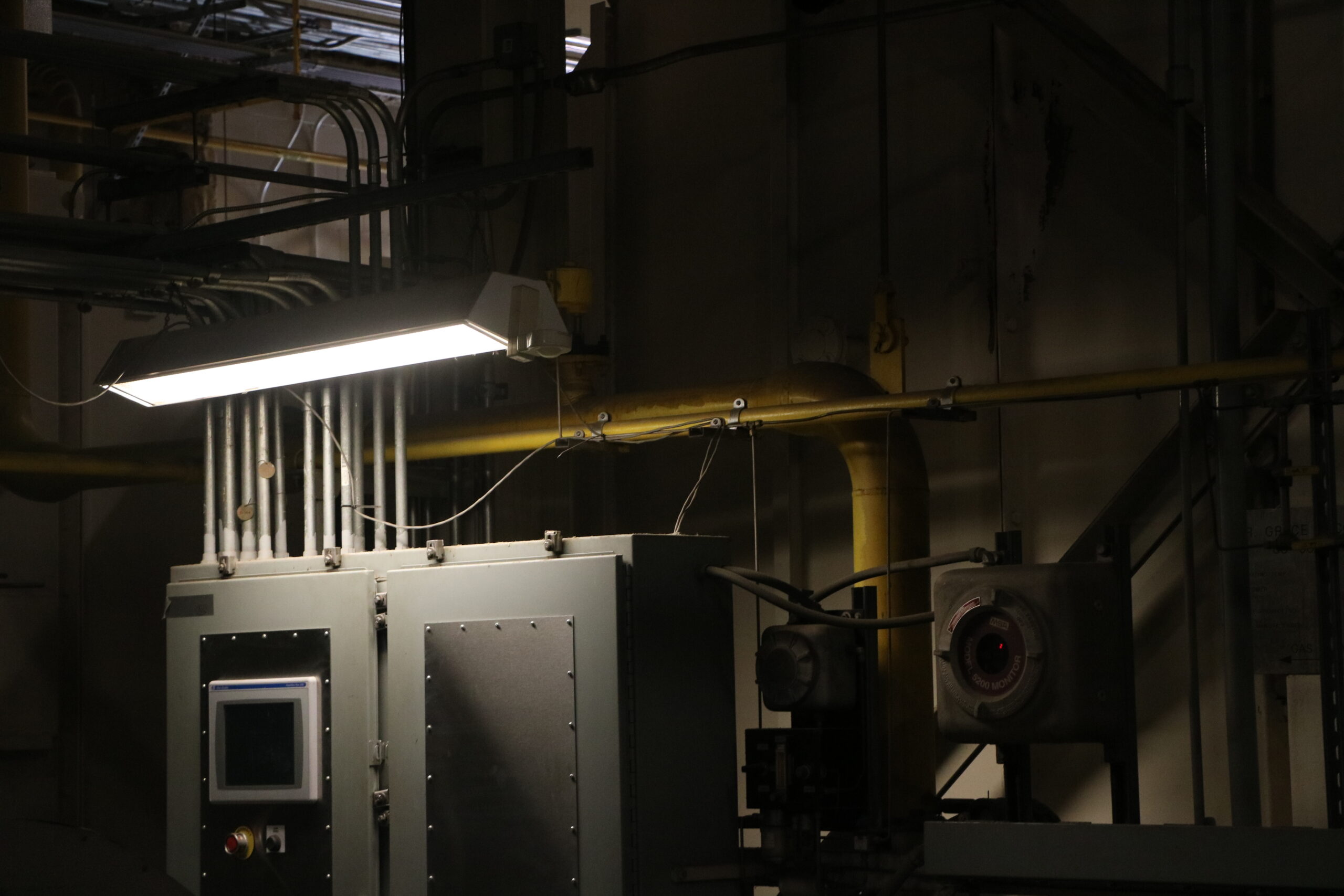
A light hangs above one of the plant’s many control panels.
To comply with the permit, Princeton must follow three requirements. First, Princeton must run a “continuous emission monitoring” system at all times to detect whenever the plant exceeds its allowable emissions limits. “It’s going to catch every little blip,” said Wolf Skacel, head of environmental compliance consultancy enviroCOP and a former DEP Director. Princeton must also perform “stack tests” twice a year to ensure that the instruments reading emissions data are properly calibrated. “You’re bringing in a huge truck which is basically a mobile combustion emissions laboratory,” Borer explained. Hoses from the truck are extended and connected to the cogeneration plant’s two metallic exhaust stacks. At the end of these hoses, sensors collect data every minute to be analyzed through a series of tests. “You’re pulling those emissions down, sampling them, getting everything calibrated and tweaked,” Borer said.
A third testing mechanism completes the set: the annual combustion adjustment. Burn conditions inside Princeton’s boilers and turbines deteriorate slowly over time due to a drift in their fuel-air ratio, causing plant operators to bring in maintenance technicians from their manufacturers to “carefully tweak” the ratio and fix the drift, according to Borer.
Complying with the Title V permit takes effort. Managing an unstable and literally explosive machine requires constant vigilance and upkeep. “Princeton does its best to operate at the level of best practices,” Borer said. But that does not mean it has a flawless track record.
“The air permit is so complicated, the equipment is so complicated,” said Tom Nyquist, Princeton’s former Executive Director of Facilities Engineering and Campus Energy. “Things slip through the cracks.”
***
Princeton’s air permit compliance reports leave a paper trail in the depths of a DEP database known as DataMiner. The site looks (and loads) like it was designed in the late 1990s, with an interface surrounded by blue ones-and-zeros that resemble a hacker’s screen in a blockbuster film.
Digging into DataMiner’s information on Princeton’s permit compliance reveals a curious fact: between 2000 and 2025, the University has paid more than $85,000 in fines for 17 violations of its Title V permit. Unpacking that figure requires more context.
Most of Princeton’s fines were incurred in the early 2000s, as the campus energy team was ironing out the kinks of the cogeneration turbine. Since 2018, seven of the fines levied came from physical emissions exceedances such as a few hours of slight carbon monoxide over-emission, as well as a water-to-fuel ratio imbalance. But these violations have been minor. “None of them appeared to me as things that could cause adverse public health impacts,” concluded Joann Held, a former DEP air quality specialist.
Borer explained that violations can happen due to the gradual degradation of the plant’s thousands of moving, heating, and rotating parts. “Things break, especially in complex systems that are running close to their material limits.” Borer said. “It’s not trivial to fix that.”
Fixing problems also takes time. When the plant’s continuous emissions monitor registers an exceedance, Princeton reports it to the DEP. Then the clock starts ticking. Plant operators have a one-hour grace period to correct the exceedance before the DEP levies a fine. But an hour is not always enough for corrective actions to get systems back into service, and a fine is sometimes unavoidable, according to Borer.
Outside of emissions violations, Princeton has received fines for seven late submissions of the University’s annual combustion adjustment reports since 2016, and two stack tests that were submitted a year late. Borer stressed that scheduling tests and receiving reports from testing companies on time can be a logistical challenge, as only a few companies offer stack testing services statewide. Power plants usually contract them in the spring and fall when power demand lessens, so they can afford to take a unit offline for testing. “If you don’t get the window, you need to defer,” Borer said. That alone can mean a late test or report. So can processing the raw data that the tests generate, which, according to Borer, can take months.
“Princeton strives to maintain compliance with environmental regulations and permits at all times,” a University spokesperson said. “The NJDEP has cited Princeton with violations related to mechanical or maintenance issues, late reporting, emission exceedances, or incomplete record-keeping. All violations have been satisfied or defended.”
According to Held, missing reports happen more than they should. “But it’s not like everybody’s missing their reports,” she said.
***
Like any metabolic entity, the cogeneration plant has a lifespan. After three decades of operation, it is quickly nearing that lifespan’s end.
Succeeding Borer as Campus Plant Director in 2024, David Weis continued to execute Princeton’s decarbonization plan, which aims to decommission the cogeneration plant and replace its functions with cleaner sources of heating and electricity. On the heating side, a new campus geoexchange system is gradually coming online to replace the steam heating system with an electrified alternative that can also provide cooling. On the power side, solar panels mean that Princeton can generate some of its power without combustion.
Meanwhile, Princeton intended to obtain electricity from cleaner sources from New Jersey’s grid, allowing it to gradually replace fossil fuels with net-zero energy. “The thought all along was,” Nyquist said, “at some point, America has got to decarbonize the grid. And we would buy decarbonized electricity to run the heat pumps and drastically reduce combustion on campus and lower our carbon footprint.”
This plan coincided with the cogeneration plant’s increasing age. “It’s approaching obsolescence,” according to Weis. “Parts are much harder to find. Skilled technicians who are familiar with maintaining that particular model of engine are becoming harder to find.”
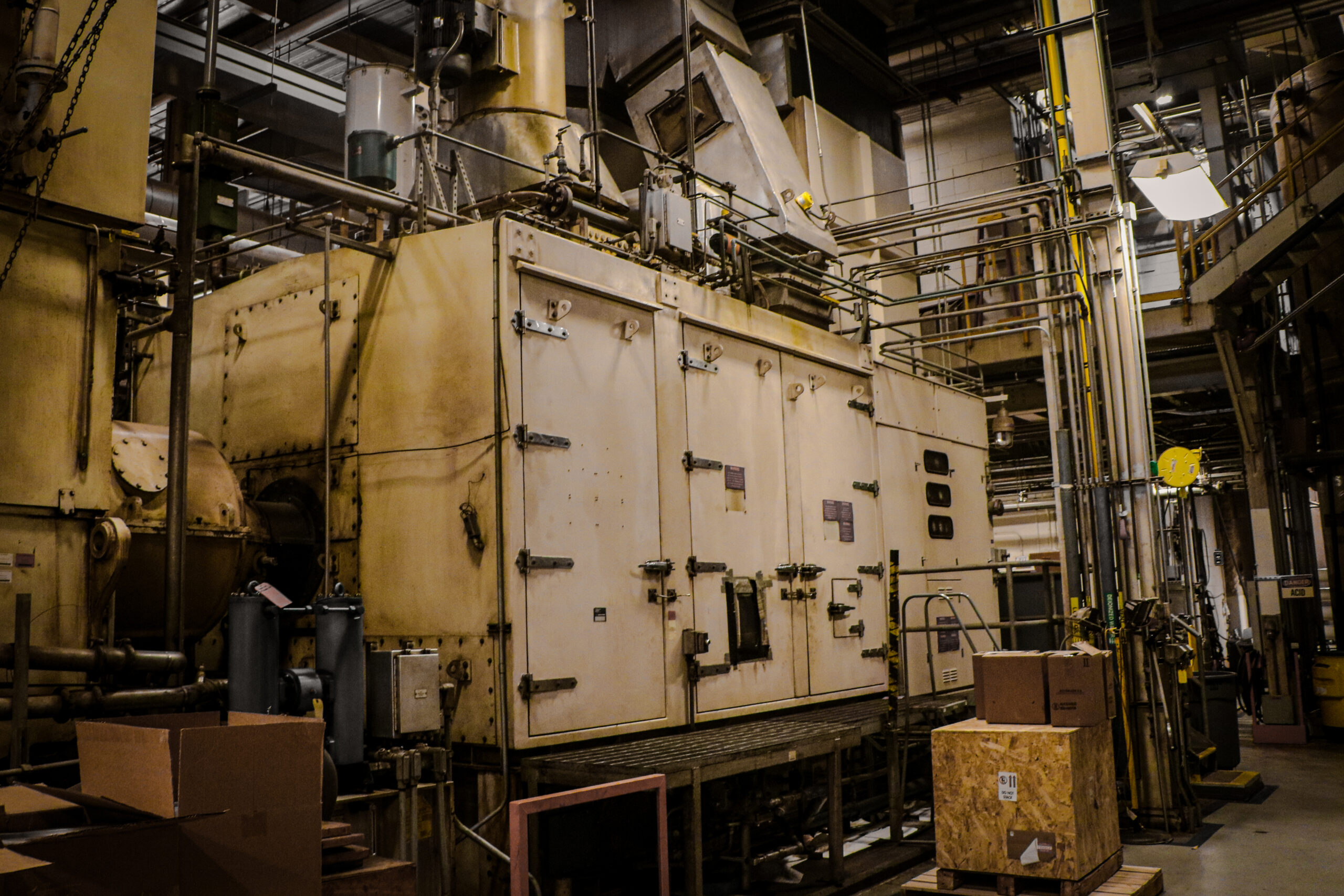
A General Electric LM-1600 aeroderivative turbine is encased in a grey steel box at the heart of the cogeneration plant. The turbine was modified from the General Electric F404 aircraft engine series, which powers the F/A-18 Hornet fighter jet. It can generate up to 15 MW of power for Princeton—enough to power a small town.
As a result, the University has decided to replace the cogeneration plant with a set of smaller reciprocating piston generators sometime in the early 2030s, as well as a supplementary battery bank. Although plans may very well change, Weis expects to replace the single 15-megawatt turbine with four generators operating at around three megawatts apiece, allowing the University to generate smaller increments of power via combustion while building in redundancy for emergencies.
These four generators would act as backup for the University. According to Weis, they would primarily run when demand is high, allowing Princeton to avoid paying high electricity costs to the grid. That means that they would see fewer than one thousand hours of runtime per year, compared with the existing turbine that operates at between four and five thousand hours per year. Although the generators will likely run on diesel fuel, a far more polluting fuel than the natural gas that Princeton’s existing turbine can use, Weis expects that this less frequent runtime will lead to net carbon emissions benefits regardless. This is because the turbines will only be running during periods of peak demand, when the grid is operating its dirtiest generators. “With the emission controls that we have, there is a chance we’ll still beat the grid,” Weis said.
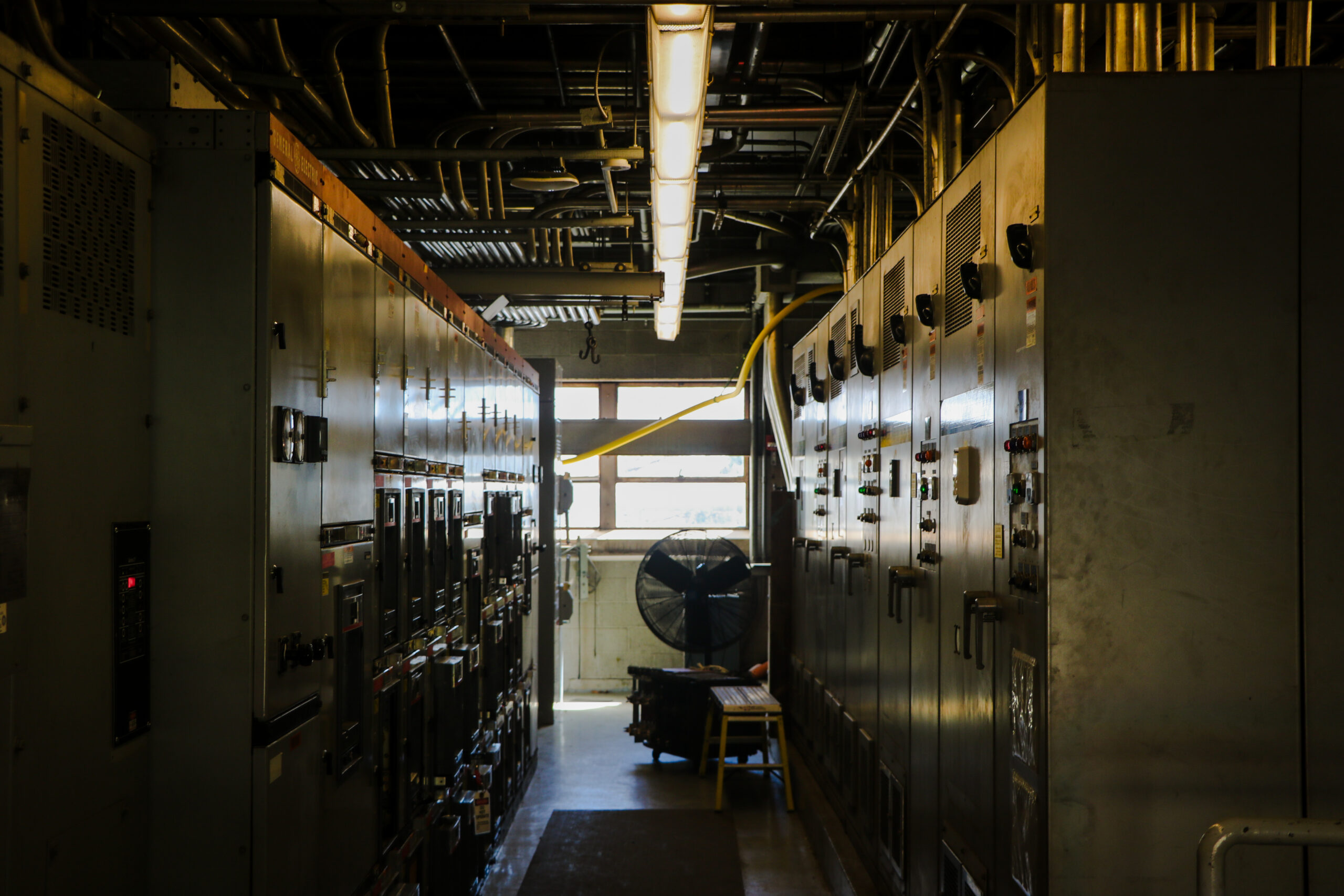
The electrical room of the plant sits above the main shop floor. Soon, the electrical system will involve managing a bank of batteries to supplement on-campus generators and power supply from the wider grid.
Before these generators replace the cogeneration turbine, though, Weis expects to install batteries to store energy. “The batteries come into play as a partner, so to speak, for the engines,” he said. Although the University has not released specifications for how much battery capacity it hopes to build, Weis plans to install enough to lower Princeton’s peak demand, which will reduce a specific charge Princeton has to pay to the grid determined by that peak demand. When installed, batteries will also allow Princeton to save money on power by trading in different types of wholesale electricity markets. Perhaps most importantly, they can serve as backup during the cogeneration decommissioning process—and for the future reciprocating generators should one fail. “Having the ability to put electricity into our microgrid at our moment of choosing is extremely valuable to us as an institution,” Weis said.
A few factors have interrupted this plan. When the Trump administration cancelled or obstructed offshore wind farms up and down the East Coast, it threw a wrench in Princeton’s decision to make its electricity consumption cleaner by buying from an increasingly clean grid. Federal funding cuts have strained the University’s budget, pushing back the timeframe for when capital investments like new generators and batteries are financially feasible, according to plant operators.
Despite these changes, the plan’s broad strokes remain in place. Weis intends to follow it diligently. “They didn’t leave a whole lot left for me to really innovate,” he said. “But that’s fine.”
Weis now sees his role as straightforward: “Just to keep it moving, keep the forward momentum, and keep everything on target.”
Within the next decade, Weis will see to it that the roaring purple flame at the heart of the campus plant flickers and dies. In its place, four smaller flames will light up, marking a new era for the University. Combustion will lose its prime place in Princeton’s energy system. But it won’t be completely gone from campus anytime soon.
Alex Norbrook is a contributing writer for Second Look and former EIC of the Nassau Weekly.