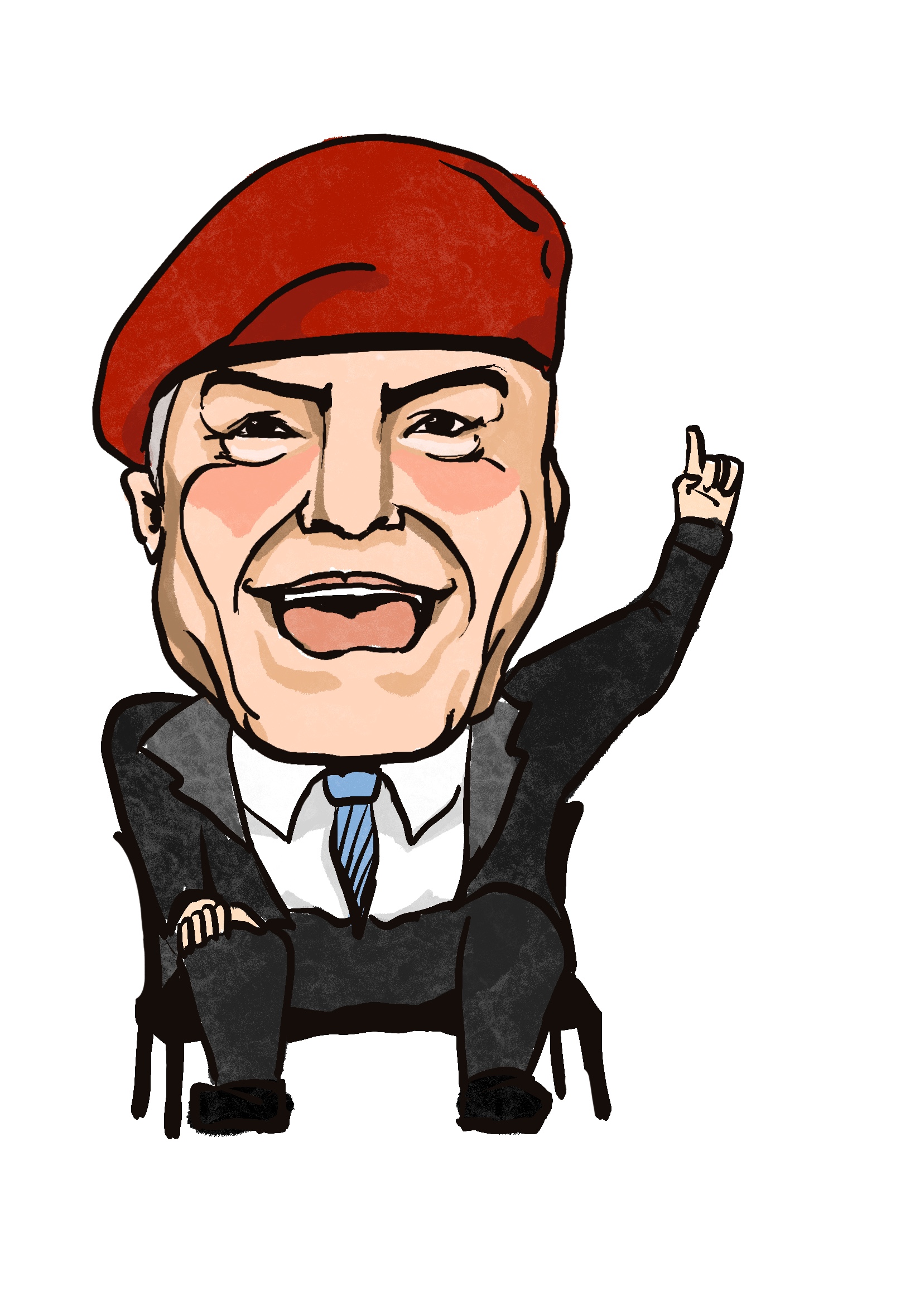
In late March, former New York City Mayoral candidate Curtis Sliwa made a sensational appearance at Whig-Clio.
By 4:56, the Whig Senate Chamber had reached capacity. By 4:58, the room was overflowing. Students started to populate the upper balcony, craning their necks over the edge so that they would not miss Curtis Sliwa’s entrance.
On March 27, the American Whig-Cliosophic Society, or Whig-Clio, hosted Curtis Sliwa, the infamous politician and anti-crime activist whose antics as the Republican nominee in New York City’s 2025 mayoral race made national headlines. During his televised debates with Zohran Mamdani, who topped the Democratic ticket, Sliwa’s distinctively Brooklynese accent yielded a host of viral moments, including carny Gen-Z-isms (“don’t be glazing me here”) and blunt personal asides (“I try to avoid yellow cabs… I was shot in the back of a yellow cab in 1992 by the Gottis and Gambinos.”)
Bringing Curtis Sliwa to campus was not an easy task—Whig-Clio President Alejandra Ramos ‘27 and Vice President Noah Barkan ‘28 had to find some creative ways to reach him.
“Alejandra basically hunted through a bunch of different Instagram accounts,” Noah said. “That all started in mid-February.” She was eventually able to reach James Perrone, Sliwa’s main campaign manager and long-time political aide.
“I’m very much a New York or nowhere kind of guy. So when I heard he was coming, I was thrilled that someone so influential in the city was coming here, because he really is quite a character and quite a man,” Alistair Wright ‘27 said. Born in Queens himself, Wright had the event booked on his calendar since before Spring Break.
At 5:10, Alejandra Ramos ‘27 took the podium, introducing Sliwa as “the founder of the Guardian Angels,” a volunteer organization that tasks itself with keeping New York safe through unarmed community patrols, and the organizer of “citywide political campaigns.”
Then, “Don’t Let Me Down” by Daya and the Chainsmokers started blasting in the background, adding millennial flair to the somber Senate Chamber. (“I play the Chainsmokers, Daya’s, ‘Don’t Let Me Down’ every night because a lot of people have let me down,” Sliwa later said.)
Wearing a black suit jacket and his signature red beret, Sliwa slipped through Whig-Clio’s large yellow doors to cheers and waves from the crowd. Without pausing, he walked past the two chairs Alejandra had set up in the center of the room and made his way to two unassuming plastic seats set off to the side. He pointed his fingers to the ground and did a little goofy squat boogie dance, the purpose of which was not entirely clear, but was entertaining nonetheless. He then sat in the plastic chair for a half second before Alejandra directed him toward the more ceremonious, wooden-handled thrones in the center of the room.
“How was the train ride?” Alejandra started off.
“I wanted to take a yellow cab, but…” Sliwa started before the audience cut him off with fits of laughter. The cab is an important bit of Sliwa lore—as he likes to remind his audiences, he was shot five times for insulting the New York mafia on his radio show, “Curtis and Kuby in the Morning.”
Keeping the tone lighthearted to match the audience, Alejandra asked Sliwa what his favorite bagel order is.
“A plain bagel with Philadelphia cream cheese,” Sliwa responded, “and a nice piece of fish.”
In the next hour, Sliwa dropped some great one-liners:
“I wasn’t from the suites, I was from the streets,” Mr. Sliwa said in response to a question about his on-the-ground campaigning strategy. He said he liked to use slang on his radio show to bridge the generational gap between him and his listeners—a mindset he brought into his political career. “AOC was correct in describing the millennial change,” Sliwa declared. “Gen Z is the future, and baby boomers need to accept it.” His college-age audience clapped in approval.
Before long, Sliwa was narrating his own revolutionary origins as an adolescent, explaining how he started the precursor to the Guardian Angels, a crime-prevention organization in 1977, and rallied his peers fearlessly to challenge the dress code in high school. The message he wanted us to take away was pretty clear, because he said it in at least three variations: young people should always hold leaders accountable.
He gripped the microphone tightly with his right hand, emphatically moving his left hand as he spoke. He leaned in every time Alejandra asked a question — “these are really good questions,” he would say, cracking his familiar, almost grandfatherly smile.
“I thought [his responses] were great. I would say I personally was hoping to get some more New York City-specific discussions,” Wright said. “It’s not the route he chose to go, but in hindsight, that makes total sense.”
“It’s definitely our biggest event for like years and years,” Barkan said. “We have a whole host of people that are now on our email list who wouldn’t have been there. Maybe they’ll come to one or two other events.”
By the end of his talk, Sliwa had covered almost every hot political topic on the table: law enforcement, gun violence, climate change, the Epstein files, the war in the Middle East—“WHAT THE HELL ARE WE DOING IN IRAN?” he yelled at one point, kickstarting an explanation of why America should not be spending money on a war when it cannot afford to properly educate its youth.
But the discussion’s lack of substance made its coverage feel almost apolitical. After bringing up the war, the clapping and cheering fueled Sliwa’s punchy finish: “SHAME on our country…this is NOT America first.”
Every topic Sliwa brought up suggested that the conversation might take a more solemn turn, but any sense of seriousness fizzled out when he dropped his one-liners. Before you could take the mental energy to remember your own stance on the war or reflect on what he’s said, he’s dropped a sound bite, people are whooping, and we’ve already moved on to the next topic.
Sliwa could have said anything, and the crowd would have cheered.
Vaishnavi Murthy is a contributing writer for Second Look.