“While the Constabulary covered the mob
Firing into the Falls, I was suffering
Only the bullying sun of Madrid.
…
I retreated to the cool of the Prado.
Goya’s ‘Shootings of the Third of May’
Covered a wall—the thrown-up arms
And spasm of the rebel, the helmeted
And knapsacked military, the efficient
Rake of the fusillade.”
Seamus Heaney, “Summer 1969”
In the September after the turbulent summer of 1969, considered by most the inception of the Troubles, the first of many “peace walls” came up in Belfast. Summer has historically been a fraught time in Northern Ireland; marching season occurs annually from Easter to September, and the parades, drums, and general belligerent fanfare performed by Protestant organizations such as the Orange Order peak on “The Twelfth” (of July, celebrating the 1690 Protestant victory of William of Orange). Union Jacks litter Protestant neighborhoods. In Catholic neighborhoods, it is the Irish tricolor. Marching season is, if not the cause, an aggravator of sectarian tensions. 1969 was no different.
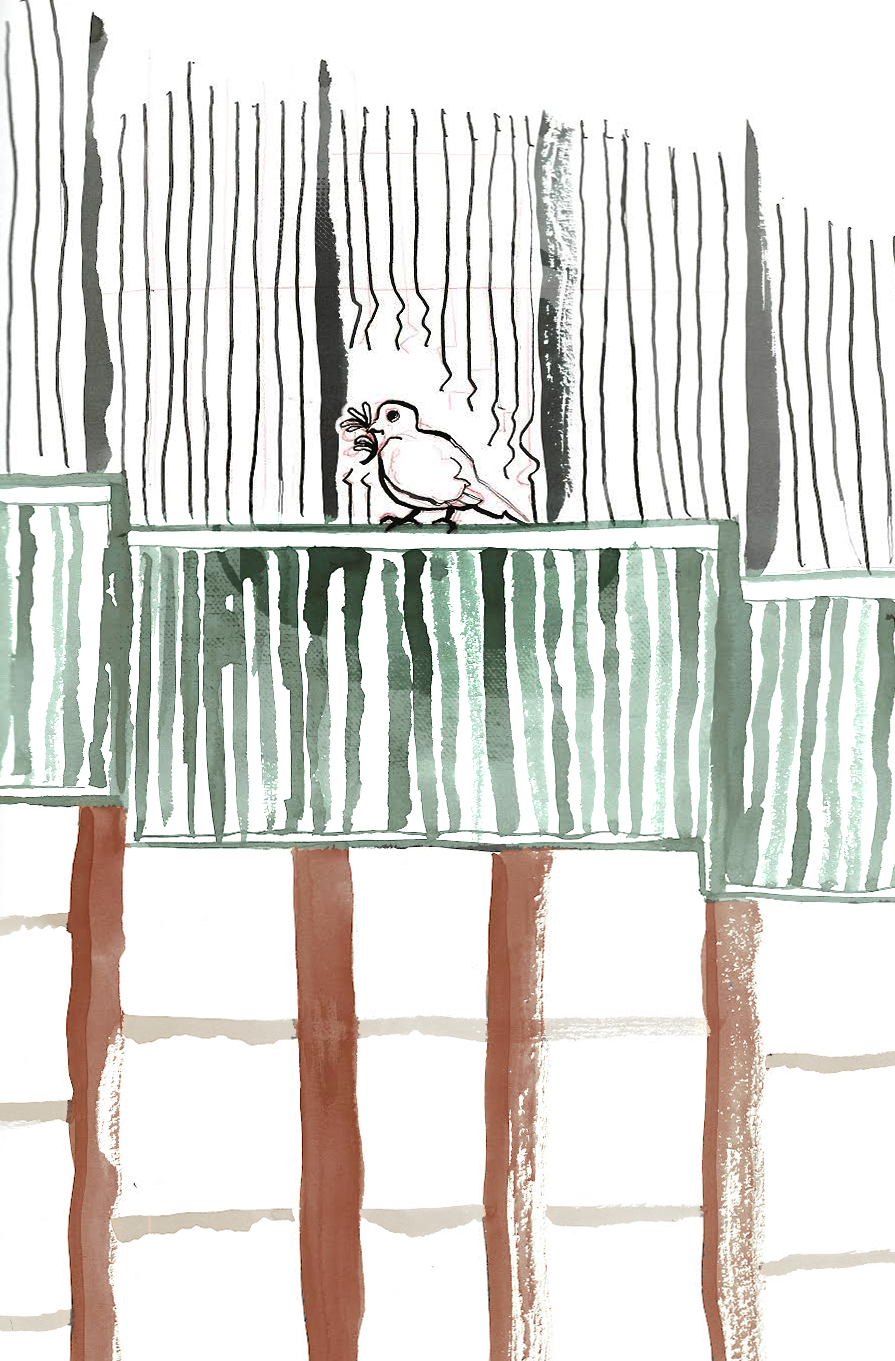
The year preceding that summer, nonviolent protestors had been campaigning throughout Northern Ireland to end housing, policing, and voting discrimination against the Catholic minority. Friction sparked, with violence surrounding the protests steadily increasing. By the time marching season began, the cities of Northern Ireland were already threatening to boil over: Catholics took the Orange Order’s parades as provocative, and Catholic/Protestant skirmishes were common near the parade routes. In August of 1969, Loyalist crowds attacked Bombay Street off of Falls Road, burning 44 of the 65 houses on the street. By September, the British Army had constructed the first peace wall to segregate the two sects. Built of coiling barbed wire between steel rods stabbed into the ground, the five-foot-tall structure on Cupar Way partitioned the Catholic area of Falls Road and the Protestant area of Shankill Road.
Though initially a temporary measure to curb the rioting and unrest arising from the Northern Ireland Civil Rights Movement, they only increased in size and scope. Most, however, were built after the Good Friday Agreement of 1998, which ostensibly brought peace to Northern Ireland. These supposed peace walls—with their accordion steel plating, their crowns of barbed wire or brutish fencing—knife sectarian gashes across Belfast. They cage the respective populations within their own sects, in a manner not unlike the separation of animals in zoos—preventing, theoretically, inter-species aggression, or worse: the feared “inter-breeding.” The more peaceful segments of the walls, which represent a pacified Belfast, feature inscriptions from venerated figures such as the Dalai Lama and Bill Clinton (who helped facilitate the Good Friday Agreement), or rousing murals depicting leaders of other social justice movements (MLK Jr., for one, or Nelson Mandela). Despite this, many walls carry vestigial sectarian graffiti spray-painting leftover sentiments from the Troubles. On the Protestant side, it is “Fenian” or “KAT” (“Kill All Taigs”); on the Catholic side, it is “proddy” or “hun.” Just ten feet from the walls on either side, however, sit the same weary brick homes under the same rainy Irish sky.
The Agreement ended 30 years of sectarian violence, and it also constructed a new government for the region. Northern Ireland was henceforth to have a consociational government, a theory of institutionalized power-sharing developed by political scientist Arend Lijphart for communities rife with ethnic conflict. As the peace walls segmented the city, Northern Ireland’s government was divvied into shares: a First Minister from one side, a Deputy First Minister from the other; cross-community voting on budget allocations and electing Speakers of Parliament; cultural autonomy, with Irish language activists having sovereign ability in organizing community life and cultural spaces. A peaceful, democratic government had been established, it seemed. This is how the West was won.
***
“In the next room,
His nightmares, grafted to the palace wall—
Dark cyclones, hosting, breaking; Saturn
Jewelled in the blood of his own children,
Gigantic Chaos turning his brute hips
Over the world.”
Seamus Heaney, “Summer 1969”
Just ten years before the Good Friday Agreement, political scientist Francis Fukuyama declared the End of History—humans had discovered the ideal government, liberal democracies with market economies. Man had thus finished his ideological evolution. Soviet hegemony was coming to a close, the Berlin Wall was falling, and Nelson Mandela had been released from prison. It was in this moment of swooping hope and glory in the world when Fukuyama argued his thesis. It was perhaps a manifestation of what Seamus Heaney was getting at in “The Cure at Troy”: “The longed-for tidal wave / Of justice can rise up, / and history and hope can rhyme.”
This poem, in the years after Heaney wrote it, came to symbolize the peace efforts of the 1990s in Northern Ireland. In a 2023 Washington Post article, Bill Clinton declared “[The Good Friday Agreement] has produced an entire generation in Northern Ireland that has grown up largely free from the horrors of sectarian violence, free to focus on solving problems and seizing opportunities.” Hope and history, he proclaimed, had rhymed.
But had it? Was the “…great sea-change / On the far side of revenge” that Heaney hoped for found in the peace walls segmenting Belfast, in the carefully divided government? Fukuyama, to be fair, had not sensed the end of all ethnic conflicts, nor had he claimed that there would be no more “events to fill the pages of Foreign Affairs.” He instead argued that the fundamental conflict over the best organization of society had ended—there would be no higher universal ideology to beat out liberalism. Yet Northern Ireland—a democratic, capitalist society, in all of its post-history Fukuyama glory—does not seem to be at the end of its story.
Michel Foucault, in his essay “The Subject and Power,” seems to agree. Foucault argues against Fukuyama’s teleological view of history, that his idea of history has a direction and an arbitrary endpoint. Instead of history culminating in a final synthesis or state of liberation, Foucault posits the relationship between power and freedom as “agonism,” a Greek term meaning a combat or struggle. Agonism is a “permanent provocation” that constitutes a “permanent political task inherent in all social existence.”
In Belfast, the continued presence of the peace walls, segregated neighborhoods, and divided schooling systems demonstrate that sectarian identity persists throughout everyday life. This continuance is evidence of the ongoing “agonism” that defines power relationships. In this sense, Northern Ireland does not represent a society that has moved beyond history, but one in which history acts as an active force, shaping subjects in the present.
Even as Northern Ireland formally operates as a liberal, capitalist democracy in the wake of the Good Friday Agreement, the country has not resolved into stability or consensus. The dialectical fragility of Northern Ireland does not eliminate the possibility of Northern Ireland plunging back into, in Fukuyaman terms, “history.” Stormont, the seat of Northern Ireland’s Parliament, often sits empty: the government has repeatedly stalled or collapsed, revealing the fragility of a nation built on unresolved sectarian divisions. Violence, though significantly reduced, has not disappeared; instead, it persists in sporadic forms, driven by groups pursuing specific ideological or territorial aims. The Agreement itself, while successful in ending widespread conflict, left key questions—justice for victims of the Troubles, treatment of societal divisions, the occasion of the next border poll (a referendum on a united Ireland)—deliberately open-ended. Even within the structures of liberal democracy, Northern Ireland shows how competing histories continue to generate tension, resisting any notion of a final political or ideological settlement.
The past which Francisco Goya painted—the Napoleonic executions in Spain—mirrors the Troubles of which Heaney writes. He articulates how his country’s conflict follows the same pattern of power and repression as all things before. Saturn eats the children he has reared, as history eats the fruit it has borne. Chaos remains turning his brute hips over Northern Ireland.
***
“Also, that holmgang
Where two berserks club each other to death
For honour’s sake, greaved in a bog, and sinking.
He painted with his fists and elbows, flourished
The stained cape of his heart as history charged.”
Seamus Heaney, “Summer 1969”
Foucault, in the same essay, defines power beyond the traditional sense: not as property held by individuals or institutions which forces obedience, but instead a relational action that operates everywhere to shape behavior. This form of power shapes individuals into subjects: it “categorizes the individual, marks him by his own individuality, attaches him to his own identity, imposes a law of truth on him which he must recognize and which others have to recognize in him.” Foucault argues that modern political struggles are less about economic exploitation or domination, and more about subjugation—the process of being categorized and tied to an identity.
In this sense, the peace walls are physical analogues of what Foucault describes: one does not simply live in Belfast, but on one side of it. The typical rhythms of life—schooling, socializing, living—are filtered through these divisions. Inhabitants of Belfast are fissured by the peace walls but also in their society—they have become entrenched in their sectarian identities. Children grow up in neighborhoods where the “other side” is geographically proximate but socially distant. It is entirely possible for a Catholic to meet a Protestant for the first time at university. And while overt violence has largely ceased, the epistemology of the Troubles remains fractured on identity lines.
Yet just as this fragile equilibrium began to look permanent, history intervened once again. Brexit, the United Kingdom’s decision to leave the European Union, reopened questions that the Good Friday Agreement had, if not settled, at least deferred. The Agreement had depended in part on the softening of borders between North and South—Britain and Ireland—facilitated by shared EU membership. With that framework disrupted, the Irish question returned in full force, larger than it had in many years.
Brexit could, in some ways, be considered the end to the End of History. That thesis rested on the idea that governments would grow alike in democratic nature and people would grow alike in their capitalistic desires. It would be the end of tariffs and the beginning of an easy flow of money and workers. People would become worldly consumers more than nationalistic citizens. But Brexit happened nevertheless. It was antithetical to all of Fukuyama’s predictions: the UK tore apart its free trade deal with the rest of Europe, in doing so turning its back on the ultimate democratic-capitalist dream.
The question of whether Northern Ireland should remain aligned with the UK or move toward reunification with the Republic of Ireland has gained renewed urgency. The possibility of a border poll—once a distant hypothetical—now appears increasingly plausible. Demographic shifts, too, have altered the landscape—the war may ultimately be won with a simple Catholic majority. And with that comes the unsettling realization that the “end” of the Troubles may not preclude the beginning of something else.
Yet the “two berserks,” even if they have lowered their clubs, are still stuck in a metaphorical bog. Though the Agreement has led Northern Ireland through a period of peace almost as long as the duration of the Troubles, it simply mellows two irreconcilable ideologies. The only path forward for Unionists would be a move toward Irish unity. In the inverse, Loyalists wish for more recognition of their British identity, and never a united Ireland.
To say that history is not over is, in one sense, banal. But the case of Northern Ireland suggests a more specific claim: that history cannot be over because it is not a linear progression toward resolution, but a recursive process in which past and present continually reconfigure one another. The “end of history,” as Fukuyama conceived it, presumes a teleology. Northern Ireland reveals the limits of that vision.
Beyond the shadows of the peace walls, there is optimism in Belfast. Sections of the barriers are coming down now, replaced by shared spaces and community centers. On certain streets, the brutish metal gives way to open pavement, and for a few yards there is nothing to mark where one side ends and the other begins. Perhaps Belfast, to use the language of Foucault, is breaking out of subjugation. Citizens are beginning to target immediate forms of power, those barbed, harsh structures, rather than an abstract enemy.
Just beyond those openings, however, the walls resume. The struggle is ongoing. Marching season still occurs annually. The drums return, the flags fly once again, and the old struggles occur in the same old areas. The past remains present, as a living, evolving force. Hope and history may rhyme, as Heaney suggests, but they do not conclude the poem.
Sophie O’Connor is a contributing writer for the Nassau Weekly.