That night, we lay on the cots in the temp room, and I listened to the hail tapping on the windows. The hail scattered down in handfuls, and all night you could hear it knocking and dropping into the gutters. I did not want to sleep because I knew that if I ever shut my eyes in the dark and let myself go, my soul would go out of my body. I had been that way for a few months, ever since I was sucked up into the sea at night and felt it go out of me and off across the surface, then come back. I tried never to think about it, but it had started to pull away since then, in the nights, just at the moment of going off to sleep, and I could only stop it by a very great effort. So, while now I am fairly sure that it would not really have gone out, that winter I was unwilling to chance anything at all.
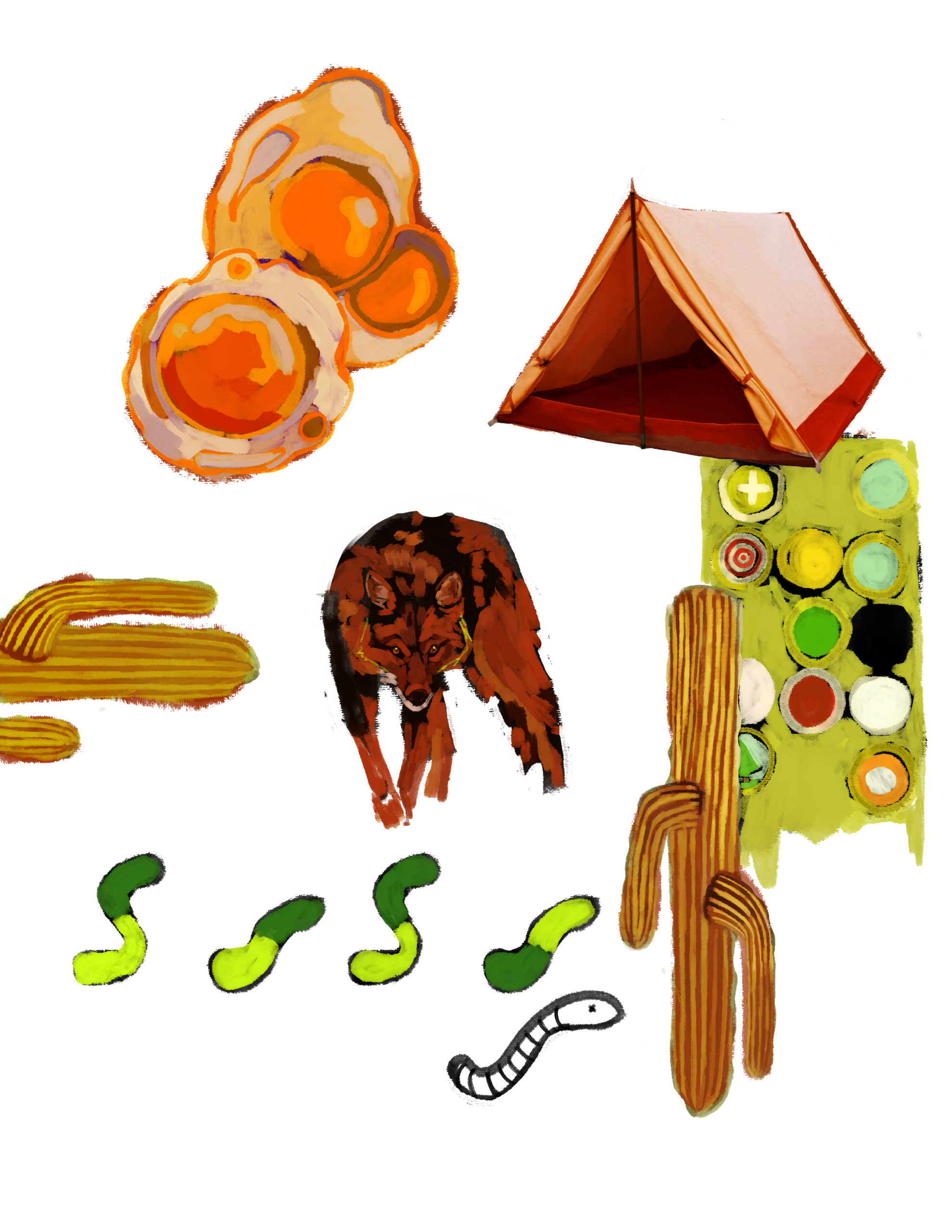
I had different ways of occupying myself while I lay awake. I would think of a desert road I had gone down when I was a Boy Scout and do the whole trip very carefully in my mind: the 2-D rock faces I watched intently along the highway, the gas station sour gummy worms, all the frightening, loud desert birds and the very early hikes. I would stop hiking at nine to flip pancakes on the camp stove and watch the overlapped coronas of batter begin to bubble and toast; or sometimes it would be oatmeal with globby peanut butter; or sometimes eggs, and I always ate last. I hunched over in the green camp chair with my spork and watched the fire smoke into the thin dry air. I would feel good that the other boys ate before me because I’d made them the good hot food and I could watch them wash up after me. Often, I could not identify the animals from the field atlas my stepmother had bought me because the troop tramped all over the open silent hills. I loved to look at it in the firelight and run my fingers over the watercolored portraits of the animals, their soft Latin names and the details of what they were meant to do, like nests at the bases of cacti or eat carrion. The atlas was too heavy to bring on the steep trails, and without the book I couldn’t identify the creatures. I had to zoom in tight around them with my burning hot cellphone and take photos for later. Sometimes, it was very difficult hiking with stiff straight legs to get ahead of bends and swaths of dry brush before the loud troop and see the kit foxes and cactus mice before they fled the exposed path, and often I could see none. Always, though, I found some kind of sign, a tuft of fur or piece of scat, but one time in the oasis I could find no sign at all and had to sit at the campground in the green camp chair to stare at the rock face across the desert while the sun mashed itself red into the horizon and to wait there for bighorn sheep.
Sometimes I would imagine how I would swat my skinny arms at the tiny bats that swarmed over the campground after dusk and watch them flap up in circles against the stars and neon nebulae. I knew they circled up and away, but to me, it looked like they stayed the same height and flew in flat spirals.
When I had finished too quickly, and the time did not go, I would remember the hike over again, starting where it opened out into the oasis and the ancient basin and going back over the crag again, looking alone for animals the troop might h
ave scared off. Some nights, too, I made up encounters with badgers or coyotes, and some of them were very exciting, and it was like being awake and dreaming. Some of those animals I still remember and think that I have seen them, the bobcat’s shocked round head and the coyote’s mean low eyes, and they are confused with animals I really have seen. If you took the highway and hiked the trail and camped out three days, three times over, very carefully, it took a long time and finally it would be light. Then you could go to sleep, if you were in a place where you could sleep in the daylight.
But on some nights I could not take the trip, and on those nights I was tacky in my sheets and tried to remember everything that had ever happened to me, starting from just before the flood and remembering back from one thing to another. I found I could only remember back to kindergarten on the steaming blacktop where we pushed Andrew down the slope in his wheelchair. Then I would start there and remember this way again, until I reached the flood.
I remember that, after Andrew got his cast off, we moved to Seal Beach to an apartment above a bakery. My friends were not at the new school, and I remember how sadly we kicked the kickball in a large white square before I had to go. I remember how their hair stuck in flat swirls to their sweating foreheads. But there were only muddled faces in the kickball games, no distinct noses or eyes like the coyote or the badger, and I could not remember their names even apart from Andrew, nor the kinds of things they said.
About the new apartment, I remember how my stepmother was always looking at the unblinking computer to check my grades on the school website. One time when my father was out snowboarding with his old judge friend, she went through his computer and found some photos of naked men and other long chains of messages. When my father came home and knocked the morning’s snow from his boots and put the gear away in the back closet, she had been waiting on the couch with her hands on her knees. He handed me his car keys and looked down at her.
“I saw your messages, dear,” she said and looked out the window. “The photos too. And Will saw.” My father looked at the hulking monitor, then down the hall that led to his closet office with the little computer. “Move the car to a spot, Will,” he said
to me. I went down the stairs to the street and turned on the car, which rumbled nicely. The fields in Nebraska were empty and quiet. There, my father taught me to drive when I was nine, when we visited his brothers. I was familiar now with the rules about parking and the street sweeping schedules and was good at parallel parking, too. I looked up at the apartment window but couldn’t see through the glare except for the row of California atlases in the windowsill. The California Deserts Field Atlas was there, then, and the general edition, and the forest one with my encyclopedias also. I wished I had them in the car.
People lined up out the door of the bakery. Some people outside had brown paper bags seeped with sugar grease. The car squeaked when I swung it out of the spot and around the block, braking so smoothly that a passenger would hardly know we were slowing down, then parallel parked on the next block where street sweeping wouldn’t start until between 11 a.m. and 2 p.m. tomorrow.
I locked the car but had forgotten the house key in there with them, so I knocked for a while, but it was loud, he was shouting, so no one heard, and I sat on the doormat that said Hello in dark cursive and waited for a while there and looked at the ceiling and remembered the fish I saw once in Hawaii when we snorkeled, the ones colored like sunsets and the pressed flat ones. Now, I don’t much like to remember Hawaii, but I remember the doormat well and how impressed everyone was with my parking and the way my father and stepmother looked before I went to park the car, she more white and he more red than usual.
Some nights, though, I would get to that part and could not stand to remember the looks of the fish in the clear water. Then I would have to recognize that I absolutely could not think of the apartment and had to try something else. So on those nights, I would try to sing through every song I knew with the right timing to the words and sounds and then the three poems I knew and then the names of all the beaches and all the missions the Spanish had built and the names of the mountains, like Junipero Serra Peak, which was named for the man who started all of the missions and put the Native people into the reductions that spread disease and killed many people, and when I could not name any more missions or mountains or animals, I would just listen. And I do not remember a night during which you could not hear things. If I could have a light, I was not afraid to sleep because I knew that my soul would only go out of me if it were dark. So, of course, many nights I was where I could have a light, and then I slept because I was nearly always tired and often very sleepy. I fell asleep many times at my metal desk at the new school. And I am sure many times, too, that I slept without knowing it in the dark—but I never slept knowing it, and on this night I listened to the hail. You can hear the cars always streaming in a heavy way down PCH just outside the window, but this night there was hail. This week was the first time I had ever seen hail and the first time Southern California had seen it in thirty years. I lay with my eyes open and listened.
There was only one other person in this room, and she was awake too. I listened to her being awake for a long time. She could lie nearly as quietly as I could because she was used to laying beside my father, who would wake even at tiny noises. She turned over, and the spring of the cot squeaked. I moved too, so she would know I was awake. She had lived for two years away from us, then came back to Seal Beach last year just before the flood and began again doing the things she did before, like checking my grades and throwing out the cat litter. For
a long time before and for the two years away, she worked on adoption cases and visited the people who wanted a child to make sure the homes were safe. I heard her listening, so I moved again in the blankets.
“Can’t you sleep, Will?” she asked.
“No.”
“I can’t sleep either.”
“Why not?”
“I don’t know, baby.”
“Do you feel okay?”
“Yes. I feel okay. I just can’t sleep.”
“Should we talk?” I asked.
“Yes. What is there to talk about here.”
“This place is okay,” I said.
“Sure. It’s all right.”
“Tell me about the babies and the families.”
“Oh, I’ve told you that before.”
“Tell me about how you met my dad.”
“You know.”
“Was that him on the phone on Monday?”
“Yes, honey.”
“I bet he’s really good by now,” I said.
“I would hope so. By now. He’s been up there with your uncles and Judge Paterson a long time.”
“Did you ever hear that the best athletes are actually dumb? Like Agassi. He has to be dumb so he doesn’t think about being nervous and doesn’t care that he spends all his time hitting a ball with a racket.”
“Where did you hear that?”
“Don’t you think we’ll wake the neighbors up, talking?” I asked.
“No. They can’t hear. Anyway, the hail is so loud.”
“You can hear it going into the gutter. The metal sound.”
We were both quiet and listened to the hail.
“Will. Is there something we could talk about and help you sleep? I haven’t heard you sleep ever since we’ve been here.”
“I don’t know,” I said. “My ears still hurt from what happened with the water when
I was under. At night they bother me.”
“Just like me,” she said. “I should’ve had us stay with Aunt Lindsey. This place isn’t good for you.”
“Maybe it will get better.”
“Say, Will, what do you want to do when it’s over and we move back?”
“I’ll go on more trips. And I’ll talk to the boys at the new school. We’ll do kickball.”
“Will you stay in the Boy Scouts?”
“Maybe.”
“Do you want me to buy you new atlases? I can order them here for you to look at.”
“Maybe. I still have the one about the coasts. It was with Connor’s family still from the Catalina trip.”
“I’m glad you’ve got it.”
“I am too. I like it but I want the fires atlas and the Bay Area. Then I’ll have more for going north.”
The hail tapped for a while. Then she said, “Why don’t you try and go to sleep?”
“No. I’m wide awake now. I hope you can sleep though.”
“So young and you can’t sleep. I wish I could give you my sleep.”
“You get used to it. It just takes a while.”
“Are you worried about anything, Will? Anything on your mind?”
“No, Jackie. I don’t think so.”
“You should try a sport. Why don’t you join the soccer team? You could wear the big shin guards and eat clementines. You’d be so tired by the time you got home that there’d be nothing to think of except sleep.”
“I can’t run well enough.”
“You run fine. Anyone can play on the middle school team.”
“I’ll think about it.”
“You know some boys on the team, right?”
“Right.”
“Well, ask one of them about it and have them bring you to a practice. You’ll never regret it. Every young man should play a sport.”
“I’ll think about it.”
“Do it.”
“All right.”
“You’ll be glad for it.”
“All right,” I said. “Let’s try and sleep a while.”
“All right. But you remember what I said.”
I rolled over on my cot and was very quiet, and I listened to her breathing regularly. Then she started to snore. I listened to her snore for a long time, and then I stopped listening to her snore and listened to the hail dropping. It fell steadily, making a rapping on the windows. I thought of the boys I knew who played soccer and what I would look like in the uniform and how good I would be—if I would be good enough for people to cheer for me and love me. It was a very interesting thing to think about, and for a while it was better than camping and interfe
red with my remembering. Finally, though, I went back to the hiking and the desert because I found that I could remember all the animals and there was always something new about them, though I wished I had the atlases to remember for sure. The soccer boys, after I thought of them a few times, blurred, and I could not call them into my mind, and finally they all blurred and all became rather the same, and I gave up thinking of them altogether.
Does anyone have a new atlas for Claire Beeli?
Leave a Reply