In my freshman year, I took on the long-delayed responsibility of digitizing the Nassau Weekly’s archive, without realizing exactly how much work the task would demand. I had recently been awarded the role of Nass Historian, and I wanted to make an impression. This was my shot. In the corner of the Nass room sit a few filing cabinets containing decades of previous issues, dating all the way back to the magazine’s inception in 1979. The issues had accumulated over the years and there was little intention to organization: issues were misfiled, some had crumbled and ripped pages, and others were even missing entirely. The older the issue, the more yellow and brittle it was. One motion and the pages would rip. Undeterred, I got to work. I flipped through every file of every cabinet, carefully cataloging exactly what we had in storage and subsequently organized them onto a massive datasheet. I often spent hours a session cataloging those issues before emerging from the Nass chamber with ink on my fingertips due to the oxidized newsprint. That pile of magazines was both deferred paper and deferred responsibility, and newsprint does not age gracefully enough to be deferred forever.
It would take a year for me to catalog every issue in our storage and another to arrange their official digitization through the Princeton University Library. Soon, around 11,000 pages of Nass history will be available to everyone through the public domain. Within my time as Historian, and eventually Co-Managing Editor, I have sifted through more of the Nass past than perhaps anyone currently on staff. What that process made clear is that the history of the Nass is not simply a record of issues printed and distributed. It is the story of an institution that survived when it probably should not have, rebuilt every few years by people who had never managed a publication before. This is that story, set down here for the Nass alum and the curious reader who has not yet found their place on campus to write.
The Nass was not produced out of some vacuum: there was a single-issue publication that preceded it. It was called Friday. Launched in the spring of 1979 by a group of University Press Club writers—among them Marc Fisher ‘80, Steve Reiss ‘79, and Sue Krones ‘79. Friday spawned out of a growing thirst for bold journalism. It was an ambitious project with longform profiles, arts criticism, and strong reviews. Unfortunately, the project was perhaps too ambitious and they could only scrape up enough money for its one issue. But their journey did not conclude there.
In the following summer, the founding members of Friday met again with a clearer sense of direction. Fisher recruited two entrepreneurial business managers, David Bookbinder ‘82 and Andrew Carnegie Rose ‘82 to manage the financial side of their new paper, something which was overlooked in the one prior. Plus, Rose had a car. Fisher also expanded his team to Robert Faggen ‘82. David Remnick ‘81, and Alex Wolff ‘79. This team, including many others not named here, found the journalism scene at Princeton to be stilted; neither The Daily Princetonian nor the Press Club offered what they were looking for. They wanted to write about life beyond the Orange Bubble, to critically engage with arts, culture, and the sciences in ways campus journalism had never attempted; they wanted to bring the texture of the wider world into conversation with campus life rather than shutting it out. And so they made another paper and settled on the name “Nassau,” surprised that no other on-campus publication had claimed the title first. The Nassau Weekly would have its debut issue the following fall.
That first issue was produced under conditions that would be unrecognizable to any current Nass staffer. The team had to lease a typesetting machine, an expensive behemoth that occupied half a room, onto which writers would type their copy directly, column by column, with no margin for error. A single typo meant reprinting the entire piece, cutting it out, and gluing it back down onto the layout page. Every night before printing, the members would often pull all-nighters in order to put the paper to bed, the room heavy with the smell of adhesive and pressure of a deadline in equal measure. It was, by all rights, an absurd way to put out a newspaper. But issue after issue, somehow, it worked.
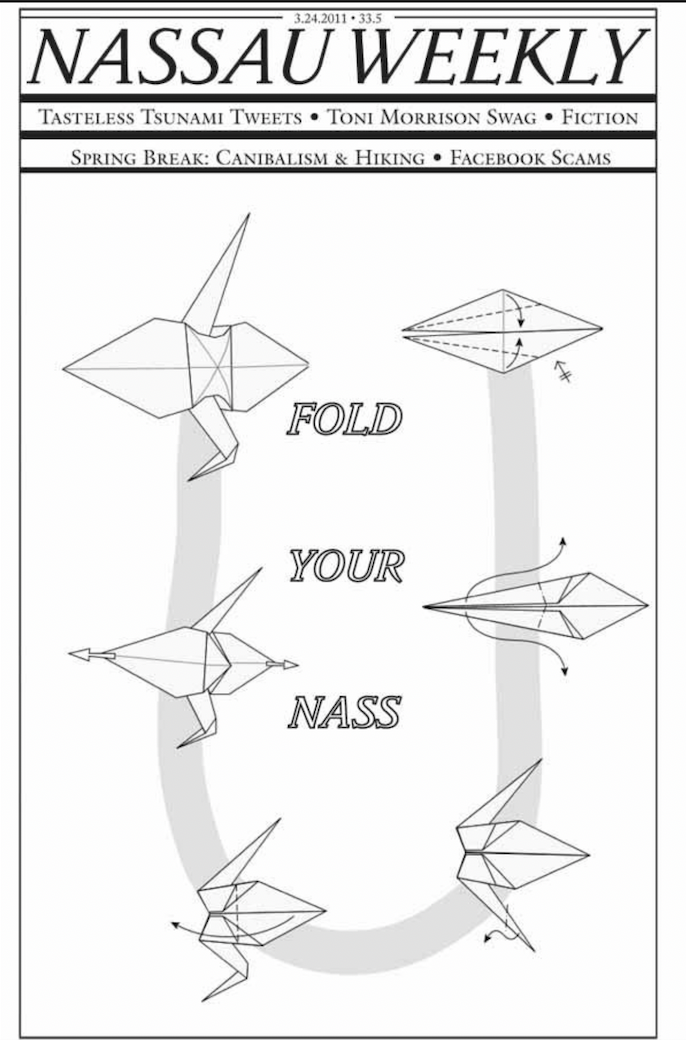
That was until one problem grew too big to ignore: the publication was broke. Printing costs, typesetting fees, and an accumulated phone bill the staff hadn’t known existed pushed the paper to the edge of collapse. By the early 1980s, the debt had grown to roughly $35,000, the equivalent of nearly $100,000 today. It was Sharon Lowe ‘85, the paper’s first female publisher, who pulled the Nass back from the brink. In early 1985, she walked into Nassau Hall and convinced the Dean of Students to forgive a significant portion of the debt and, in a stroke of unlikely good fortune, to furnish the Nass room with a set of the newly released Apple Macintosh computers.
Over time, the paper evolved. The reporting that was prominent in the early days of the Nass eventually gave way to something looser and stranger: essays, criticism, humor, the quintessential verbatims and a brand of irreverence that became the Nass’ signature. What had begun as an alternative newspaper became something harder to categorize. The physical paper itself changed over the years as well. The old newsprint was changed into the modern magazine-style print we distribute today, and just last year we expanded its page size to accommodate even more writing. Our basecamp moved from Holder tower to the basement of Bloomberg. We moved on from the Macintosh computers as well, which can still be found in the Nass room. Today, our Audiovisual department is as large and serious as ever, and we have revamped our editing process to ensure more credible and rigorous writing. The Nass, as it turns out, does not only move forward. Sometimes it reaches back. In 2024, former EICs Alex Norbrook ‘26 and Frankie Salinsky-Duryea ‘26 launched the debut issue of Second Look, our dedicated journalistic section that appears in almost every issue to date, returning to the journalistic spirit out of which the Nass was born.
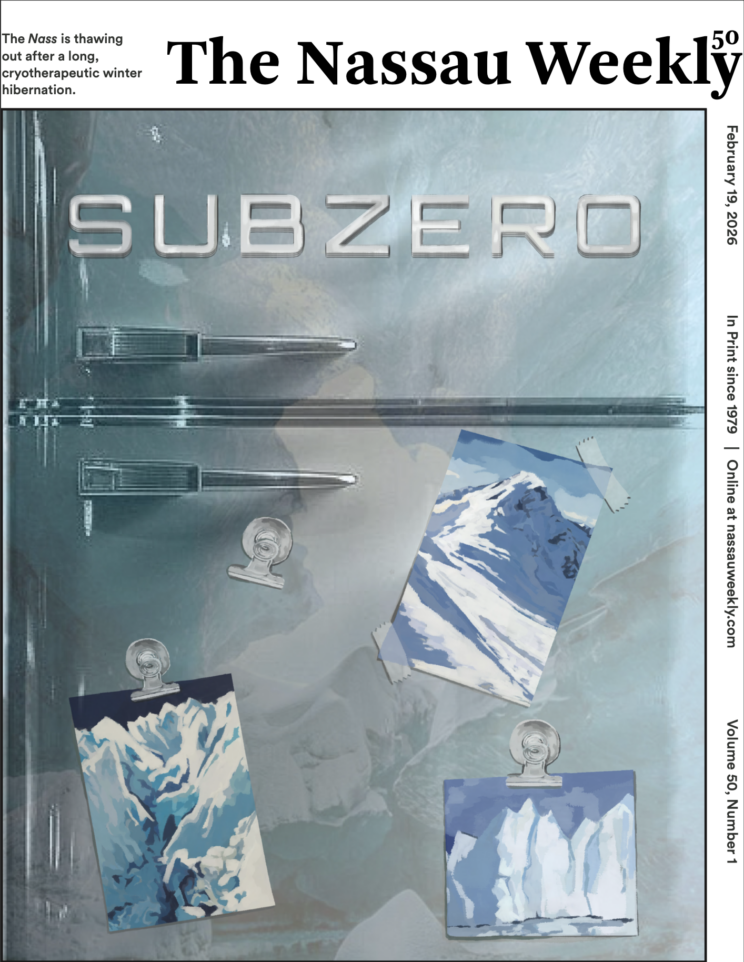
Now 46 years in, there is no projecting how long any of this will last. The Nass has known moments of genuine precarity, years when it was not at all clear whether another issue would follow the last. But here we are. Those 11,000 pages, once yellowing in the corner of a basement room, will soon be readable by anyone in the world, and that feels like proof enough that something worth preserving has been happening here for a long time. This account is only a piece of the full history and is only able to hold so many names, so many stories, and the ones left out are no less a part of what the Nass was or is. The Nass will keep happening, I think. Maybe out of defiance of its death, maybe out of that restless desire to write which brought the whole thing into existence in the first place.
Former Managing Editor Jonathan Dolce is currently studying a broad. He now knows her very well.