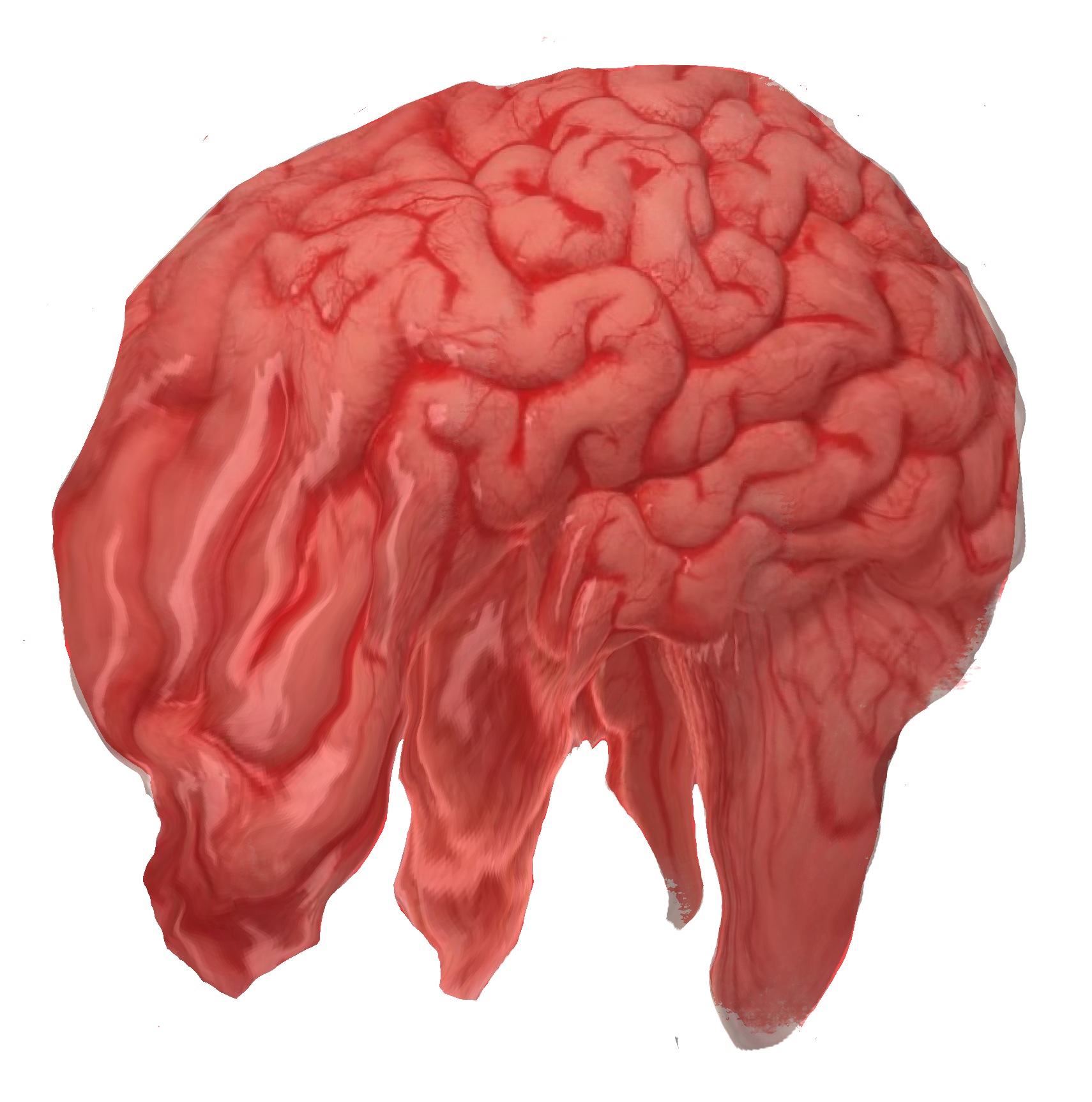
These days, I do a lot more thinking than I used to. I’ve always had thoughts, but like most people, I wasn’t really thinking. Thoughts were clouds in the sky that passed over me—I was aware of their presence, but I didn’t really consider them. Thinking is the process of looking up at these clouds and identifying their shapes as something other than a blob. Recently, I’ve been thinking a lot about these clouds and what they mean to me.
I started thinking in December. December was when I started meditating. I had been off all forms of social media for about a month at that point because I wanted to be a more present person. I started meditating because I wanted to become a calmer person, and I had decided that “You are what you eat” would become my mantra for the end of the year. “You are what you eat” did not simply refer to eating, but rather the fact that you are your consumption, and therefore, you are what you choose. By meditating daily, I thought I’d become a more relaxed, reflective person. So, I would finish each day by looking up “10-minute meditation” on Spotify. “Take a deep breath,” some soft soothing voice murmured through my headphones, “Make sure you’re sitting in a comfortable position.” I would become hyper-aware of my position. Am I comfortable? Am I sitting up straight? Do I have scoliosis because I slouch? Wow, that’s crazy that I have scoliosis. Stop thinking about this. Focus on the meditation. Focus on the meditation. Focus. What should I wear tomorrow? Focus. Do I have the attention span of a goldfish? What if goldfish have a really good attention span? What if when I open my eyes a stranger is standing in my bedroom? Don’t open your eyes! I’m going to open my eyes. I open my eyes. No one is there. Great, now the meditation is ruined.
In meditation, breathwork is key. Take a deep breath and hold it and let it out and whatnot. The point of breathwork is to focus on one specific thing you’re doing in order to become more in touch with yourself. Breathing, like many of our thoughts, is automatic, so we don’t think twice about it. During breathwork, all I was supposed to think about was breathing. “Hold for five,” the meditation would say. I wondered if I was going to pass out. Noted that I should take a deeper breath next time. Remarked that I was breathing right then. Also, wasn’t it crazy I was alive? This whole thing was crazy.
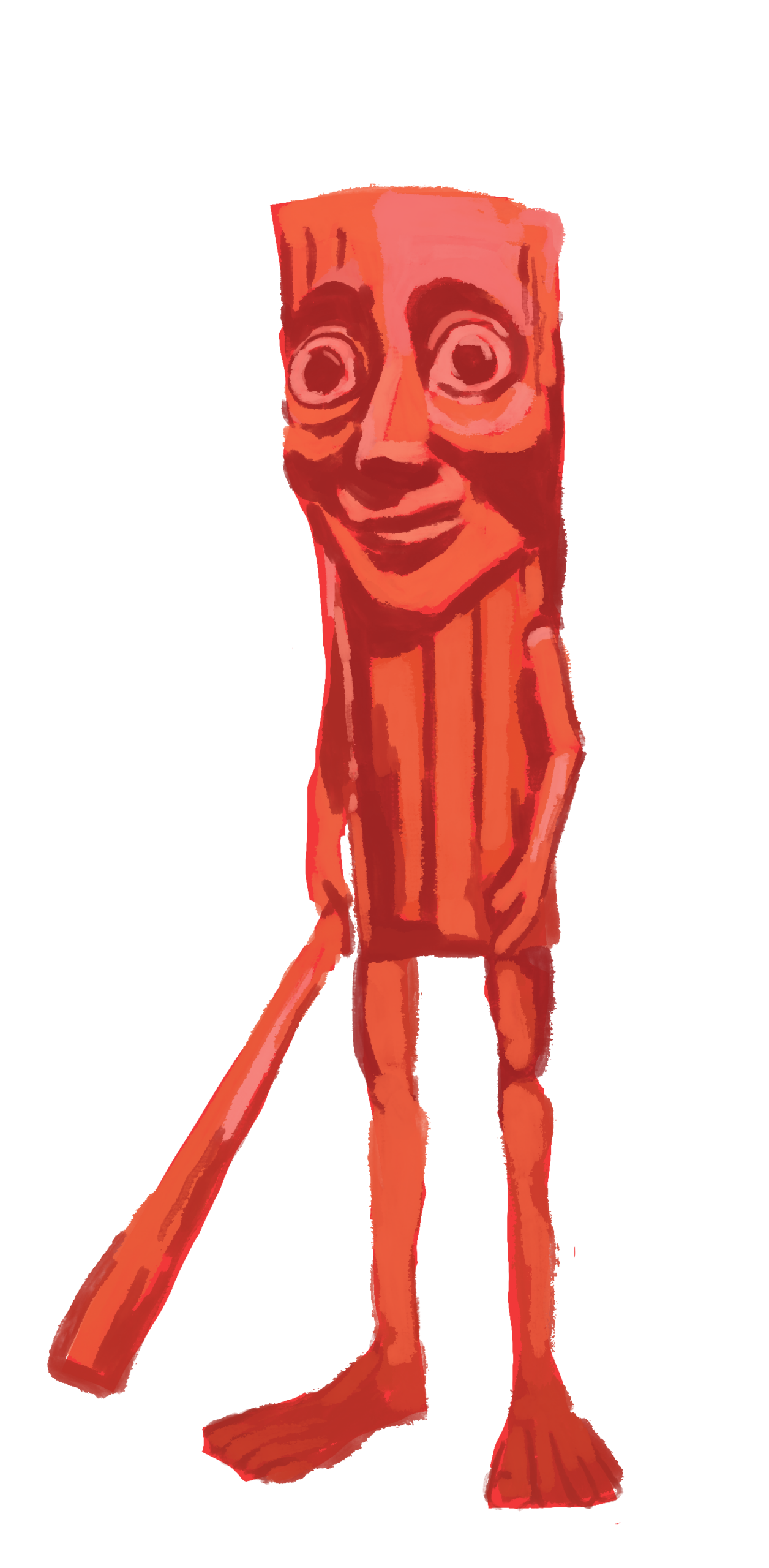
Like my breathing, most of my thinking was done without thought or regard. For example, a good meal was not acknowledged as good but rather experienced as pleasant. A nice perfume inspired a resmelling of the bottle without analysis. But laughter—once a chipper, automatic reaction—paused. On an icy day, I watched out the window as a girl slipped and fell. My friend next to me laughed. I stared, plain-faced. A year ago, I probably would’ve laughed. I remember crying tears of laughter as I watched a kid get knocked out by a sled last winter. I didn’t have any remorse over that, but still, I didn’t laugh this time. I noticed after that I hadn’t been laughing as much. I particularly noticed the discrepancy between my laughter and others’ when I looked at the six-seven phenomenon. In class, the phrase six-seven was laughed at again and again, whether it was referenced as a data point, a time, a year—anytime it was there, it was laughed at. Six-seven came out of nowhere to me—I first heard about it in my writing seminar, and when everyone laughed as the professor listed his office hours I, like he, was confused about what was so funny about this number.
Six-seven appeared over and over again, and again and again, everyone laughed. My senses felt not as attuned to my classmates; though I could recognize fire at the smell of smoke like any of my classmates, I could not recognize the humor of six-seven. Now, I see, six-seven is funny because it is a joke, and it is a joke because it is funny. It’s “brainrot,” which means it’s funny for its lack of meaning. I was pissed—I thought I’d missed out on a piece of cultural news, an awards show snafu perhaps. But I had only missed the instruction that six-seven was supposed to be funny. I had spent hours simply breathing to try to find myself, whereas those around me found pleasure in nothing. I will admit to my pretentiousness now—why don’t people want substance? Six-seven and the shift of the zeitgeist to brainrot signals a substantive change in our society; we want speed. We want immediate laughter triggers—Chicken Jockey, Hawk Tuah, Skibidi Toilet—things that require little background are simply funny because they are. Whatever happened to jokes that start with, “A guy walks into a bar”? Where did the puns go? As someone who envisions a potential career in screenwriting for comedy, six-seven casts doubt on my future endeavours. Six-seven might effortlessly make you chuckle, but shows like Veep, 30 Rock, How I Met Your Mother—to name a few—will have you slapping your knee while simultaneously questioning your place in society. Humor at its best reveals intricate, amusing societal truths. Is six-seven the standard now? Will the work I want to produce become pretentious or too inaccessible for a brain-rotted generation? That’s why six-seven disappoints me; the truth that it represents is the erasure of complexity.
Six-seven parallels the rise of OpenAI. As six-seven came to prominence, so did ChatGPT. As we started to laugh at six-seven, we started to turn to ChatGPT to do our homework, write our emails, analyze social situations—really, just do anything we did not feel like. Six-seven and ChatGPT’s simultaneity reveal the rise of laziness in society. It’s not a crime to not want to do your homework. What interests me, though, is the number of college students who regularly use “Chat” to read their assigned readings—isn’t the point of college to learn? This too, I’ve realized is not the case—for many, college is simply the stepping stone into making six figures as a consultant. Six-seven and ChatGPT are the diluents of society, normalizing a world where finding depth is a luxury. In the worst world, humor devolves solely into brainrot. We stop thinking critically—more six-sevens pop up, and laughter becomes automatic and robotic. AI takes over all of our jobs—coding first, then the media, then doctors. Politicians will stay employed, of course. Then, we become subordinate to the robots, the corporations, and the government, assuming the corporations did not attempt to take total control. We would’ve been able to stop it, of course, if instead of asking AI to write our essays for us, we did our own research and writing to find our own conclusions. AI functions on its ability to predict what we are most likely to say, but we have the power of thought: AI cannot predict what “different” idea we might have. It can only conceive of the common.
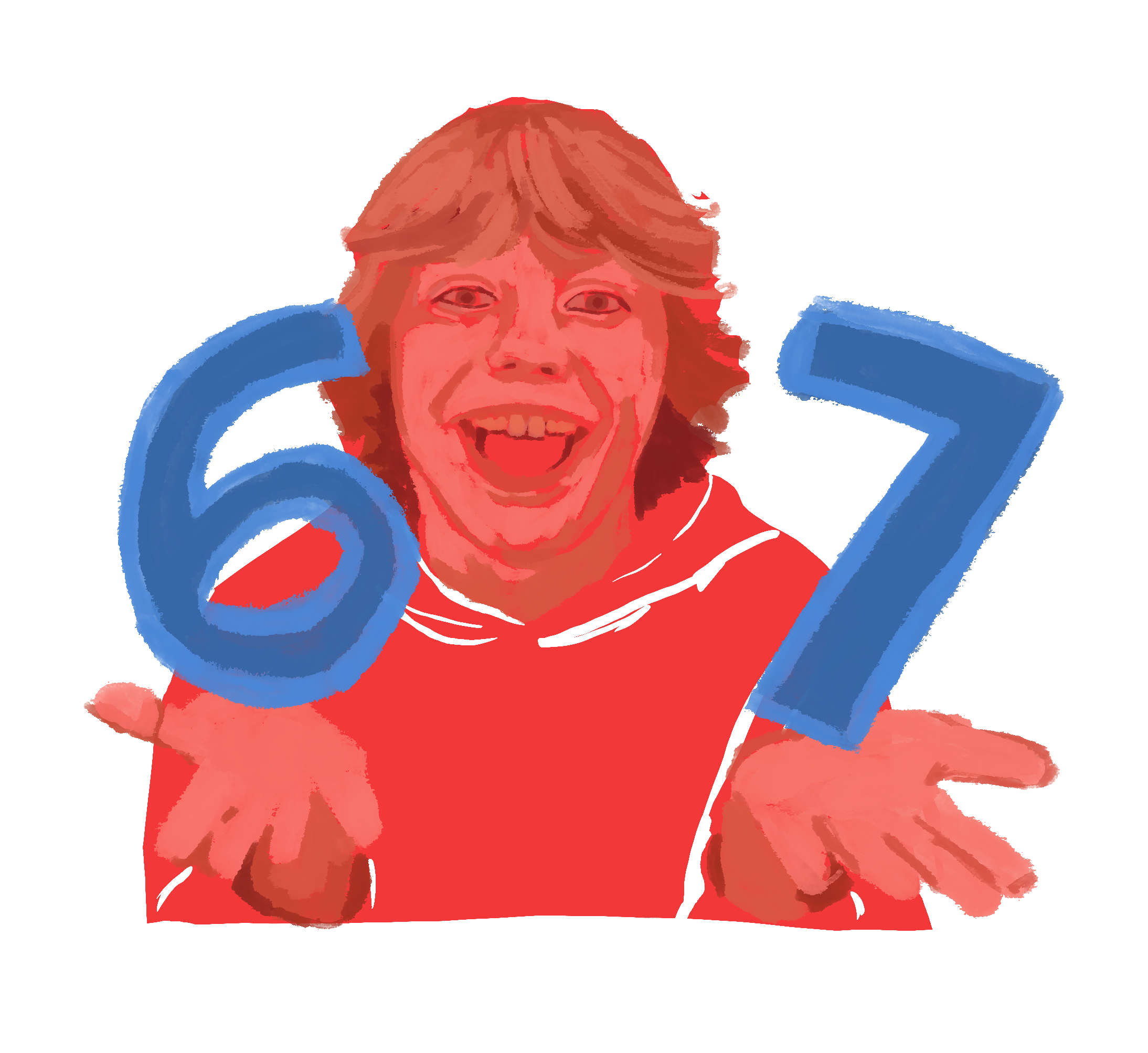
There are benefits to brainrot. I can immediately recognize that it has provided a universal humor. Six-seven was something that a football player, an a cappella singer, and a physicist could all laugh at in my writing seminar. But brainrot also forces a lack of thinking. We don’t question the humor of these jokes—we don’t question why a word or image is funny, and often we don’t need to look up at these clouds and analyze their shapes and effects and whatnot. We do not need to think all the time, but when we lose the ability to think, we lose ourselves completely. My meditation once asked me who I was—was I my body, my voice, my thoughts, or the observer of my thoughts? If we cannot recognize our thoughts, we will not be able to recognize anything else. And if we don’t look at the clouds, we won’t notice them darkening.
Unc status has no age limit for Soa Andriamananjara.