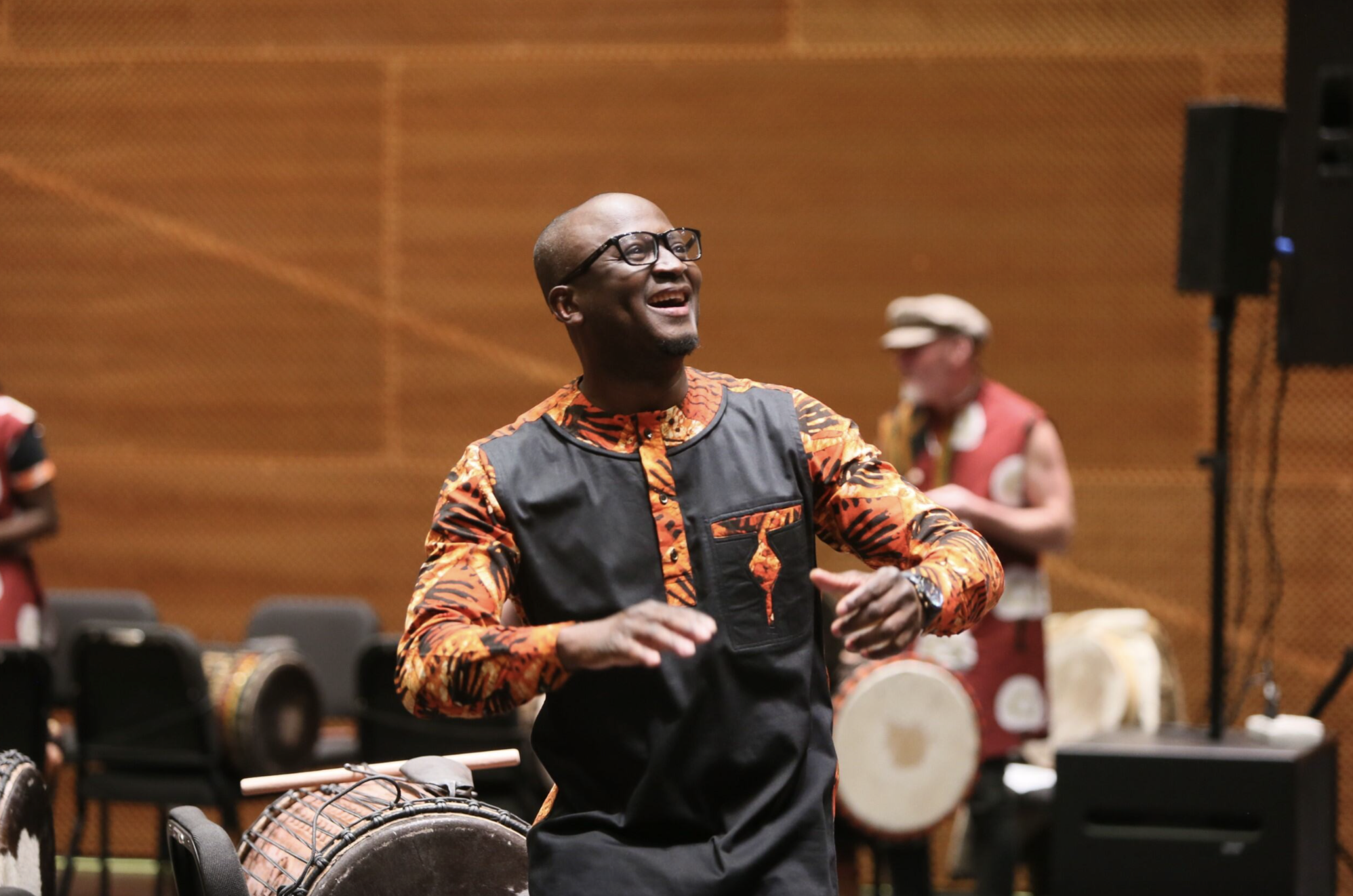
Every Tuesday night, Olivier Tarpaga, senior lecturer in music and director of African Music Ensembles at Princeton, stays late in the Lee Music Performance and Rehearsal Room. Inside, the award-winning choreographer composes music, welcomes community members, and flits between student saxophonists, professional guitarists, and drummers. All the while, students chitchat, a father and daughter practice rhythms, and a barefoot mother passes out kazoos. For just three hours a week, you could join this cheerful, slightly chaotic group too—it’s Tarpaga’s Afrobeat Ensemble.
Afrobeat (not to be confused with Afrobeats) was created by Fela Kuti in the 1960s. It is a jazz-traditional Yoruba-funk fusion inspired by West African percussive rhythms. Tarpaga showcases Afrobeat because “it’s important that people understand the beauty, this raw creativity, and the power of music from Africa.” To punctuate his point, he told me, “You can search it: this is the only Afrobeat ensemble at any university in the United States.” I looked it up. I couldn’t find any others.
I met with Tarpaga on a Tuesday evening, before rehearsal. We didn’t meet in his office. Visitors were in there, he explained, as he guided me to a practice room. As we walked, he dodged my questions—so subtly I wouldn’t have noticed it had an ensemble-member not warned me of Tarpaga’s humility the week prior—instead redirecting the conversation towards me. He congratulated me on having submitted a paper. I thanked him; he thanked me for writing this piece.
Once inside, I noticed how his all-black outfit—neatly tied together with a sleek black fedora—contrasted with the sterile white walls. He insisted on giving me the chair and he tucked himself into the corner on a wooden stool, nursing a cup of tea (with two different teabags) in his hands. When I left half an hour later, it was empty.
Before coming to the U.S., Tarpaga grew up in a multilingual household in Ouagadougou, Burkina Faso. His father was a saxophonist for Super Volta, a popular Burkinabé 1960s funk band, and hosted rehearsals on their family compound. “I was just a little kid dancing around in my underwear,” Tarpaga reminisced, mimicking a childlike voice. “The band would finish practicing and I’d go in, and I’d play all kinds of stuff. I’d break instruments. It was fun.”
Despite growing up with music, Tarpaga said that his father always “had other plans” for him. “They didn’t work out! I was like the rebel,” he quipped. He continued to dance, and he continued to play and “break instruments.” At 16, Tarpaga was selected to join acclaimed Burkinabé performing arts company, Le Bourgeon du Burkina. Since then, Tarpaga has composed and choreographed numerous works called “irresistably groovy” by The New York Times; course reviewers consider his Princeton classes “super fun and so engaging.” Before making his way to Princeton, he taught in many states and over 60 countries: “I’m a nomad,” he said. And when I asked him to tell me about himself, he left all of that out. Looking me in the eye, he replied, simply, “I am a musician, a choreographer.”
I asked him if he had a favorite artistic medium.
In Burkina Faso and most of West Africa, he explained, dance and music are considered one body: “Music doesn’t exist without movement; movement cannot exist without music.”
In response, Tarpaga chuckled. “That would be dangerous. Because I can’t highlight my dance more than my music.”
Tarpaga’s work blends West African artistic tradition with contemporary urban styles. Part of how he brings this tradition to life is through his compositional method. Tarpaga was trained in the ancient West African oral tradition. This process, he believes, makes sure “artists feel the music, understand the music, embody the music. And it becomes natural.”
He straightened his back. “Everyday,” he began, “I wake up, I sing in my car. I stop my car on the road and just start recording music and rhythms and phrases and melodies.” He started playing the air-guitar (rather meticulously—his fingers even formed the chords): “I don’t wait to get to the studio. I take my phone, and I sing everything.” He scatted. “That’s the bass, that’s the drums, that’s gonna be the guitar.”
This method extends to the Afrobeat Ensemble as well. Nothing is written, no musical score is handed out to the 13 drummers, the two guitarists, the two xylophonists, the four winds and brass players, or the single pianist. Tarpaga sings the various drum parts to his assistant, who then teaches the group in a call-and-response fashion.
A week before we spoke, I went to the ensemble’s rehearsal. They were learning a new piece, but not a music sheet was in sight.
As the drummers perfected rhythms and the clarinetist riffed, Tarpaga walked around, offering corrections and greeting latecomers. The rehearsal space echoed with a chaotic euphony, each instrumental section practicing different melodies at different pitches. At this point no one knows what the final iteration will sound like.
Except for Tarpaga. “In my head, I know how everything is going to go. They have no idea.”
Then comes the big reveal: “It comes together, like boom, boom, boom!” He smiled as he pictured his ensemble members’ faces. The gleam in his eyes matched that of the glossed piano.
As our time neared its end, I asked him why students should join the ensemble. First, he corrected me: the Afrobeat ensemble is open to the “Princeton community”—students, faculty, and staff.
Then, he laughed. “You will leave practice with a big smile.” He looked down at his now-empty cup, growing more ponderous. “You will learn something new. It’s urban African music. It’s happy; its rhythm is positivity. It’s just different.”
I closed my notebook and packed my backpack. “I know you’re going to write about ‘who’s Olivier?’” he added as he stood up. “Say Olivier speaks four languages”—Mooré, his father’s language; Dioula, his mother’s language; French—“and English is number four.”
But it occurs to me that he actually speaks one more: music.

Willa Mack is a contributing writer for Second Look.