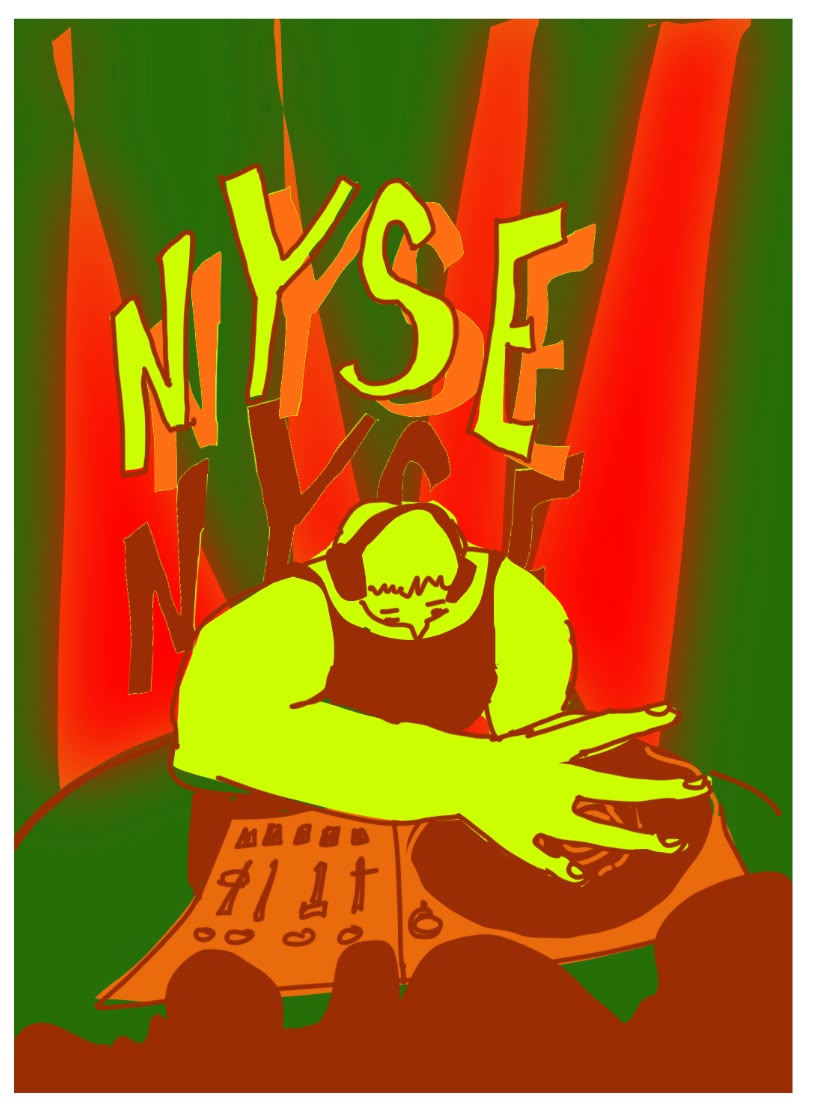
On September 18th, hours after closing for the day, the New York Stock Exchange welcomed John Summit. Instead of its typical sterile white light, flashing green lasers filled the room. Summit, dressed in a double-breasted gray suit, stood at the front of the room; behind him, alongside the NYSE logo, a screen displayed a graph of Summit’s imagined stock value rising. Summit pumped his fist to his remix of Daft Punk’s “One More Time,” while a crowd, half dressed in black and half donning khakis and button-ups, stretched their bodies towards Summit, craning their necks to see him. The stunt, a secret pop-up before his Experts Only festival, was sponsored by CashApp and Visa. Just 9 months before, Summit had tweeted “almost every dj at the top right now is boring as fuck / i swear money makes everyone complacent.”
The New York Stock Exchange is the heart of the corporate world. It’s famously been featured in The Wolf of Wall Street and The Dark Knight Rises, where white button-up-wearing men yell at everything on the trading floor. Despite being previously opened to the public, licensed stockbrokers and “Designated Market Makers” who have successfully applied for membership are now the only non-celebrities that can set foot inside. When a company goes public, a bell-ringing ceremony is held, often attended by celebrities and the ultra rich. The NYSE is the pinnacle of Wall Street—it is the physical embodiment of American capitalism. So why throw a party there?
John Schuster, known more commonly as the DJ John Summit, discovered DJing as a student at the University of Illinois Urbana-Champaign, where he was a member of the Delta Tau Delta fraternity. Growing up in the Chicago suburbs, Summit was vaguely familiar with the EDM music scene, having annually attended Lollapalooza starting when he was 16. Later in college, Summit would spend weekends at various music festivals, where he saw artists like Kaskade and deadmau5. He began DJing during his sophomore year: “I was a bartender at this bar, and I got fired,” he told Miami New Times, “but I still wanted to work there. They said, ‘We need a DJ.’ So, I said, ‘Well, good, because I can DJ.’” Soon after, Summit began to DJ at local bars and clubs on $200 equipment.
After graduating, Summit went on to get a master’s and become a Certified Public Accountant at Ernst and Young—one of the largest privately owned companies in America. “Literally the most soul sucking job,” Summit described, “It was one of those things where you become an accountant, you get an accounting job—unless for some reason you love it—because it’s safe… health insurance, all that.” He worked 12-hour days before going home to his apartment to produce music, often sending hundreds of demos to various record labels. As Summit’s commitment to music increased, he began to show up late to work and leave early in order to produce music and play sets, later joking, “Apparently going on benders isn’t a good excuse for missing work in the corporate world.” In 2019, he was fired, so when the pandemic hit in 2020, Summit was able to spend a significant amount of time at home working on music. That year, Summit sent the single “Deep End” to Defected Records, who recognized the song’s potential. They quickly signed Summit, and the song was an immediate hit. A snippet that goes “I’ve been tryin’ not to go off the deep end / I don’t think you wanna give me a reason” even went viral on TikTok. Despite his disdain for corporate work, Summit has expressed gratitude for his time as an accountant: “People don’t realise how much business is involved in the music industry. Royalties, signing remixes, managers, agents; so much money moving around. It’s good to know basic accounting.”
Summit is perhaps a bit too aware of the business in the music industry. Though his latest album, CTRL ESCAPE, focuses on his supposed exit from the corporate world, Summit’s tour is a strong return to it. His tour, like his NYSE outing, is sponsored by Visa and Cashapp. Even before his NYSE party, Summit threw a “corporate rave,” co-hosted by LinkedIn and Spotify. This performance took place in an office building, where the walls showed a blue projection of the label “Summit CPA,” and Summit, dressed in a white-button up and tie, mixed behind a literal office desk. Guests even received their invitations through LinkedIn messaging.
Instead of playing clubs and festivals like fellow DJs Peggy Gou, David Guetta, and Dom Dolla, Summit has embarked on an arena tour for this album, the kind usually reserved for pop stars like Harry Styles or Ariana Grande. Similarly, Summit’s tickets cost no less than one hundred dollars. His shows are staged as performances rather than parties; Summit stands alone, on a platform high above the audience. Not accounting for elevation, there’s probably a solid thirty feet between Summit and his audience. Moreover, Summit is not at the front of the room; he is in the center of it. His audience surrounds him, watching as orange lasers shoot out from under him. By placing himself at the center of the room, elevated above the common people’s ground, Summit has made himself, rather than his music, the focal point of the night. There’s something a bit feudal about this whole situation, where Summit is both the king and the court jester. The DJ booth is his altar, and his subjects, paying hundreds of dollars for a chance to see him, reach their phone-clad hands to him in worship. In return, Summit smiles and throws his arms in the air, forming a cross with his body. And lest you forget where you are, a projection of “Summit” adorns all four walls.
“I feel like I’m rooted in the underground,” Summit once declared to the Miami New Times. Chicago, Summit’s hometown, is the birthplace of house music, and Summit is certainly aware of the benefit of growing up around the area, explaining “Learning how to DJ in a place like Chicago also helped me really hone my proper house and techno DJ sets.” The term “house” stems from the iconic Chicago club The Warehouse, where, in the eighties, DJs began to combine disco and electronic music. A four-beat kickdrum, loud bass, and limited lyrics—all of which mainstream audiences hated in disco—were all fundamental to house music. Chip E, the “architect of house,” described house music as “made for the dance floor… It’s not made to be listened to while you’re sitting down.” At Summit’s arena tour, tickets are bought by the seat. Besides its unique sound, The Warehouse also had a distinct audience of Black and Latino gay men; the club acted as a haven for those facing exclusion from their religious communities. In fact, the club was a members-only group, so the house community was extremely protective over its spaces—so much so that Frankie Knuckles, the “Godfather of House Music,” quit his residency at The Warehouse when the club’s promoters abandoned formal membership and doubled the cover fee. He went on to open The Power Plant—a new members-only club—where much of The Warehouse’s clientele migrated.
PLUR—an acronym standing for “Peace, Love, Unity, and Respect”—is the general code of conduct in rave culture. Raves started in the 80s as various geographic music scenes—Chicago house, Detroit techno, and New York garage, notably—arose. Raves were underground, often days-long parties fueled with alternative music and experimentation. The underground aspect of raving, which stemmed from the need to prevent the police from shutting them down, was key to their success; raves often took place in illegal locations, cost nothing (or if they had a cover, they were “pay what you’re willing”), and embraced recreational drug use, which when all combined, created a sense of ecstasy and community. Today, however, raving, while still having underground aspects, can also refer to attending massive commercial EDM festivals. This version of raving often costs hundreds of dollars, creating a fundamental divide between underground raving and corporate raving. Corporate raves are massively advertised and documented; underground raves are more lowkey, often only being announced day-of and being discovered through word-of-mouth. The publicization of these corporate raves, importantly, requires performance: at a corporate rave, audiences have paid significant sums, leading to high expectations. This forces organizers, often music executives, to create large spectacles of flashy lights and big-name DJs. As a result, corporate raves focus on bravado, and the P in PLUR comes to stand for performance. The focus at a John Summit set, then, is John Summit—it is not on the music, it is not on the community, and it is certainly not on the dancing. What is John Summit doing up there? Is this show worth it? Could I get behind the booth near him? a corporate raver might wonder while looking up at Summit’s altar.
When a rave is at its best, PLUR is high: strangers compliment each other like best friends, bodies face one another instead of the DJ, and the shared experience of movement creates a sacred space. Basement, one of New York’s biggest techno clubs, writes on its website, “We hope you come for the music, to support the artists we present, and to enjoy a liberated environment for everyone.” NYC Rave Girls, a promoter group, specifically instructs rave-goers to “say hi to someone new.” And critically, the dance floor is not a concert: Shared experience and communal movement make the dancefloor sacred space. Bringing the dance floor to the NYSE trading floors is like wearing neon to a funeral. Traditional raves attract an intentionally alternative audience, whereas a John Summit rave literally invites stockbrokers. Is the corporate office really the space we want to take the dance floor to? When raves are hosted on Wall Street, the rebelliousness that defines rave culture disappears. Rage against the machine becomes rave inside the machine.
There’s a photo on Summit’s Instagram of him shirtless and shiny with sweat behind his DJ table at Breakaway Festival 2025. The photo’s caption reads “after this past weekend i better hear no one talk trash about my crowds again.” The last photo in this specific post is a screenshot of his tweets, in which he compliments his own crowd, saying, “seems like the real ones going for the music have stuck around and the ones who just came when it got popular have filtered out, or maybe it’s because i’ve been choosing the right events lately… ” As of late, Summit’s events have only been his own: his own festival, his own tour, his own name everywhere. Before the NYSE set, Summit tweeted “another casual week in the office” accompanied with photos of himself in a white button up behind a deck. The music video of “LIGHTS GO OUT,” the lead single from CTRL ESCAPE, depicts Summit and his supposed co-workers rebelling against the corporate world by throwing up their papers and dancing, all while chanting “Where do we go when the lights go out?” The answer? Apparently, nowhere.
Soa Andriamananjara, Princeton’s resident DJ, is busy raving. Or is she raging?
Leave a Reply