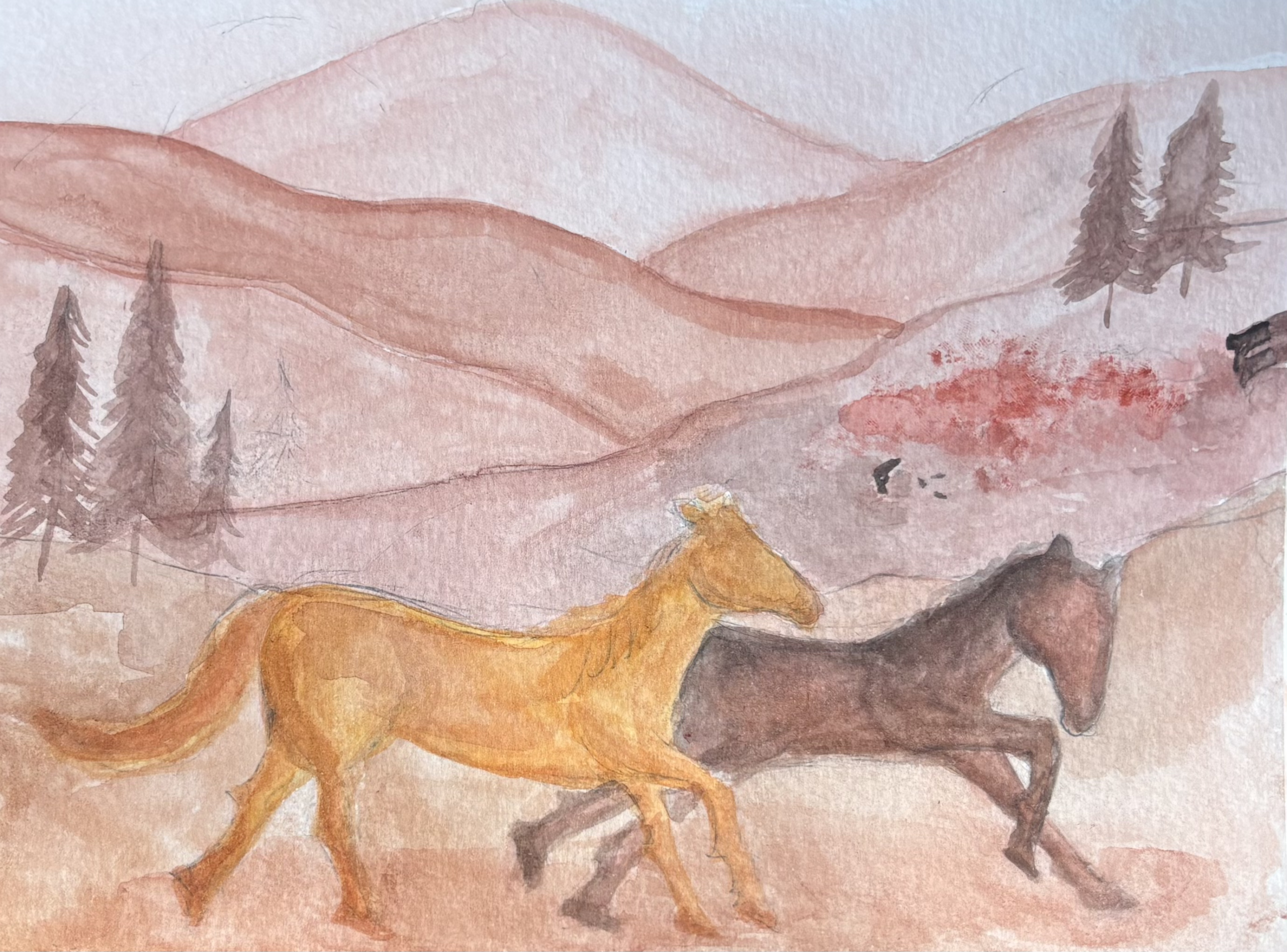
I find myself sitting on the floor of my dorm room, waving my arms about, as I relate to my friends the gravity of Kalin March and Landry Gatestone scaling the Upecksay Headwall—and on horseback! My fingers trace the air, trying to carve out the face of Katanogos, the faint pattern of ledges rising thousands of feet high, maybe the moon above, eclipsed by snowfall. Do you understand, Alex Honnold is nothing compared to this. These are two children with three horses and a mule too! In a snowstorm at night! While being shot at!
They are unimpressed. My arms fall limp beside me. It’s no use.
To understand Kalin scaling the Upecksay Headwall, my friends must first understand how he scaled Aster Scree while the earth gave way beneath him, a scree that broke the legs of Egan Porch’s horse, Cavalry. But then I must explain that Egan Porch is hunting Kalin and Landry to prove to his father Old Porch that he is “the real horseradish,” then I must explain why it is Kalin and Landry he is hunting rather than Kalin and Tom, and then I must explain how Tom Gatestone died.
I am talking about Tom’s Crossing, Mark Z. Danielewski’s newest neo-Western novel, a gutsy 1,200-page endeavor with an ensemble of characters so prodigious it borders on absurd. It is a story one must talk about, a story about how people talk about stories—or rather, one story, whether it is called Landry’s Ride or Pillars Meadow or Old Porch or Tom’s Crossing. But talking about this story is like gathering water from Altar Lake in my hands: something always slips through.
As I was abandoning this essay before I’d even begun, a figure with long sandy hair and a turquoise bolo tie presented himself to me: Cal Carneros. Cal first appears on page 917 as the owner of the Time Gallery, whose exhibition opened on February 29, 2000, in Houston, Texas. The show features artworks related to the events that took place between October 27 and October 31, 1982 in Orvop, Utah. On opening night, Cal makes his way through the maze of pieces he hung himself, has seen dozens of times, and considers amateur at best. A mule drawn with white chalk on gray paper. Lemon cake painted on a paper plate. Lariats and reatas. A glass case containing a human nail caked with blood. Pencil sketches titled Between Paddock A and Paddock B. A child’s pink rain jacket. He passes through these records, and “Cal Carneros didn’t have a clue how any of this went together, but somehow in the name of a logic he couldn’t track, it weren’t particularly discordant either.”
I trail Cal because, in many ways, he serves as a model for you, the reader. While I could tell you how Old Porch ripped off his fingernail before jabbing his soon-to-be infected thumb at a map and tracing the route of two teenagers through Isatch Canyon, you, like Cal, would feel lost. And if you were to press me for details, all I could give you is “I rightly don’t know how to give you the short of it.” Nevertheless, as a bewildered Cal passes from Chamber to Chamber in the gallery, he feels a thrumming in the pieces, yoked by spectres: “Oh, Cal was in the cemetery now! Right there on the edge of the grave!” I too can offer only tatters of this epic, or gestures of its characters, but I hope they are enough for you to sense the weight of what haunts them.
Let us follow Cal as he approaches a sculpture titled Old Porch in the Rain: “Somehow the bronze, though, achieved the storm at war, outside of as well as within this Old Porch, one hand pressin a mug against his swole belly, the other hand reachin up as if searchin for a handhold in the heavens to keep hisself from topplin over. Or if not to hold then grab, like a rifle over a door that weren’t there?” This is a fine place to start. Orwin Porch, “Old Porch,” is the villain of this story.
The bronze depicts the moment when Old Porch is assaulted by a vision of his youngest son’s death, and his conscience betrays him: “Old Porch’s guts full-on revolted then, and up it come, provin hisself no better than Kelly’s weak innards, the same innards, except Old Porch refused the comin, he weren’t no weak sister, first catchin the molten divulgence in his throat, like the mean thing he was.” We see here that Old Porch is human, he has a body like our own that can become sick and die. Still, he is incomprehensible. We don’t understand how a father can be so cruel to his children, and yet all they want is for him to bring them a cold beer and say he is proud. We don’t understand how the youngest Porch came to collapse in his brother’s home, blood slipping through the floorboards. Russell Porch, who returned from Isatch Canyon that night, gladdened by the thought of having made two new friends to see in school the next morning. Returned to announce to his father that he bartered a deal with Landry Gatestone, getting twenty dollars for those two horses, more than they were worth. Even if he left the family Colt Peacemaker with Landry in the mountains.
Old Porch shoots people when their backs are turned. Old Porch butchers his favorite mule Effy, like his own Iphigenia. His appetite is for chewing tobacco and mountains. Old Porch makes Tom’s Crossing more than an Odyssey. He makes this about the enduring conflict between Good and Evil.
Just as Old Porch is wholly evil, Kalin March is goodness. His journey is one of uncomplicated ambition. He will ride to the backside of Katanogos. He will set Mouse and Navidad free at the gateposts. He will do this because he swore it to Tom in the hospital room, and because he loves the horses. He cares for their hooves, rubs their legs, feeds them oats and apples, and urges them forward: “Instead of dismountin, Kalin patted Navidad’s neck and whispered in her ear what needed whisperin. He didn’t even dig his knees in none, nor tap his heels to her side; she knew what needed doin and did it.” Kalin is remarkably selfless. He makes sure Landry and the horses have enough to eat, even if he starves. He believes that “It ain’t good enuf to wanna be free… Every dang livin thing wants to be free. It’s elemental I reckon. But like my momma taught me, and it’s how I see things too: to matter you gotta set free someone that ain’t you.”
What Danielewski has done with his novel is unleash forces of Good and Evil upon the Utah Valley. Old Porch and Kalin embody moral extremities—“it was hard to defend Old Porch as an agathokakological creature”—so they seem more like heroes of classical mythology than people we might encounter in real life. Indeed, characters often compare Kalin to Orpheus or Achilles; one can just imagine the hands of gods guiding Kalin up those screes, or guiding Old Porch’s bullets. Yet there are no gods in this story—only ghosts, who care not for good or evil. The ghosts do not control the living; instead, they serve as evidence of the violence committed by the first Mormon settlers. Danielewski thus invokes superhuman forces only to locate their origins in the human, a tension that runs throughout the novel. Old Porch is pitiful, unable even to repair the cracks in his house’s windows, and Kalin is awkward and clumsy, mocked at school for the shoes he wears.
Danielewski continues to borrow the familiar machinery of myth only to strip it of its sense. He toys with fate, placing a Chekhov’s gun—the Colt Peacemaker—in Landry’s saddlebag for the duration of the journey. Its presence confirms our expectation that when Good and Evil share a battlefield they are destined to clash and leave bodies in their wake; we have seen it time and time again in Milton, Tolkien, Steinbeck, McCarthy. But in Tom’s Crossing, this battle is an unbalanced one. The Porch clan mount their ATVs and hunt Kalin and Landry like animals, while Kalin is focused solely on freeing Navidad and Mouse, and recoils from the sight of a gun. The image of grown men hunting fifteen-year-olds begins to unsettle us. It makes the fated showdown at Pillars Meadow, when Kalin finally wields the Colt and massacres the Porches, read more as a tragedy than as the deliverance of justice. We mourn that Kalin has become complicit in the violence he has tried so hard to resist. Kalin’s deftness with guns, remarkable as it is in this scene, is a burden on his slight frame. He limps onto Pillars Meadow, remembering his mother’s warning: “you but touch a gun and what you love most will forsake you for the rest of your life.” When Kalin leaves the meadow, her curse is fulfilled and the horses shrink from his presence. What has been set up as the familiar triumph of Good over Evil instead becomes a senseless display of violence.
And what do we make of the fact that, in a novel where every death we witness is a murder, the death that began it all—Tom’s—was caused by cancer? Senseless.
Stories of good versus evil are meant to offer us a safe framework for understanding conflict. They teach children to recognize justice; they invoke greater forces of fate and divinity and apply them to human actions. But Tom’s Crossing refuses this comfort. It insists on senseless tragedy, on violence as a writhing, volatile thing that strikes down children. This depiction of good and evil could be dismissed as one of many that affirm “moral grayness,” but what sets Tom’s Crossing apart is that its ambiguity operates among unambiguous devices: Good, Evil, Fate, Power. In its simplest form, the story is cliché: the evil oligarch who wants to gobble up land and slaughter horses versus the kindhearted family who wants to protect horses. Danielewski refuses to sacrifice his archetypes, but neither does he allow them to organize his world into a stable moral order.
So how do we attach ourselves to this story? Why do the people of Orvop continue to speculate over it, reenact scenes from it, analogize it to Greek epics, and make artworks in its honor? For one, the story is resonant in its maximalist scale: the feats are staggering, the crimes shocking. We cannot help but wonder at Old Porch’s deranged psyche or at Tom’s ghost astride his horse. Tom’s Crossing is an epic of its own, one that re-enchants our modern world, drawing upon the mythos of the American West. For all its maximalism, the novel still manages tenderness. Its characters embody larger-than-life devotions, but they are far from one-dimensional; each possesses a specific humanity, down to every last Porch boy. We care for these characters, and begin to see how amid all the senselessness, the novel still believes in something. It muses on loss, on how the dead may find relief, on the inheritance of violence, and on friendship. The people of Orvop parse the tale, each finding one’s own meaning in it—whether in the solidarity of mothers, the greed of church leaders, or the memory of ghosts—even when Tom’s Crossing insists that it was only ever about two horses being set free.
Scarlett Huntington is good.
Leave a Reply