Freud’s Eternal Apartment


Left: Freud Museum London | Right: Sigmund Freud Museum, Vienna
Sigmund Freud’s apartment in Vienna is markedly different from his London home. In London, the house is fully preserved as Freud had occupied it during his last years, containing ornate Persian rugs scattered across his study and his extensive collection of antique figurines. In contrast, Freud’s Viennese apartment, vacated when he escaped the Anschluss in 1938, remains empty. Nothing—not his original psychoanalytic couch, nor his desk where he predicted the very threat that would ultimately drive him out of Nazi-occupied Austria—is recreated.

The empty room, which once contained Freud’s original psychoanalytic sofa
Only behind traces of old wallpaper can we see Freud’s former occupancy in the Viennese apartment. Showcased photographs capture Freud sitting in the same spot as the display. Tracing through these disembodied images, an incomprehensible feeling bubbled up within me: How am I in the same space that Freud was once in?
I had the fortune of studying at the Sigmund Freud Museum, colloquially known by its address “Berggasse 19,” in the summer of 2023 through a Princeton-funded global seminar in Austria. While most Freud enthusiasts would have salivated at this opportunity, I confess that I had no experience with Freud other than crass jokes about his Oedipus complex or his topical fixation on anal eroticism.
Nearly 94 years before that summer, Freud wrote Civilization and Its Discontents in Berggasse 19. In the book, Freud described that there is a problem of preservation in the mind. He attempted to illustrate this mental phenomenon through the pictorial example of the “Eternal City,” or Rome. Freud translated Rome as not a space of “human habitation, but a psychical entity, [where] all the earlier phases of development continue to exist alongside the latest ones.” This Eternal City has sites containing buildings that exist simultaneously with its predecessors and successors: “Where the Colosseum now stands, we could at the same time admire Nero’s vanished Golden House.”
Ultimately, Freud contended that his attempt to represent mental life in pictorial terms was impossible. Representing the past of the mind as a “historical sequence in spatial terms” cannot happen as “the same space cannot have two different contents.” He concluded that “a city is thus a priori unsuited for a comparison of this sort with a mental organism,” and that “only in the mind is such preservation of all the earlier stages alongside the final form possible.”
But maybe Freud’s wild goose chase wasn’t in vain. Perhaps a city can represent mental life. Occupying a space, and especially one of historical significance, I feel a rush, a weird affection that people in the past were living in the same space that I now stand in. That summer in Vienna, how was I casually eating a McDonald’s burger after class on the same doorsteps that Freud used daily? The feeling carries over to Princeton—the battered steps up McCosh 50 give material evidence of the centuries of students who have preceded me and have gradually weathered the same staircases I step on now.
In the material world, space looks like a palimpsest, where physical traces of the past coexist in the present. Mentally, my existence in space is complicated by a feeling of simultaneous cohabitation with infinite other instances across time. In quantum mechanics, this feeling is measured and quantified as a “qubit,” where there is a superposition of both states in a bit: “0” and “1.” In this feeling, the superpositioned bits are not binary; it is not a logical switch between feeling the “present” state of a space and then its past. No, the bits extend endlessly across time. This affection is explored by eternalism, where time (past, present, future) concurrently exists in a four-dimensional, block universe; I have also heard that this feeling is alluded to by Derrida’s theory of hauntology, where the past haunts the present. Nowhere are these thoughts more overwhelmingly present than in Berggasse 19: perhaps a more apt name for the place would be the “Eternal Apartment.”
Freud’s Eternal Apartment demonstrates that material space cannot have simultaneous contents, as Freud himself had postulated. Instead, the apartment prompts visitors to mentally reconstruct the space in response to the voidness of the internal architecture. As I walked through the apartment, I imagined I was Freud himself, or one of his patients in the waiting room.


Left: The layers of wallpaper whisper about what once occupied the space while a security camera watches below.
Right: “The waiting room was the only room for which the ‘Sigmund Freud Museum’ attempted a reconstruction.”
This feeling was even more amplified when I met Dr. Gohar Homayounpour, author of Persian Blues, Psychoanalysis and Mourning, at Berggasse 19. Dr. Homayounpour specializes in applying psychoanalysis to somatic skin symptoms. In Persian Blues, Homayounpour states that the skin condition of psoriasis in her patient, who developed it after leaving his family, is “a memorial site for unfinished mourning.” Painful patches of unfinished skin express and manifest the turmoil in the psyche rooted in the loss of home, identity, and a mourning of past life.
What if one applied Dr. Homayounpour’s psychoanalysis of somatic skin disorders to the architecture of Freud’s Eternal Apartment?

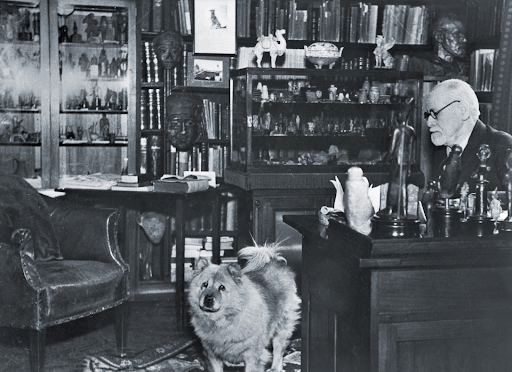
Left: Psoriasis of the Museum | Right: Photograph of Sigmund Freud near the same space as the left photograph
Going through the rooms of Freud’s apartment—specifically the study—feels congruent to exploring the spatialized chambers of Freud’s mind and its inner sanctums. The chambers are enveloped by walls, which are material witnesses to over 132 years of human occupancy. But they remain silent and disturbingly blank. The layers of wallpaper on them suggest a psoriasis of the building itself, where fragmented traces of original decorations exist as disparate, scab-like remains that the building’s skin has not completely shed off; a necropsy might be a more appropriate term than psychoanalysis in this case. The apartment building, gutted by Freud’s forcible vacation, is in a permanent state of unfinished mourning and melancholia. Freud himself wrote that the built environment of the Eternal City and the mind can become effaced and demolished by violence and trauma.
Here, Fanon’s thoughts on forward-looking, infrastructural projects of worldmaking after colonial violence can have interesting applications. In his The Wretched of the Earth, Fanon analyzes how colonial oppression is baked within the bodies, minds, and spaces of the colonized. As a solution, Fanon urges that “Imperialism…must be mercilessly rooted out from our land and from our minds.”
Freud’s Viennese apartment sits within a building constructed during the Austro-Hungarian Empire. The facade of Berggasse 19 reflects the imperial grandeur of the nearby Ringstrasse. Nevertheless, the Anschluss gutted out the building’s occupants and their material belongings during a period of fascist occupation, leaving Berggasse 19 empty in its post-conflict state. How do we approach post-conflict sites embedded by violence—whether it be colonial-era buildings in a post-colonial nation, or the emptiness of Freud’s apartment?
Fanon aimed to heal a diseased colonial state through the radically cleansing force of violence, which would serve as the foundation of a fresh, new society. Applied to architecture, Fanon may have wanted to raze colonial-era buildings in the postcolonial built environment. However, Fanon still recognized the sizable task of postcolonial reconstruction, and referenced that the colonial systems of the past “must pay up.” His idea of constructive reparations, as a result, exists somewhat awkwardly with the difficulty of complete divorcement from colonial or violent pasts—we cannot claim a postcolonial world is “new” without referencing the preceding world.


Left: Le Corbusier’s Palace of the Assembly in Chandigarh | Right: Louis Kahn, Bangladeshi National Assembly
This tension is embodied in South Asian postcolonial nations after British rule. Many of their parliamentary buildings, which housed and structured the newly independent governments, are of a brutalist, International Style, including Le Corbusier’s plan for Chandigarh and Louis Kahn’s Bangladeshi National Assembly. As Fredric Jameson characterized the postmodern through architectural analysis, Internationalist buildings were the zeitgeist of postcolonial nation-building and their efforts for global recognition. However, their aesthetics were hegemonized by Western, white, male architects who defined what “international” spaces ought to look like.
Freud’s Eternal Apartment represents a different side to spatial healing after conflict: how do we go back in time to a semi-ideal, pre-Anschluss state? Does one completely reconstruct the place to its original furnishings and decorations, to leave no trace of Freud’s forcible escape from Nazism? Or, does one leave the apartment empty for visitors as is?
There are efforts to harken back to a “pre-occupation” life, as seen by the Freud Museum London, which reconstructed the place as if Freud was still there. After independence from Spanish colonialism, post-revolutionary Mexican Muralists also approached visualizing a new Mexican society through pre-Columbian iconography. However, it is difficult to simply go back to an antebellum state in either case: space has been permanently marred by the violence it has witnessed. Conflict is irreversible.
As such, Berggasse 19 sits in an awkward middle ground between a retrospective approach to restoring sites according to pre-conflict nostalgia and a forward-looking project of constructing a wholly new post-conflict world. The dialectical difficulty of referencing the past and the present is architecturally embodied within Freud’s disorienting Viennese apartment.
In terms of the past, Freud’s Eternal Apartment situates viewers in a historical space through suggestive samples of prewar wallpaper, photographs of Freud’s family, and his personal effects scattered across the rooms.
Yet, the apartment still spatializes the tragic, post-conflict present. The whitewashed walls are emulative of the “cleansing force of violence” that Fanon emphasized—the gutting of the space leaves everything liquidated and disassembled. Instead of an aesthetic restoration to the apartment’s former glory, the abyss of loss in the present is conveyed through desolation.
In essence, both past and present are superpositioned in the Eternal Apartment. Such superposition is done immaterially, by utilizing the problem of preservation in the mind. While Fanon was obsessed with mastery over material resources to construct postcolonial superstructures, Berggasse 19 reconstructs the Eternal Apartment through an awkward emptiness that is unified by a mentally-defined augmented reality. For example, confronting the museum’s emptiness, my mind desperately tried to fill in the gaps, understanding the apartment as a discombobulating and simultaneous cohabitation of everyone and everything that had inhabited it before I heard Freud’s footsteps in 1929, saw the faces of Freud’s friends in the dining room, and felt the very breath that my lungs exhaled into the apartment. The apartment became a psycho-architectural palimpsest of a space, making the mind gather scrap-like artifacts together to create an incomprehensible collage of experiential affection across space-time.
In the Eternal Apartment, the only thing I could have done was to acknowledge and confront this feeling of superpositioned time in space. Unable to fully reconcile the cognitive dissonance between the apartment’s Freudian past and my present occupancy, I simply…existed, walking through the rooms for forty or so minutes. I was so overwhelmed by this eternalist feeling that I never walked through Freud’s third-floor apartment again. For the next seven weeks of my seminar, I exclusively stayed and studied in the upstairs classroom. Three years later, I am only now beginning to describe this sensation of the simultaneous cohabitation of space between the past and present. But during that summer, I just needed a reprieve.
Sol Choi recounts the time he found himself in Freud’s apartment for the Nassau Weekly, which kinda sounds like the beginning of a joke a less mature person would make… anyways, what’s the deal with airplane food?