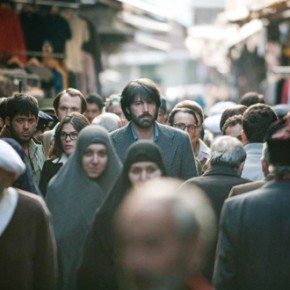
But the more I thought about this movie, the more I realized it simply gives an illusion of depth. A movie filmed with somewhat unconventional techniques, or featuring naturalistic dialogue and little plot, is automatically assumed to be “artsy” and thus philosophical, by association with the style of the French New Wave.
My parents put in uncommon efforts to raise my brother and me completely bilingual. Our mother (a Frenchwoman from Normandy) spoke only French to us, ever, our father (a New Yorker by way of Romania and Tunisia) only English. To build a wall of separation within us between French and English, they pretended not to understand when we addressed them in the wrong language.
The dining hall lurches with athletes. You sit down next to your friend’s maybe-roommate and she looks down at her own plate. “Wow,” she says, “you’re eating so little.”
It was 9 a.m. Awakened, as I often am, by sunlight, I opened my door to go to the bathroom downstairs. Supine, to the side of my door, was a male form, blonde and muscular and naked. His hands were cupped over his genitals, his underwear crumpled by his head. His eyes were closed. I froze in surprise, but I had to pee, and out of some ingrained politeness didn’t want to disturb him. I stepped over him quietly and went downstairs.
The following passage is adapted from the opening of Albert Camus’ The Plague, which is a description of Oran, a city in French Algeria, in the 1940s. I have translated it into English and into the setting of Princeton in 2013 (office jobs become classwork, going to the movies is replaced by the more common pastime of the Internet and so on), but those are the only changes I believe I have made.
As Princeton’s end-of-year-rituals bring to a close the first half of my time here, I’ve been thinking of milestones and the future and most of all about how much I’ll miss late meal.
Before the war, I often perched on the fence of the cow pasture to watch the trains go by. That was well before I was unable to stand the sound of trains. I had nothing else to do besides throwing rocks in the muddled Risle and memorizing geometry and morality lessons until everything mingled irremediably in my head. My only friend was Adam, though sometimes his cousin Anne, who was a year younger than we were—but just as sharp if not more—would tag along with us when we went down by the outskirts of town to smoke cigarettes and kick a ball back and forth.
Like any child of the millennium I’ve moved through several cell phones. Each served as a safety blanket, a confidant, a sort of external hard drive for my social life.