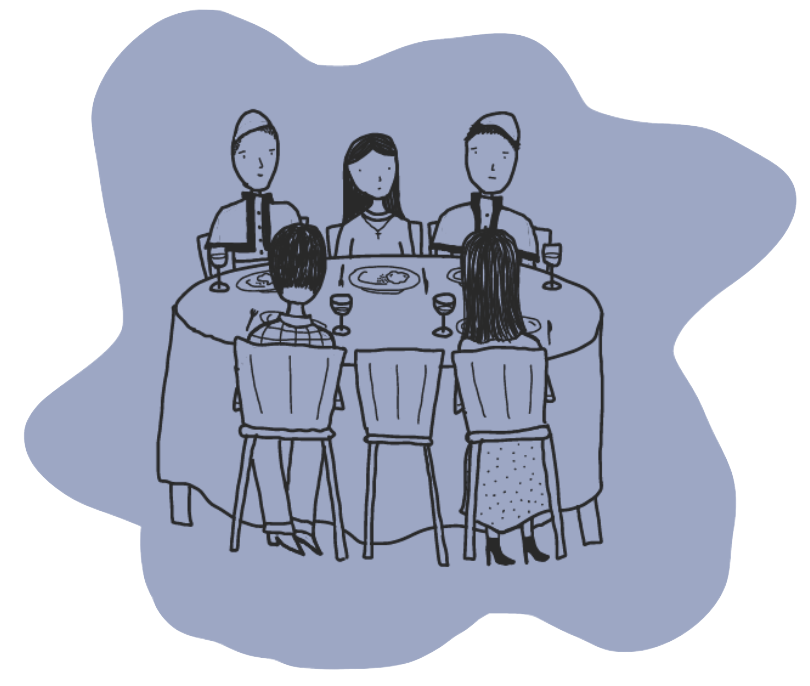
At the restaurant, while we waited for the rest of our party, I thought about the gates of heaven. It is a thought I often return to––I have always been fixated on accounts of near-death experiences. I stumbled upon them on the internet as a young child; I was particularly drawn to the image of a bright, overpowering light described in many of them, a light that consumed out from the middle like a divine flashlight. When I was seven, I held my breath underwater at the pool, trying to catch a glimpse of it. I still remember the lifeguard yanking me out by my underarms and throwing me on the deck like a big fish to twitch around and helplessly sputter water. It took months of convincing for my parents to believe that I had been expressing scientific curiosity rather than a genuine desire to die. That was also when they first brought me to speak with Father Nolan.
I recognized his flashy smile as soon as he turned the corner into the private dining room. We hadn’t met one-on-one in years, but he often attended family dinners. Life had been so crazy that it had been a few months since he’d seen any of us. My parents quickly stood to greet him.
“Cormac, long time no see!” My father clasped his hands around Father Nolan’s and pulled him in for a hug. My mother followed suit and kissed him on each cheek.
“I’ve missed your faces,” he replied, before turning to me, “How are you feeling? Excited for the big trip?”
I sat back in my chair and felt the elastic of my tights dig into my abdomen. “All packed.” Father Nolan would probably look young until he was very, very old. He had barely sprouted a gray hair since I first sat in the sacristy alone with him more than ten years ago. They wanted me to receive some kind of explanation about the afterlife despite their own wavering faith––it was the first time my parents had set foot in a church since before I was born. I still remember his expressionless gaze when I told him about my desire to see heaven. Probing, maybe plotting.
Do your parents ever talk about Jamie with you?
Jamie’s ghost pervaded every corner of our home like cobwebs. All of my flaws were seen through the lens of his perfection, even though we had never actually met. Jamie’s existence, to my parents, represented everything good in an irreversibly bad world. I had to learn how to share my toys because Jamie shared his time with the homeless in soup kitchens. I had to control my temper because Jamie never raised his voice. Jamie’s life was a blessing because he was born prematurely at thirty-two weeks, yet grew to be six feet tall and a great soccer player. Life itself was a blessing because Jamie was born when my parents were seventeen, yet they still managed to finish high school and college. He was a straight-A student set to start at the Naval Academy the fall after he graduated high school. He was working as a lifeguard at Rockaway Beach over the summer when he got caught in a riptide trying to save a toddler and drowned. His memory was untouchable. This all happened before I was even born.
As a child, I quickly learned that anything I offered would pale in comparison to my parents’ idea of what Jamie would have offered. I obviously didn’t realize it then, but seven-year-olds are not very reliable narrators. It only took that one pointed question from Father Nolan for me to insist that Jamie had saved me from drowning.
Everyone sat back down and my parents started catching up with Father Nolan. At one point, he lowered his voice and said he hoped Cardinal Salinas would show, but you never really knew what could come up for the Cardinal at the last second. I found that kind of hard to believe. There were almost two -hundred fifty cardinals in the world; it wasn’t like we were trying to get an audience with the Pope.
The waiter came by to take drink orders.
“We might be waiting for one more,” said my mother. She turned to Father Nolan and asked if he wanted anything, to which he said, What the hell, Jesus turned water into wine! He ordered a glass of chardonnay.
Most of my friends’ parents let them have a glass of wine at dinner. Some of them are French or Italian so wine-drinking is part of their heritage, but their parents also realize that the United States’ drinking age being twenty-one is uniquely old and somewhat pointless. My parents were not like those parents. After my first communion, they did joke about letting me try “the real deal” instead of the shitty church wine, but they quickly retracted that offer the following week when I stood at the front of the church with the chalice gripped in my grubby hands and gulped the blood of Christ as if my life depended on it. I had gotten it in my head that if I drank enough of it, Jesus’ blood would begin to replace my own, and I wanted to know what that would feel like. My parents were scandalized by this explanation––they took it to mean that I wanted to become God. They grounded me and took me straight to Father Nolan. I was thenceforth banned from all alcoholic beverages, regardless of transubstantiation, until I was too old for them to tell me otherwise.
“So, how have you guys been?” Father Nolan placed his napkin on his lap with gusto. “It’s been a good couple of months, hasn’t it?”
“Past couple of months?” said my mother, pondering. “It’s been such a whirlwind. It doesn’t even feel like it’s been that long. Wow.”
“Oh, I’m sure.”
“Planning the trip, and all the press, too! It’s still surreal. Like, wow.” She placed her chin on carefully folded hands. “Paul and I were talking about this just the other day. This whole process normally takes decades, no? Even centuries. But to experience it, start to finish, in our lifetimes, what a blessing.”
“It took almost five hundred years to canonize Joan of Arc. This truly is an enigma. Of course, it helps that we had so many living accounts, and record-keeping has vastly improved since the Middle Ages. It’s hard to do an investigation into the life of a person who mainly exists in legends, and barely even appears in census records. Convenient feature of the modern era,” he pensively propped his chin on one hand. “You know, I often wonder how that will affect the future of the church. We just know so much now. Sometimes it feels like the only mystery left is God Himself.” He sat back in his chair, taking a moment to let this thought marinate. Then he gestured at the three of us, “You have been through so much as a family, and I hope you’re all glad to see your hard work come to fruition.”
I stopped liking Father Nolan the first time he talked about my brother’s death as if it were some long-running project. He had come to my house to lead a Bible study with my parents, but they only made it through half a book when he started talking about his ten-year plan to get Jamie beatified. I was nine, and even then the whole thing felt morbid. But he achieved his goal––Jamie was declared blessed seven years later.
“Speaking of hard work,” my father cut in, “This one starts college next month!”
I gave a tight-lipped smile. My father tended to do that, refer to me as this one or that one, as if I only existed in the context of another, when really I was their only child in every way that mattered.
I was sipping on my Shirley Temple when Cardinal Salinas walked in. He was an absolute beast of a presence. Well over six feet tall and fit despite being even older than Father Nolan, but with a weathered face and sad-hound eyes. I hadn’t seen him since my Confirmation in eighth grade––he was a much hotter commodity than little old Father Nolan. He and my parents sprang out of their seats to shake his hand before Cardinal Salinas sat down at the head of the table.
“Would you like anything to drink?” my father asked. “We already put our orders in, but I can call the waiter over right now.”
“Just water is fine,” he replied. His voice was low and gruff, as if he didn’t want to be heard by anyone except the receiver of his message.
We continued on with our idle conversation, mostly floating around my parents and Father Nolan, while I interjected only when necessary. Cardinal Salinas sat quietly, but not disengaged. I watched his tired eyes gaze at each of us as we spoke. I tried to remember if he had been like this when I had watched him give homilies in the past. Our food arrived. It was an Italian restaurant, in honor of the country that we were traveling to the next day. Upon further thought, I wondered if there was such a thing as Vaticanese food.
We all clasped our hands in front of us to say grace.
Cardinal Salinas looked at me, “Would you like to lead us, Dolores?”
I cleared my throat. “Bless us, O Lord, for these gifts that we are about to receive––”
“You can do better than that,” he interrupted. I stared at him. “I know you have more interesting things to say than the prayer everyone learns when they’re five.”
“Okay.” I took a deep breath. “Um. Lord. God. Thank you for this food. Not everyone gets food like this. So for that, let us be grateful. Let us pray for those who are no longer with us. Like Jamie. Even though I’ve only known him through stories…and through my prayers, I hope to live the rest of my life as close to his as possible. Um…” I tried to think of something more profound to say. But nothing I thought of wasn’t already said by someone else, at some point in time. We had run his name dry. “Blessed Jamie, hear our prayer.”
We unclasped our hands and ate in silence for a few minutes, before Cardinal Salinas broke it.
“I must say,” he put down his fork, “You have a very special daughter. Spiritually in tune with herself from such a young age. We talk about the rarity of such a young saint, but we have an even younger mystic sitting at the table with us right now.”
Cardinal Salinas made eye contact with me from across the table. I averted my gaze back down to my plate, but my appetite was gone. I forced down my bite of food and excused myself from the table.
I locked the restroom door behind me and sat down on the closed toilet seat. I stared at the aging paisley wallpaper in front of me, bubbling at the corners from water damage. I thought about the picture of my brother my parents had hanging above our dining room table. He was right between the Virgin of Guadalupe and the crucifix: two miracles and one martyred teenage boy.
Martyrdom normally implies suffering. Some people say that drowning is a peaceful way to die. I disagree. I read online that you do feel an overwhelming peace, a submission to the water, just before everything goes dark. You stop fighting just because you no longer care to. But when you die by drowning, it’s most likely because no one noticed you go down. No bubbles. No sound. If the sun glares off the surface of the pool at the wrong angle, no one can even see you sinking to the bottom. The idea of my brother dying unnoticed uneased me, especially when he was about to become one of the most famous names in the world. It was the fact that no one noticed him enough to save his life, and his existence was somehow more valuable after his death.
Jamie also didn’t fit the Catholic definition of a martyr. He didn’t die for his faith. No one was persecuting him or accusing him of heresy or trying to burn him at the stake. No one asked him to renounce his faith. If that had been the case, he wouldn’t have needed to perform a miracle in order to get beatified. He died simply because he was a good person. That’s it.
I turned on the sink. Watched the stream of water swirl around the drain. Turned it off. Touched the still-wet ceramic.
Someone knocked on the door. I quickly washed my hands before opening it. It was Cardinal Salinas.
“Is everything alright?”
“Yeah. I’m just finishing up. I’ll be back soon.” I hoped he didn’t notice how pale I’d gone. I moved to shut the door.
“Do you want to talk about it?”
I froze. My distress must have been clear on my face. I wasn’t sure if he was talking about my brother being dead or something else. A lot of people seemed to think that I grieved him, that I laid awake at night crying for him. That I felt some part of me was missing. That I felt his presence, or wished to. I didn’t. I didn’t know him at all. I stepped out of the bathroom and closed the door. We were in a narrow hallway lit by only a small hanging lightbulb. Waiters were rushing in and out of the kitchen.
“I didn’t know Jamie at all,” was what came out of my mouth. I said it like a confession. That’s what this was––confession. That was the only other time I’d ever spoken to Cardinal Salinas alone. I went to him for confession before my Confirmation. It felt unnatural speaking to him face-to-face, without the smell of incense enveloping the confessional booth. But he was kind. I could see it in the way his eyes softened as he nodded sympathetically.
“I know.” Cardinal Salinas leaned against the wall, more casual than I’d ever seen him. “But I knew him. He was a wonderful boy.”
“I figured.” I couldn’t help the bitterness that crept into my voice.
“I imagine this has been a lot.”
“It’s whatever. It’ll be over soon, anyway.”
He looked at me dead in the eye. “It’s been hard for your whole life.” I didn’t know what to say to that. “Your parents are good people, but they’ve never been able to show their love without showing their grief, too.”
“When I was little, all I wanted to do was die.” I’d never said that out loud before. “But I didn’t hate living. It’s complicated.”
“Your parents paid more attention to their dead son than their living daughter. It was the only way you knew how to win their love.”
Only then did I notice the tears silently streaming down my cheeks. “Yeah.” I tried to shrug, but my voice choked up. “I don’t even know that he was speaking to me that day in the pool.”
“Why?”
“I don’t know. It’s kind of funny, actually. I was trying to have a near-death experience. I wanted to see what was on the other side. Father Nolan made the drowning connection and then asked me about Jamie. I told him that he saved me, but I don’t know if that’s true.” I took a deep breath. “My parents hadn’t been religious since Jamie died. I think they were just looking for a sign. Anywhere. And my surviving was their sign. And that’s when they started paying attention.”
Cardinal Salinas seemed to ponder this for a second. “I think that’s a miracle in itself, no? Something saved you, whether it was a spur of motivation from within or a more literal divine intervention. And your life being saved caused a transformation in the lives around you.”
“I just feel like I haven’t been truthful.” I looked down at my feet. “I feel like there’s this whole narrative that Jamie himself plucked me out of the water.”
“I wouldn’t be so hard on yourself.” A waiter passed by with stacks of empty plates, and he gave us a strange glance. “I think many people have a very contrived definition of what makes someone holy. I knew your brother. He was really just an ordinary boy. Kind, smart, strong, sensitive, but normal. But that’s what made him so magnetic. That was his holiness. It’s hard to relate to people who lived before the invention of sliced bread, and that’s what saints are supposed to be––relatable. Symbols, not idols. So, miracles aside, Jamie represents something special. A new generation. A new ideal. The everyday hero. He may never have walked on water, but he has brought good to the lives of many, both in life and in death. Do you understand what I’m saying?”
I nodded. I understood, but I was finding it hard to believe in anything at all. Part of me wanted to believe in men like Cardinal Salinas. But Father Nolan had seen me as his ticket to Vatican stardom, the priest who heard my miracle. He’d taken my brother’s death as an opportunity to see something where there was nothing, and I was afraid that trying to believe in God was doing the same thing. But I wanted to believe in goodness. Cardinal Salinas saw me, and Cardinal Salinas believed in me.
“Good,” he continued, “For your penance, recite two Hail Marys and order a tiramisu for dessert.” Cardinal Salinas patted me on the shoulder and walked back to the table, but not before I caught a glint of something in his eye––maybe just the one meager lightbulb. I wanted the prayers to absolve me of guilt, but I had lost hope in that, just as I had lost hope in Father Nolan. I wanted to believe Jamie saw something brighter at the end, brighter than the flawed visions of the men who didn’t know him at all.
The Nassau Weekly forays into the realm of canonization with Olivia Romano — does this make us the patron saint of people who wear baggy jeans?