Fujianese people are a people of the ocean. After six decades of political turmoil and unprecedented developments, has that changed?
Along the intertidal mudflats of the Pacific Asian coast, the Chinese razor clams are masters of self-burial. From its sharp, long, razor-shaped shell extend two siphons and an oversized, muscular foot. With its tip as an anchor, the foot’s contraction pulls the clam quickly downward in the mud, and within minutes, the clam is more than twelve inches deep in the soil. When vibrations signal an impending predator, the clam escapes by retracting even deeper. What you usually see of a razor clam is no more than a tiny airhole.
In eighteen months, it grows from a seed smaller than a grain of rice to the length of a palm. By late August, the clam populates every market in Fujian Province, China, mud-caked and briny. You buy a pound of razor clams for only a few dollars, thoroughly wash them, line them up in a pan, and steam them with scallion oil until the shells crack open and the meat turns milky white. They taste salty as the sea with a faint, lingering sweetness.
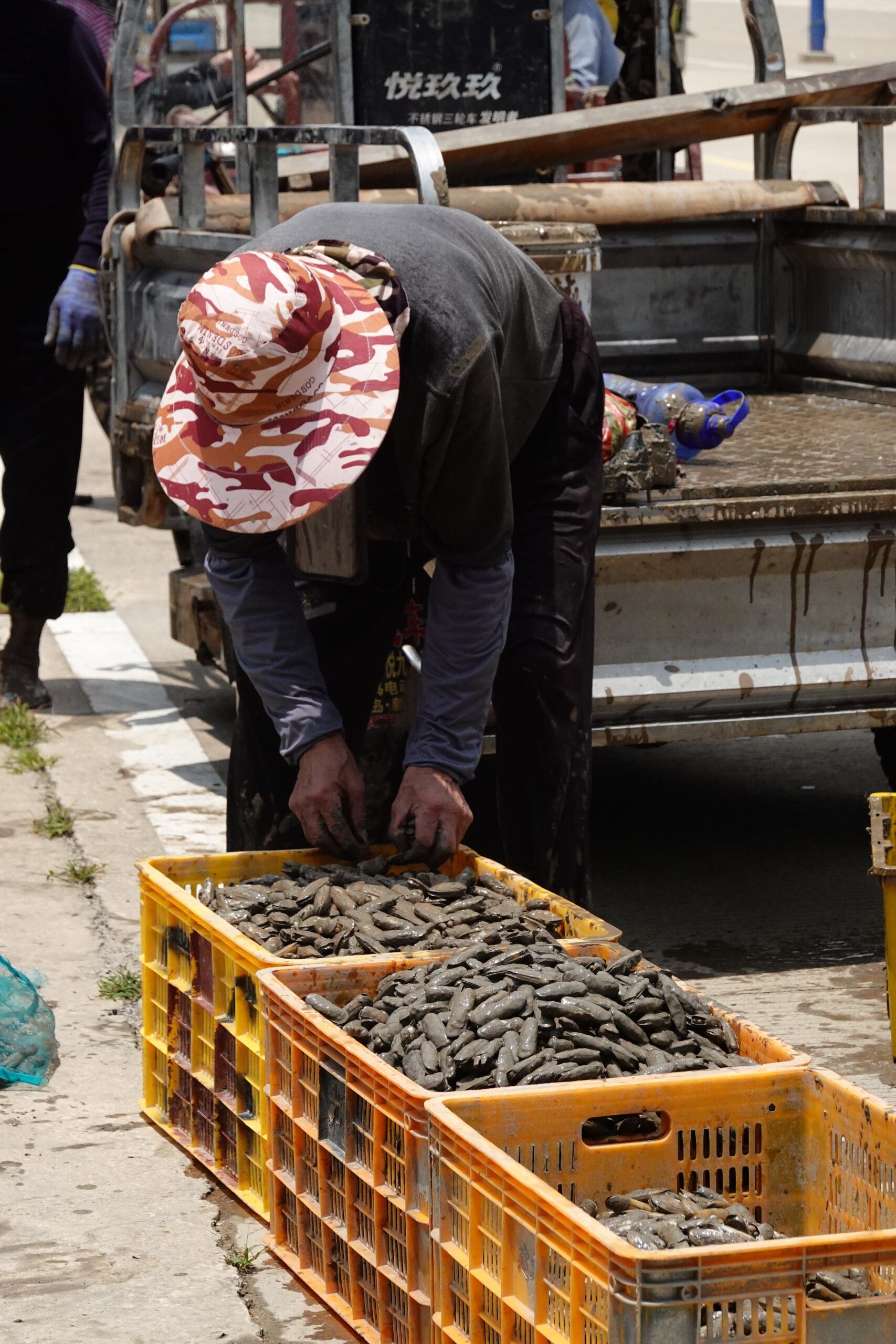
Razor clam farming is a back-breaking job. In 1960s coastal China, razor clams were bred and harvested in squares of mudfields that extended for miles into the ocean. In the spring, farmers tamped the mudplains smooth, separated each square by willow sticks, and sprinkled clam seeds. During harvest at low tide, farmers waded through thick mud, usually with conical hats shielding them from the sun and funnel-shaped baskets on their backs. Spotting a razor clam’s bubbling airhole, they broke the mud with a shovel and tossed the clam back. As the clam slid down the funnel into the basket, the farmer treaded forward, with their back to the sun and face to the soil.
On non-harvest days, farmers turned to the mountains, carrying baskets of sand—more than 100 pounds at a time—uphill to plant sweet potatoes. The crop, small and reddish, was soaked to extract its starch for sale, while the leftover fibers were consumed. When there were no harvests from the sea, villagers would mix a little rice with a lot of dried sweet potato fibers to fool the stomach.
From October 1964 to July 1965, Ruiji Chen lived in a razor clam village in coastal Fujian. Recruited from the Fujian Agricultural University as a member of the “Socialist Education Work Group,” he was sent to monitor “corruption” by rural bureaucrats, which, in reality, meant things like checking if they had eaten more than their portion of clams. Like many positions created during Mao’s various social experiments, he never understood his job title. Instead, he spent eight months planting razor clams, growing sweet potatoes, and wandering along the shores.
Now a five-foot octogenarian with lush white hair, he recalled the times with a sense of wonderment. Perhaps because it was his first time living in rural China, and as the Chinese saying goes, “labor is glorious,” perhaps it was because of the clams themselves (“two legs and a head, the razor clams are a strange creature,” he’d say). Perhaps it was something more. When he told the story, Ruiji Chen—my grandpa, my yéye—started laughing. His gray eyes, cloudy and half-blind from cataracts and macular degeneration, sparked with light.
But then he paused. “Aya! But I don’t remember the name of the village anymore. It’s been 60 years.”
I was hooked by his story. Fishing communities in Southern China remained a mystery for me, a place where people lived by the whims of the sea, obeyed the rules of different gods, and were marginalized by the rest of Chinese history.
After a few tries, tracing the coastline on the map (“It’s close to Baisheng village, somewhere in Lianjiang…”), we narrowed the potential villages down to one: Xiao’ao. And a family road trip was scheduled for the weekend.
My grandpa wasn’t as excited. It would be all different. There wouldn’t be any use in going back, he said that night. Sixty years in recent Chinese history, after all, had shifted the country from a totalitarian regime to a strange marriage of capitalism and communism. How did all this history change the small fishing village?
Born in 1942, my grandpa lived through the most turbulent years of recent Chinese history. Following the country’s establishment in 1949, the young People’s Republic went through four years of Land Reform that wiped out the landlord class and the Great Leap Forward in 1958, an ambitious plan to collectivize agriculture that resulted in a famine killing 30 to 45 million people. In 1962, Mao Zedong launched the Socialist Education Movement to “clean up” rural bureaucrats. Tens of thousands of cadres were killed, kidnapped, or driven to suicide. In 1966, this class war turned into the Cultural Revolution. For many Chinese people, the years between 1950 and 1976 were blank pages in a history book.
Deng Xiaoping, Mao’s successor since 1978, turned China from ideology to pragmatism, creating a market economy that emphasized development and materialism. Seeking Truth from Facts. Let some people get rich first. Those were the slogans that prevailed at the time. As journalist Peter Hessler wrote, “The experiments of the two generations were completely different: one was political, the other economic; one happened on a national level, whereas the other took root person by person, decision by decision.”
Perhaps because of that, my grandpa didn’t expect anything to remain. And I sometimes wonder, too, how people kept their bearings in a country that changed so fast.
After half an hour of driving, we saw the ocean. To the side of the highway, the iron-colored sea flashed between the shadows of dark trees. I checked the map. We were crossing a jagged shoreline with scattered towns. All the towns looked the same with gray, squarish buildings, except that each specialized in one aquaculture trade. Blue float chambers dotted the ocean, and we passed signs for oyster, kelp, shrimp, and mussel farms. The air was still; the ocean was in a dull lumber in the midday sun. Small islands in the distance looked like mirages.
Then, we crossed a gateway inscribed “Xiao’ao.” The road curved along the hill edge, and the town was in our view. We reached the destination.
Like the ocean, the town was eerily quiet. Twenty-story apartments lined each side of the street, and colonial-style houses faced into the blue, but all looked unoccupied. Western-style houses were often built by wealthy overseas returnees, but were left deserted.
My grandpa pointed us to where the village used to be: in the narrow strip of land between the sea and the mountain, the village of stone houses was covered with seaweed and shells. You could walk out the door and step straight onto the mudflat.
But there was not a shadow of the past left. In the Mao era, the village’s poverty and seclusion protected it from most political turmoils; when people were equally poor, eating sweet potato fibers and saving scarce freshwater, it was hard to identify the hidden capitalists. My grandpa’s Socialist Education Work Group existed peacefully with the village. Taiwan was the bigger threat. During Deng’s Reform and Opening-Up movement in the 1980s, the coast shifted into the center of economic development. Shenzhen, once a fishing village in neighboring Guangdong Province, was designated a Special Economic Zone and, in less than five decades, grew into one of China’s biggest technocratic metropolises. Meanwhile, policies in Fujian and Guangzhou encouraged emigration to prompt the inflow of overseas capital.
Standing before the ocean, it was obvious why so many left: distant islands felt closer than the civilization behind the mountains. Fujianese people are a people of the ocean. They live by “begging” the Small Ocean and the Big Ocean. Some relied on small catches of crabs, scallops, and clams, while others threw themselves into the open sea for years. I suppose immigration is but a more permanent form of begging the Big Ocean for Big Money. By 1985, 7.6 million Fujianese people lived abroad—enough to fill another New York City today.
My grandfather was silent. He was right. Xiao’ao was not his little place anymore.
As we were about to leave, I caught a glimpse of a warehouse, “Mussel and Clam Commercial Market,” at the street corner. This was what we were looking for.
The town burst into life. We found ourselves surrounded by a cacophony of honking tricycles, middle-aged farmers in colorful outfits and cone hats, and boxes of razor clams. I jumped when a tricycle frantically honked behind us while approaching at full speed. It swerved to a stop, and three women crouched on the sides hopped down. Their hats bobbed up and down as they poured clams from yellow boxes loaded in the tricycle to larger white trays on the floor. Then the next box. Then the next one.
Each tricycle appeared as quickly as it left. When each tray was filled, they were stacked to the back of trucks that drove away as soon as enough containers were loaded.
From the ocean, more tricycles appeared. In the distance, where the mudflat began, hundreds more tricycles came, in a single file down a pebble road that extended to the end of the mudflat. Everyone moved frantically. Honking as if drivers were leaning on their horns. Rushing over to assist someone else. Shouting and gesturing to make space. My grandpa stood in the middle, looking over the muddy clams, the only static figure among a flurry of colors.
According to Fuzhou News, Mussel Market was constructed in 2019 to streamline the clam trade. It opens twice a year, during the seed trade and harvest. You no longer see the old chaos of small merchant intermediaries fighting to purchase the biggest clams. Instead, lines of trucks waited for harvest during low tide every day, delivering them to restaurants, hotels, and markets. We were lucky to bump into the harvest.
Within 15 minutes, all the tricycles vanished. “Mussel Commercial Market,” again, became a plaque hanging above an empty warehouse. The high-rises, colonial houses, and mountains encircled us in silence.
The sun had started to burn through my shirt. My grandpa walked far, to the edge of the port, looking over the gravel road winding through the mudflat, piled with razor clam shells on both sides. He stood there, taking photos of the mud plain. If he went a bit further, he could almost forget about the high-rises behind him and walk into his memory.
When my grandpa left Xiao’ao in 1965, the villagers walked for hours to send him off. It was dark when they reached the other side of the mountain. Before my grandpa climbed into the bus to take him away, he looked back, and the mountain glittered with stars. It was a sea of villagers’ flashlights.
Evan Osnos wrote in The New Yorker, “I have often marvelled at how much people in China have managed to put behind them: revolution, war, poverty, and the upheavals of the present.” In Xiao’ao, the forgetting took a tangible form. Six heavy decades of famine, political campaigns, and rapid reform all weighed upon one small village more than it could bear. Emigration and new developments erased much of this past, with only the razor clam farmers accidentally left behind.
I remembered an anecdote about razor clams: Razor clam harvesting began in Fujian province during the Ming dynasty, more than 500 years ago. Unlike scallops, they do not travel great distances. With their foot in the mud, the little clams, puddles of memory from a long past, root themselves in the poor dark soil by the sea.
Ariel Chen is an associate editor for Second Look.