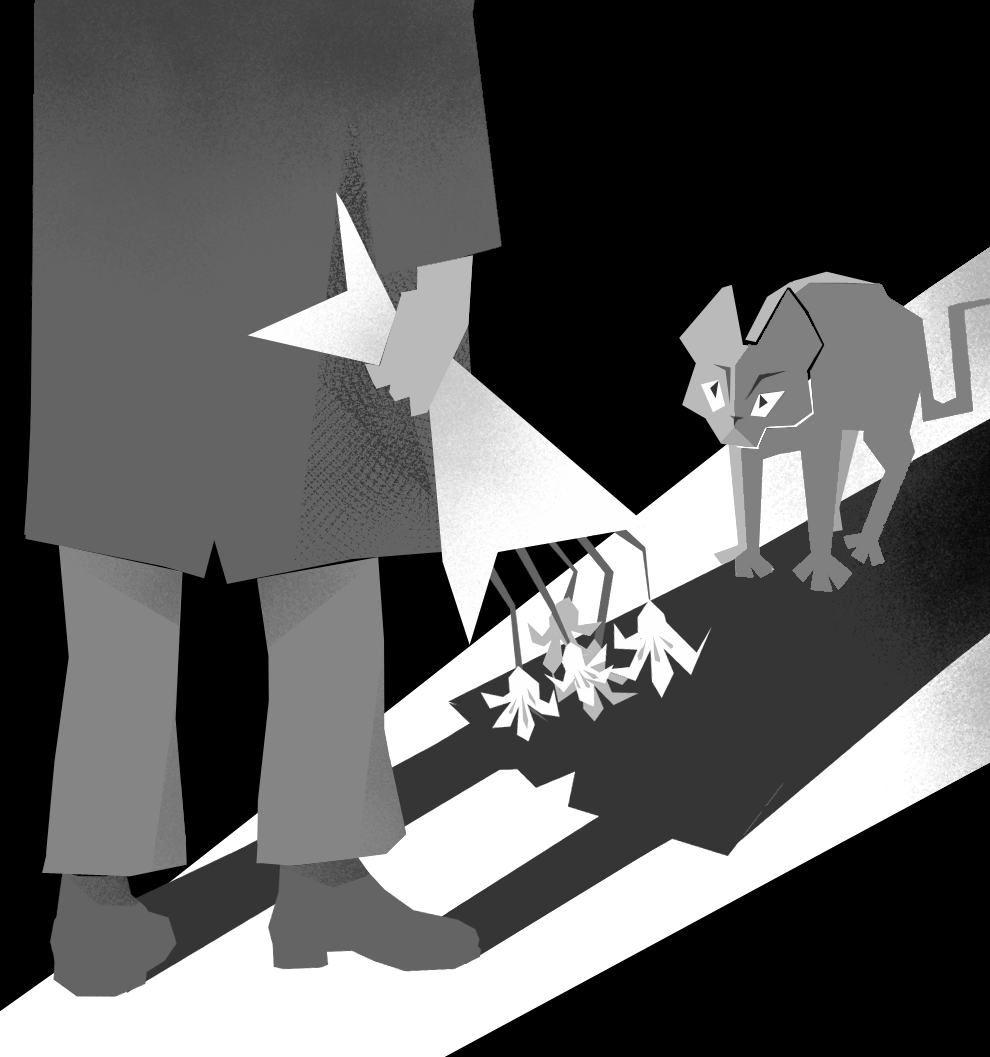
Malina’s body hadn’t turned up, she wasn’t dead, the radio never mentioned her name, but she preoccupied Philip’s every waking thought.
On the night of their first engagement, a ritzy dinner, there was a deluge of rainfall upon Manhattan, and Philip had arrived late, drenched, and squelching in his ruined suede shoes. He found Malina by her smoldering cigarette embers beneath the restaurant awning.
“I know, I smoke. I’m a disgusting woman,” she admitted, continuing to smoke. “It’s a gross thing to look at. I’m disgusted. I won’t suit you. We should end this whole grotesque happening before you sicken yourself for good.”
Malina was cast in a disfiguring shadow so that, abstractly, her disembodied voice seemed to belong to the restaurant bricks.
Precisely when she chose to blow out her smoke in his direction, he chose to admit, “Tomorrow I’ll be four years clean.”
Malina turned as pale and as unmoving as a sheet on a clothesline when the wind is still. “Dear lord. You resilient soul.” And then, casually, as if wanting him to hold her purse, she said, “Kiss me.”
They forsook their dinner reservation for the Manhattan Bridge — a scene plucked from a musical. Malina was music in the fullest sense of the word. It was composed in her soul. A grand piano was staged centermost in her apartment while the furniture was shoved against the walls. Her CD collection and music library were outrageous, overtaking medicine cabinets and dresser drawers, covering countertops and windowsills. She fortressed herself within sound.
Malina preferred the pianos of manic, populated restaurants to those of the quiet and classy. She preferred rooms with heartbeats where dishes flew to clothed tables and glamorous patrons babbled and her music threw the whole restaurant into a whirling commotion — but the hysteria was momentary. Malina retired prematurely when her hands were crushed in a Macy’s elevator on Christmas Eve, maiming every phalanx bone at an irregular angle. When she attempted a simple etude, the piece sounded clumsy and unpleasant, like she hadn’t spent her entire life sitting on a piano bench.
Philip had been most attracted to Malina’s root-like fingers. Gnarled as they were, he had never felt more held, more entangled, than when his joints assumed unnatural contortions to fit his hand with hers.
On their fourth date, Philip trekked up to Malina’s sixth-floor West Village apartment with a bouquet of lilies and two Carnegie Hall tickets. Her front door was ajar. When he pushed it further open, it jammed and, peaking inside, Philip beheld CDs. Everywhere. Toppled, scattered, snapped. Her apartment was a bomb site, but Philip had a premonition that this upending was Malina’s own doing. She was a dissociative woman, always gazing too intently at a stain on the wallpaper, a lump in the carpet, behaving as though on a precipice. Malina’s apartment was a corner unit. The fire escape overlooked the graveyard and the bathroom window overlooked the garden.
Malina’s unannounced departure stranded Philip. Only then, in her absence, did he regret not knowing her more intimately. Malina didn’t own a phonebook, so he didn’t know who to call aside from her landlord. He had never met her friends or seen her photo albums. She didn’t hang pictures of herself, not even mirrors. Philip only knew of Malina’s cat, so, to prevent its starved carcass from stenching the apartment, he came routinely after work to replenish its feeding bowl.
Malina’s cat was a rescue and surely conceived in a sewer. It was an unsightly creature, grotesque, and with puckered pink skin like that of a malnourished burn victim. It preferred a carnivorous diet and tore murderously into its dinners of mashed turkey and beef. The cat stank of unbathed felineness, sinisterly rubbed its fishy odor over Philip’s ironed pant leg, and bore a striking resemblance to Malina when she cried. Both their faces were blotchy and flushed like a disease, and it discomforted Philip that this was the only reminder he had left of her.
Philip tolerated cat-sitting because Malina had been the only delight in his mundane life, stuck behind a bank teller window. She was introspective and tortured, yet curious and inviting. Straddling a Manhattan Bridge beam, Malina wanted to know everything about Philip, all at once, from his foulest deed to first love. Usually, Philip found prying women unattractive because they provoked his ugly speech impediment. He rarely used his voice. But Malina was patient, she wanted to hear what he sounded like, and Philip felt compelled to divulge his entire person to her.
It was one of those topsy-turvy Wednesday evenings in New York when one feels like they’ve fallen through a manhole and landed in New Amsterdam: when everything feels offputting and unusual in occurrence; when all the traffic lights are green and the subway cars are empty; when there’s a mob of pigeons and the denizens are polite; when the avenue lanes are walkable and there’s nobody around; when Philip came home to feed the cat and the apartment had a draft.
She had pounced off the fire escape handrail, spread her limbs as if to be lifted by the wind, and plummeted to the graveyard below. She had split her skull on a tombstone, rolled through the dewy grass, and caught her head between two pickets in the wrought iron fencing.
A class of preschoolers witnessed the fall. Apocalyptic screams ensued. The nosey residents poured in an exodus from their apartments. A parade gathered around the firetrucks, the police cars, and the ambulance. The stretch of sidewalk along the graveyard was taped off. There were dozens of men in blue and paramedics and even a priest, all for a dead cat.

Leave a Reply