Foreword:
Last semester, I took my first translation class. When it came time to select the text I would be working with, I, on a late-night whim and eager to head right to bed, entered “best books Danish sci-fi” into the search engine. Out came a list until my eyes landed on De Ansatte (The Employees) by Olga Ravn. Over the course of a few months reading the book in the original Danish, the English translation, and then meticulously translating part of the book myself, I struggled (and still do) to conceptualize the world Ravn likely envisioned.
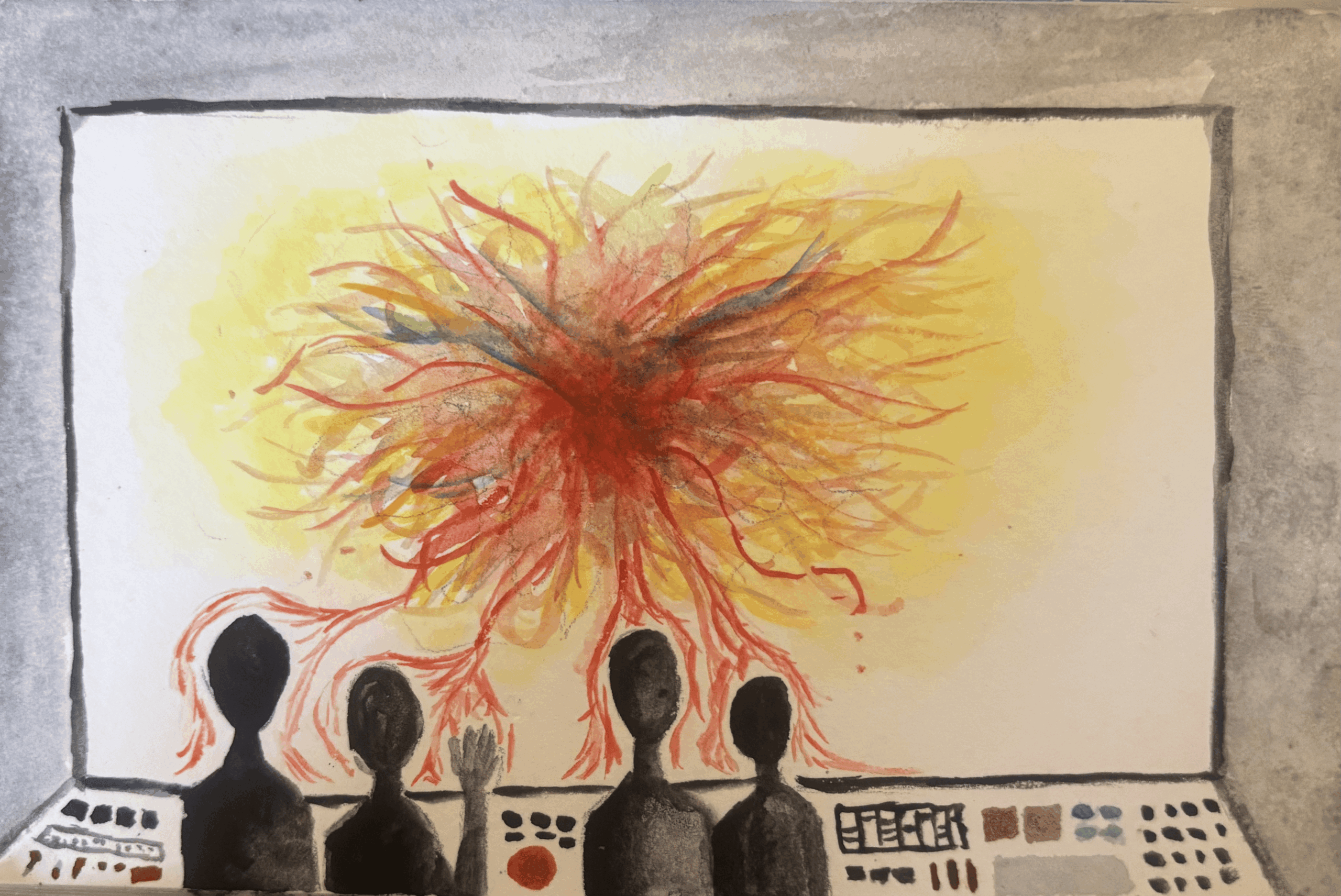
Ravn offers no traditional narrative comforts. Most of her characters have no names and may not even be fully human. But what is revealed is that these employees exist aboard the Six Thousand Ship, an intergalactic vessel that has been studying strange objects collected from the planet New Discovery. Those on the ship begin to experience peculiar attachments, often manifesting in the form of dreams or physiological distress, to the collected objects. The employee’s accounts put the question of humanity on the forefront, all while simultaneously disguising this philosophical inquiry within the mundane bureaucracy of workplace testimonials that are ultimately concerned with the ship’s productivity.
It’s the text’s structure, not its futuristic narrative, that makes it challenging to translate. The entire book is a reservoir of data, pages of testimonies collected by some unknown interview committee over a period of 18 months. These testimonies, which are out of order, document the word-for-word responses of the employees during their interview with the committee. Unlike any other book where there are several non-verbal elements which further propel a story: varying punctuation, dialogue & narrative, the indentation of a new paragraph, De Ansatte extracts all those literary privileges and the reader is forced to confront the words of each testimony in their most basic form. You then become a sort of researcher who pieces these verbatim testimonies together so as to construct a coherent story. The story that you decide to build from the testimonial data comes down to which employees you believe, and which you refuse to trust.
This fragmentation became particularly challenging when I began my own translation. For those who have not practiced serious translation before, take a moment to consider what makes a translator “faithful.” If you were like me, you likely responded with a knee-jerk reaction that, obviously, a good translator is one who sticks closest to the original. The problem here is that we must define what “sticking” to an original means. Do we maintain the syntax, word choice, structure? Or in doing this are we forgoing the spirit of the work and thus undermining the author? To this age-old question of translational fidelity I offer nothing but my failed drafts. These are questions that all translators must confront and decide how to proceed, developing their own framework for translating.
My translation professor frequently stressed that we ought to “focus on the English.” For a text like Ravn’s which offers so little other than its words at face value, it felt like a violation of some translation contract between Ravn and me to embellish the English. Not only that, I also struggled translating from a language in which I was not formally educated. Danish has always been the language of my household, of family, of time spent in Denmark. So despite speaking it fluently, I often resisted more creative interpretations of the text when operating in Danish’s written form.
I read somewhere that translating from a heritage language can often make the translator emotional. For me, that emotion was frustration. While of course no two languages are one-to-one overlaps, two Germanic languages like Danish and English get pretty close. So when translating, I was compelled to select the closest word match, but what was produced felt dull and lifeless when compared to the original.
So, I heeded my professor’s advice of focusing on the English and began to evaluate each testimony as its rightfully singular voice. Despite my loyal nature, I let my subjective decisions begin to take root in my translation. For testimonies that felt mechanical or alien to me in the Danish, I emphasized that inhuman texture in the English. For those who struck me with their humanity, I preserved their emotional resonance. I had to accept that I was not a neutral party to the text’s transformation.
There is a quote by Sean Cotter, a translator of Romanian, where he says: “The process of translation feels like playing chess with a more talented opponent, who makes a seemingly mysterious move with the rook. Maybe a piece is left unguarded as a result, maybe the position seems more awkward, and I stare and stare at the board, trying to guess the point.” If there is one thing I took away from trying to translate Olga Ravn’s De Ansatte, it would be that the translator is cursed with permanent awkwardness. You are bound to the awkwardness of manipulating something that isn’t yours, and through that manipulation you are inevitably fashioning the text to be your own. Ravn’s literary moves left me bewildered, and I rarely felt I had the upper hand in metamorphosing them into English. And yet, my translation grew more natural as I overcame my fear of linguistic overstepping — and let myself sit in that awkwardness between intention and interpretation.
The Employees
By Olga Ravn
Translated by Jonathan Dolce
These testimonies were collected over a period of 18 months in order to gain insight into the relationships between our employees and the objects in the rooms. The committee asked them questions about the relationships they had formed with the space and its objects through an unbiased documentation of the subjects’ statements. Through these measures we hoped to gain insight into the workplace’s efficiency and investigate what possible influences the employees have been exposed to, and how such influences, or possibly relationships, resulted in permanent changes in the employees. We wished to learn whether this could be said to lead to a decrease or increase of their performance, understanding of tasks, acquisition of new knowledge, and thus what consequences it has had for production.
TESTIMONY 004
Keeping them clean is not too difficult. The large one, I think, emits some form of humming sound, or maybe it’s my imagination. Or maybe that’s not what you are looking for? I don’t know the intention of the investigation, but isn’t it female? The ropes are long and bound together with blue and silver thread. They hold her up with a calf-colored leather that is distinct with white stitching. What color is a calf anyway? I’ve never seen one. From her belly hangs a long, pink, well, how do you call it, plant-like stem? I take longer to clean her than the others. I tend to use just a small brush. One day she laid an egg, and if I may suggest, I don’t think you should hang her all the time, because her egg cracked in the fall. Laying beneath her was the egg mass and the stitching was still attached. I was able to fully discard it. This is the first time I’ve said anything about it. Maybe I shouldn’t have. The next day there was a humming sound again. It was louder than before, like an electric buzz. And the day after, she went silent. She hasn’t said anything since. Is she sad? I always use both hands. I don’t know if the others have heard anything. I usually go there when everyone is asleep. It’s not a problem to keep it clean, really. I’ve made it my own little world. I talk to her while she rests. It might not look like much here. There are only two rooms. You might think it’s a small world, but not if you have to clean it.
TESTIMONY 012
I can’t stand going in there. The three on the floor in particular seem to have an inherent evil, or maybe it’s just an indifference. And in their deep indifference, I get the feeling they want to hurt me. I don’t understand why it’s my job to touch them. Two of them are always cold, and then there’s the one that’s warm. They change which one is the warm one. It’s as if they charge each other or take turns transferring their energy to one of the others. I am beginning to doubt whether there are three of them at all or if there is just one, a collective. I’ve seen an intimacy among them. It frightens me. In fact, I detest it. I’ve observed it many times. It’s as if each one of them can always be one of the others, as if they don’t really exist in themselves, but as the idea of each other. They can multiply whenever, in clusters or alone. On the mountainsides, they sometimes look like a type of eczema. But as I have said before, I can’t stand being in there. They always make me touch them, even though I don’t want to. They have a way of communicating that irks me when I go in there. Their language says that they are many, that they are not one, that one of them is the repetition of all of them.
TESTIMONY 006
When did the dream begin? It must have been after the first couple of weeks. In the dream, all the pores in my skin are open, and I see that in each pore lies a small stone. I’m not able to recognize myself. I claw and claw at my skin until it bleeds.
TESTIMONY 002
It was day seven. We put on the green uniforms. I drank milk and lied to the captain so as to avoid being the first to enter. I felt strange that day, strange enough to kiss the engineer on the cheek. I often think about when we first met in the exhaust corridor, and when we went out into the land for the first time, in the valley where the captain lost a case of green grapes, and how after work we bathed in a stream that was so cold it turned our hands and feet red. Looking back, doesn’t it seem like our fate was already decided? In the morning, as I was carrying buckets while sunlight shone through the wet, glittering trees, like the ones in the catalog you gave us, I was green and translucent, like a grape in the sun. The engineer would comfort me. His book still sits open next to his bunk, and I keep it that way as though our story hasn’t ended. At night when the lights go out, I hear the humming sound. It all began in his absence. It was day seven and, even though we’d closed for the day, I led the engineer out through the exit corridor to the hill that night. We chewed gum from the pack that was in his pocket. That’s when I dug two of them out of the soil. They’re probably gone now. My hands chafed and became raw because I wasn’t used to this sort of work. It was when the earth softened again with the change of temperature. You see, I was supposed to work in the office, but they needed me to lend a hand this time. I’ve heard that [redacted] is dead, and they had to put everyone in quarantine. Do you remember the strange chain we found at the foot of the hill on the first day? I don’t think he will forget me, the engineer. Are you going to see him? I don’t know where he is now or if you’ll get to see him, but if you see him, could you please not let him remember me as helpless. I want him to remember me as the one who kissed him that night and pulled him over the hill, and how the dew came right between day and night, and the strange humming from the ground too. There’s so much I would like to show him, but I won’t show it until I have made sense of everything, and now I might never. I’d rather not be somewhere I can be. No, it has nothing to do with the rooms. I don’t think so. I hope you’ve made good progress with the work. I hope you do all that you need to. I hope he doesn’t die, although I know it’s likely.
TESTIMONY 014
The scent in the room is somewhat light, and it has an obvious smell, like some citrus fruit or a peach. Tell me, I wonder if you guys across the table see me as a criminal? I like coming into the room. I find it very erotic. That hanging object, I recognize my gender in it. Or at least the gender I have on the Six Thousand Ship. Every time I look at the object, I can feel it between my legs and between my lips. I become moist, regardless of whether I have anything there or not. Among the hunters on my team, we call it the reversed strap-on. It might seem crude, but I have said that I don’t share your view of things here. That might well be the reason why you think of me as a criminal. Half human, made of flesh and technology. Too alive.
TESTIMONY 015
I am very satisfied with my upgrade. I think you should let more of us get upgrades. It’s me, and yet it’s not me. I had to change myself completely to integrate the new part, that which you say is also me. Which is flesh but also not flesh. When I woke up after the operation, I was afraid, but it passed quickly. Now I can do more than anyone else here. I am a very useful tool to the crew. It gives me a certain advantage. The only thing I haven’t been able to get used to yet are the dreams. I dream that there is nothing there, where the upgrade is; that the upgrade has torn itself loose or perhaps never was a part of me at all; that it harbors a deep contempt toward me; that it hangs freely floating in the air before me and attacks me. When I wake from one of these dreams, there’s a slight buzzing where the upgrade is, and it feels as if I have two: one upgrade where it should be and one floating right above it that can’t be seen with the naked eye, and which has taken shape in the darkness where I sleep, out of my dreams.
TESTIMONY 011
The scent in the room has four hearts. None of these hearts are human, and that’s why I feel drawn to them. The scent in the room is like an earth and oak moss incense, like the smell of an insect caught in amber. A brown scent. Heavy, and it lasts a long time. It can stick to your skin, even up in the nose, for up to a whole week. I am familiar with the smell of oak moss because I have planted this scent in myself, just as I have planted the idea in myself that I must love one man and be loyal to only one man. All of us here are condemned to dream of romantic love, even though no one I know loves that way or lives that life. And yet this is the dream they have given us. I know how oak moss smells, but I don’t know how it feels with my own hands, and yet in my hand, there is this faint sensation where I caress the moss on an oak’s trunk and I imagine I’m standing at the forest’s edge looking out at the sea. Tell me, is it you who has planted this image in me; is it part of the program? Or has the image arisen on its own, out of me.
TESTIMONY 013
I have sat waiting in this room many times before. There aren’t any windows but there is a door to the left and a hallway to the right, making an L-shape. The walls are white and the floor is orange. There are hooks on the wall for you to hang your suit while you wait. Here is the best place to sit, and you can come alone if you’d like. The ceiling opens in the middle to let in light. I like to first stick my hands in the light, then my bare feet, and finally my whole head; it feels incredible, almost like I am being cleansed. But then there is a sense of anticipation that runs through my body, like an electric shock. Or maybe it is an electric shock? Do you know? Are they actually electric shocks, is that it? After that, you are cleared to enter the room. But if you aren’t human enough, or are in poor standing, for example by not fulfilling your duties, then — well, if I can be so frank — if you for whatever reason inconvenienced the workplace, then you can wait indefinitely. The light from the ceiling won’t appear. You won’t be allowed into the room. You aren’t clean.
TESTIMONY 010
Don’t try going into the second room. It’s not nice in there. You have the choice to not go in. Instead, let us do it for you. We have already been in there before. It’s still possible for you to save yourselves. I’m not sure if I am human anymore. Am I human? Do your documents report what I am?

Leave a Reply