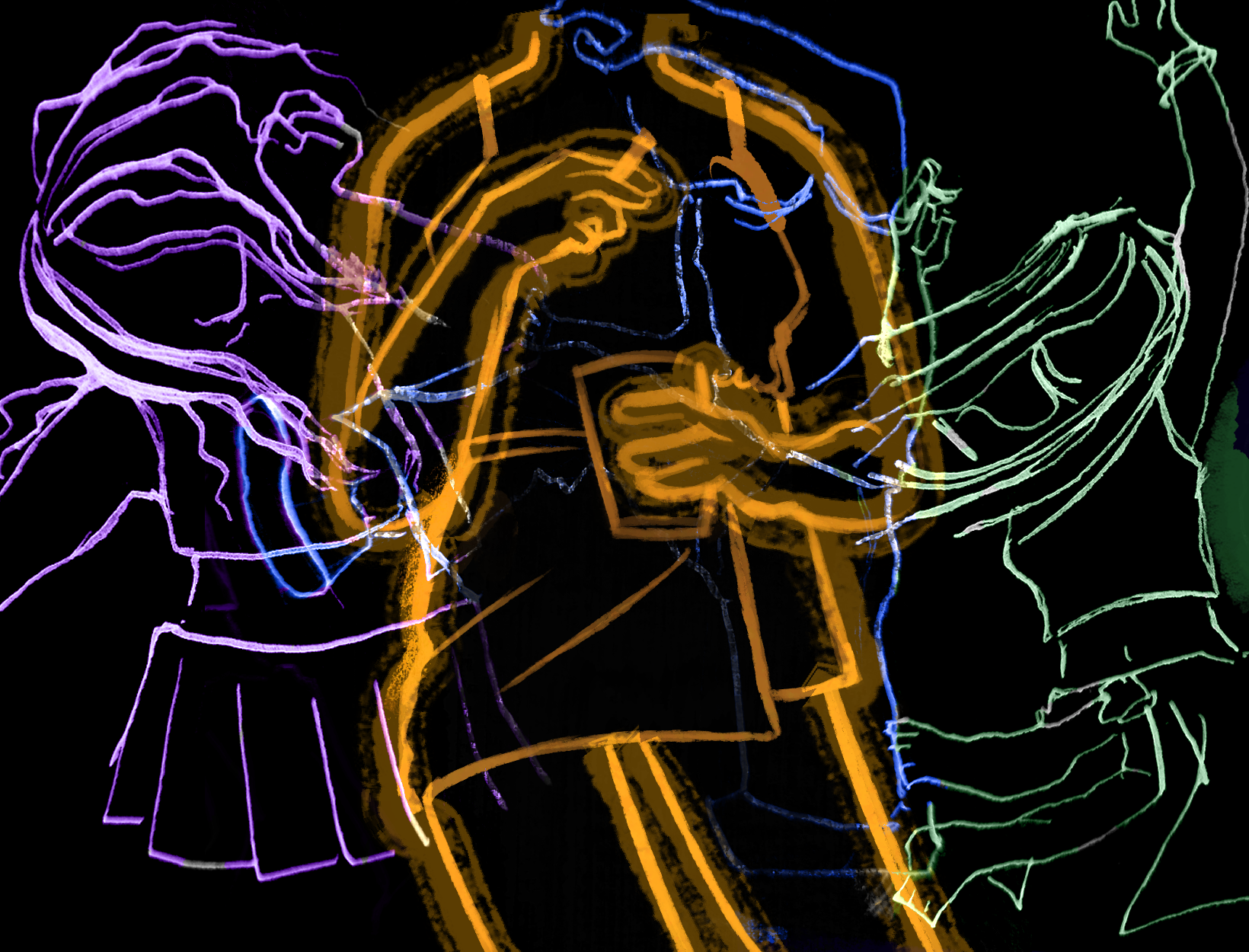
19. You step into not knowing.
Freshman year of college. Terrifying. Electric. Lonely in a way no one warns you about. You know more than you ever have, and somehow less than yesterday. You move away from home and into motion—the parties, the cigarette smoke filling your lungs, the vodka burning your throat, the constant hum of people trying to become someone.
There’s no fight, no ending you can point to, just messages you rewrite and never send. Calls you almost make. A name following a greeting that almost slips from your lips every time you see them, like muscle memory that refuses to die. Stares you share from across the room, knowing there’s so much to say between you, but no one is the first to speak. And the longer you wait, the more impossible it becomes—until silence hardens into something permanent. You start measuring time by absence, by how long it’s been since you’ve spoken. You replay your last real conversation until it distorts, until you can’t tell what was said and what you’ve added just to make it feel like it mattered more. Or whether it ever mattered at all.
Then you stop counting altogether because it hurts less that way.
You wonder if they feel it too—the distance, the slow unraveling—or if it only exists inside you, something you imagined into being and now can’t undo. Suddenly, you realize you know nothing. Nothing about them. Nothing about yourself. Nothing about the things you swore, with your whole chest, were certain.
Your name feels unfamiliar in your own mouth. You say it, and it doesn’t land the way it used to. You are becoming someone you don’t recognize anymore, or perhaps never did. And beneath all of it, something more frightening than loneliness settles in: the realization that you cannot make people stay.
At 19, you are learning how to stay, stay inside a life that keeps shifting beneath you, stay inside the pain long enough to feel it fully, stay even when every part of you wants to run from the emptiness someone else left behind.
91. You return to not knowing.
The world loosens its grip. Terrifying. Quiet. Tender in a way that feels almost cruel. You begin to lose things you thought were permanent. Names first. Then places. Then, entire pieces of time. Conversations slip through your hands before you can hold onto them. Sometimes, without meaning to, you search for someone you haven’t seen in decades. A name sits on the edge of your mind, just out of reach.
You are guided now. Hands on your arm. Voices soft, repeating. Your name is given back to you over and over until it feels like something you can hold again. You are becoming someone you once were: dependent, uncertain. But this time, there is no illusion of becoming. Only the slow understanding of release.
And yet, somewhere inside you, there is a flicker of recognition. Not of facts, or timelines, but of feeling. Of having loved. You realize, in fragments, that you knew everything you could have learned. That the fear you carried at 19—the fear of not knowing—was never something to solve, only to live alongside.
Now, as your son and daughter hold your hands, warm in your bed, you face a different unknown. Not the open expanse of a life ahead, but the quiet one closing behind you. And still, the fear feels familiar. Not new, just returned. The quiet understanding that you can love someone and still have to let them go. At 91, you are learning how to leave—not with resistance, but with trust. Not everything was yours to keep. But everything you needed, you were given.
The reversal of 19 into 91 is not just numerical; it reveals something quieter, more unsettling: the beginning and the end of life are reflections of each other.
At 19 and 91, the self becomes more stable in different ways. 19: unfettered in the world, identity begins to take shape. 91: in not knowing what is next, identity settles into place at the threshold. In both moments, there is a dependence we resist naming: a need to be seen, to be grounded by others, to have someone remind us who we are when we cannot do it ourselves.
At 19, you believe loss is temporary, something you can fix if you just find the right words, send the right message, try hard enough. At 91, you understand that loss is not something to solve. It’s something that shapes us quietly over time, until it becomes a part of us, a part of who we need to be.
The cycle, then, is not clean. A child grows into awareness, while an older person moves away from it. One expands into the world; the other contracts away from it. And yet, both are defined by the same vulnerability: the need to be held, named, loved, understood. Until we are returned to the Being who first exhaled us into existence.
And perhaps, in some unfathomable mercy, we are wrapped once more in cotton and awe. We are held as we once were, when we first emerged from between our mother’s legs, where even the pain of arrival was met with something steadier than suffering: the quiet certainty of being received and loved so dearly.
Michelle Hernandez invites the Nassau Weekly to consider the poles of life, these bookends to identity and uncertainty. Still, I have this nagging feeling that life only really begins at 32 (coincidentally, Carrie’s age at the beginning of Sex and the City).