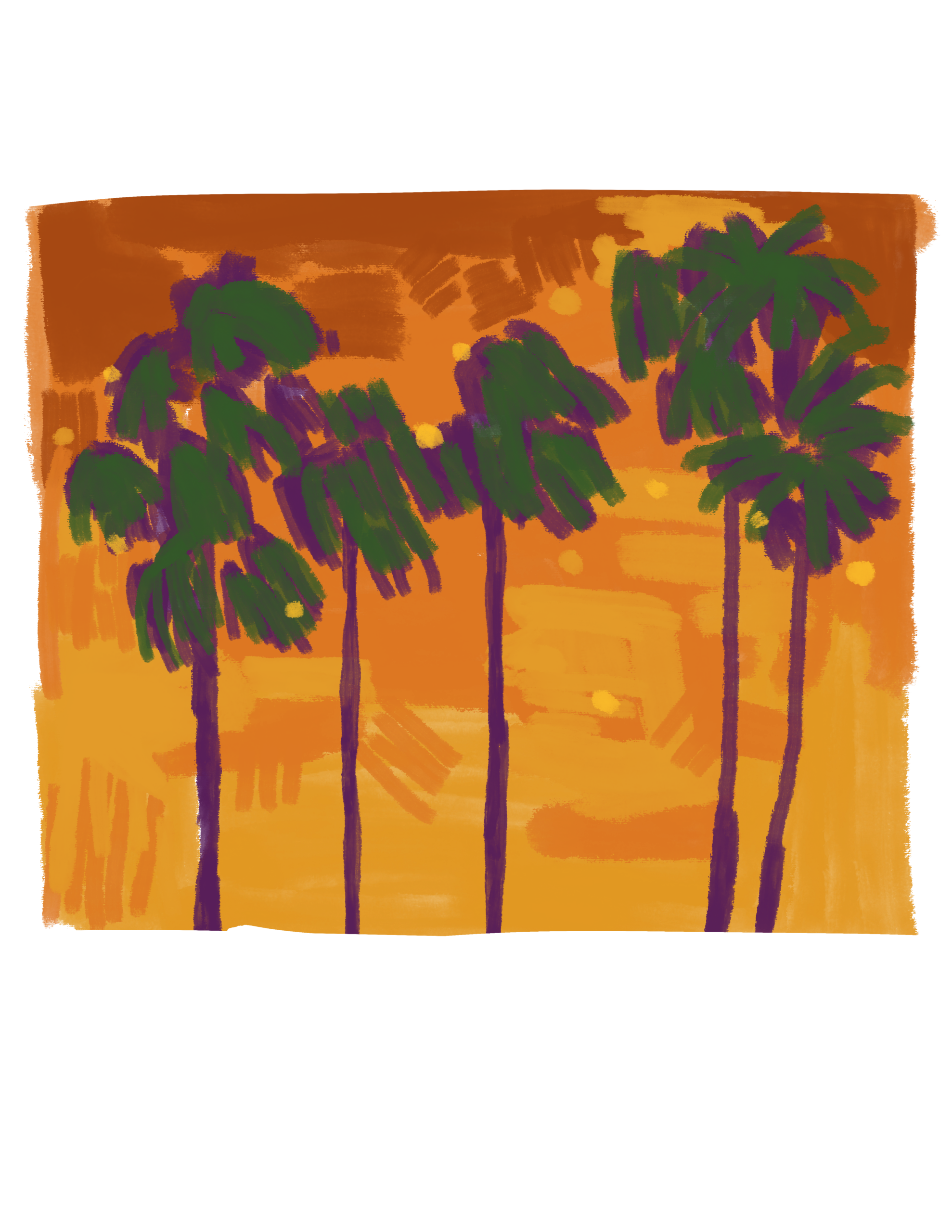
I woke up to the sound of wind rumbling through the foundation of our apartment. Like the eager fingers of a child cleaving apart wrapping paper, whirls of leaves and dust raked themselves across the living room window, scratching against the glass and throwing themselves against it as if in desperation to tear through our home. The weather had forecast gusts as fast as 98 miles per hour, and as we sat at the breakfast table, my mom declared there would be a fire today (my mom likes to think of herself as a sort of clairvoyant Los Angeles weatherwoman).
Fires weren’t unusual for this time of year: a low-pressure atmospheric system that passes through California and a high-pressure system over Nevada cause the phenomenon known as the Santa Ana Winds. Much of Northern LA County sits sandwiched between the Pacific Ocean and the Santa Monica Mountain Reserve, creating a funnel for the winds in which they build up and sweep through canyons and foothills of Los Angeles during the months from October to January. Southern California is known for its dry heat, further exacerbated by the winds, and coupled with a natural landscape known as chaparral that requires wildfires to thrive.
The Santa Anas have become a folklore embedded in the intimacy of growing up in Los Angeles. Locals will whisper the name with reverence, because amongst the sediment and debris carried by the wind, there is a belief that a greater force is ushered in by these zephyrs as well. These ill-tidings date back past the Spanish missionaries, who believed Satan to be these winds’ homonym. To my mother, the howls engulfing our apartment were screams to get out of LA.
“We should leave before they close the canyon,” she insists. Malibu Canyon, a winding road that connects its namesake to the San Fernando Valley, is prone to closing at the hint of any adverse weather pattern. This wouldn’t be the first time we’d have to evacuate within the month, as we’d just had a fire sweep through 4,000 acres of the town the month before.
My mom and I fought all morning about whether to leave. I was steadfast in my insistence to stay—it was my last week in LA for winter break, and I dreaded spending my limited time in the California sun away from home. I had imagined my grand return from New Jersey down to the day, and there was no time in my plan for evacuations. If we left, when was I supposed to eat shrimp chips at Cholada? Or run along the path under the Santa Monica Pier? I hadn’t even had the chance to walk through the Malibu Lagoon, since I’d spent most of my time wasting away in bed. My stubbornness won out, and we decided to shelter in place and wait for the winds to pass.
At 10:30 a.m., January 7, 2025, a small fire was reported in the Pacific Palisades, a predominantly wealthy, residential neighborhood that runs along the coastline south of Malibu. A week later, my family and I had evacuated as nearly 24,000 acres of land burned across Western Los Angeles. When we left, I could see the flames from my bedroom window.
The Palisades Fire spread as quickly online as it did through the dry hills of West LA. While California is often ravaged by flame, it is almost always large sections of dry brush and landscape that burn. This time, it was homes. In the age of social media and constant surveillance, we are now more than ever receiving mass amounts of information as disaster unfolds. These inflammatory gusts ushered in a virality parallel to the rate of the fires themselves. As of today, over 29,000 TikTok videos and 60,000 Instagram posts have used the hashtag #palisadesfire. Digital diaries, blogs, and the constant posting of our experiences have transformed the world into one that is increasingly personal. And we feel as though we are experiencing these disasters ourselves from the screen on our phones. Friends across the country, and many just down the street, were texting, asking if my family and I were safe. Even now, when I tell people I’m from LA, they often feel an eagerness to first inquire about the state of my home. When I came back to Princeton after winter break, a class I took had us assign sticker colors to people based on their outfits. One classmate assigned me orange and red, joking that it was because I was from LA, and that the colors reminded him of the fires.
However, as people shared viral videos of cars abandoned on Sunset Boulevard, watering their houses in a last-ditch effort to save them, or views of flames clawing through backyards, many comments under these posts were about another disaster entirely. Four months prior and 2,500 miles away, North Carolina and the Southern Coast of the United States were battered by Hurricane Helene. People affected by Hurricane Helene took to social media to protest the level of attention that the LA fires were garnering while they awaited relief from the winter temperatures that were quickly setting in. Posts about the fires became a place for people to measure them against other tragedies. Communities reeling from devastating loss were met with comments like “WHAT ABOUT NORTH CAROLINA??” and videos began popping up criticizing the appropriation of funds to endow California’s fire department rather than utilizing them to rebuild homes that had been whisked away by floodwaters.
Like a conflagration preying on an environment predisposed to inferno, algorithms feed off of anger. In recent years, the term “Online Disinhibition” has been coined to describe the factors that cause us to feel more unrestricted on the internet. People may share a vulnerable story or even a long-kept secret because they feel protected by the supposed anonymity. More frequently, however, people argue, express hatred, and send death threats because they feel removed from the consequences of these actions. Because of the algorithm, these same social media platforms will continue to serve content that upsets you. Rage prompts the biggest reaction out of all of us, and is the kindling for virality. It implores us to engage with content; we comment our dissents, we send the video to our friends to laugh about how idiotic an opinion is, and it creates a cortisol spike that leaves us wanting more. The result is clear: antagonism generates profit.
When we decide to face people who are in a time of tragedy with a mentality of what about us? Rather than understanding, we are giving in to the polarization exacerbated by social media and these forms of disinhibition. Under a blank profile picture and nameless user handle, people feel permitted to narrate someone else’s loss as an argument. The short-form scroll discourages complexity; before we have time to consider how disaster response works, our attention has already moved on. In that environment, empathy becomes inefficient.
This same logic shapes what we see in the first place. Coverage is not distributed according to need but according to legibility and recency. Many of the articles during the Palisades Fire focused on which celebrities had lost homes in the fires, creating a narrative that is recognizable and easily shared. While Hurricane Helene had made its way into and now out of the news cycle, it garnered significantly less media attention even at the height of its so-called relevance. However, California did not receive more attention because its residents deserved more care than North Carolina, but rather because its suffering was louder.
People characterize LA as a city run by the ‘show biz,’ a place continually hunting for content and vanity and celebrity. And yet the local psyche will likely conjure up a very different image. My memory of LA is that of my mom braving rush hour traffic to watch me run across the finish line of the LA Marathon. It is sneaking down to the beach during COVID, and boogie-boarding with my sister on an empty Malibu coastline. It’s shuttling my friends to Erewhon to inevitably pay too much for the Hailey Bieber Smoothie (which, by the way, definitely earns its TikTok fame). The fact of LA that evades outsider imagination is that normal people live here too.
These antithetical understandings of this city found their ways online and manifested themselves in the way that people responded to the fires. Because LA is characterized by an outpouring of content, a home to people giving their privacy over to the rest of the country in hopes to make it big online, many people found a greater sense of empathy towards those who they had come to view as a digital friend. It is certainly tragic for any place to be destroyed, but what if it was the house of the couple you’d grown up rooting for in Gossip Girl? Or the influencer family whose kids had grown up alongside yours? The hierarchy of the news cycle prioritizes what people know.
However, because LA is also labelled as a vapid, wealthy city, a sense of resentment towards the rich elite became the focus of many people’s narratives surrounding the fires. Perhaps the incendiary dryness and violent extremes that Joan Didion cites as symptoms of the Santa Anas found a way to be airborne, making its way online. Critiques started popping up over social media, saying the use of federal money to work towards recovery was a misappropriation of funds. After all, couldn’t these rich people living in LA fund the restoration themselves? On these platforms, the case of these disasters was a zero-sum game. People regarded the money allocated to the fires as money that was being taken directly from relief efforts for Hurricane Helene, which further exacerbated the sentiment of abandonment experienced by those closely related to the storm. News coverage for them became synonymous with aid. However, if people thought the blaze blowing through LA would be healed at an expedited rate, they were misguided.
Two months later, in March, I flew back to LA to spend spring break with my family. The last I had seen of my home was through the back window of our Subaru, piled to the brim with all that we could not bear to lose. I knew from my mom that our apartment complex was fine, and I suppose I had assumed that so long as I could step through the threshold of our home, everything would feel normal. The fires had not been in the news for some time now, and yet as we drove past the McDonald’s on the Pacific Coast Highway, the landmark that now delineated what constituted a burn zone and what did not, I could see that the road that I had grown up taking to track practices and bat mitzvahs was decimated. Guards wielding semi-automatic rifles stood at the entrance demanding to see our “local passes” that were issued to those who could prove they lived in a burn zone. Gone was PCH’s painstakingly slow traffic and surfers playing live-action Crossy Road as they dashed across all four lanes. Instead, we were met with empty roads and rebar piled behind melted fences. Wheeling over the asphalt, the glare of the sun on the caps of sea waves caught my eye. Before the fire, a half-mile row of houses separated the highway from the Pacific Ocean. Now, the view was unobstructed.
If every tragedy reminds us that ours has not been resolved, the world becomes a place of constant finger-pointing and comparison. Still, the couple whose house burned down while they were on vacation and the woman who watched her son get pulled away by rapids do not occupy the same material reality. Recovery will not ask the same of them. Some people may be able to absorb tragedy in the form of a second house, while others may still be in tents three months later. Comparison, then, is not inherently cruel, as it can be an attempt to decide where help is most needed. But when disasters compete for attention online, they are often not weighed by vulnerability or capacity to rebuild. We instead jump to measure visibility, and when we lend too much weight to the virality of experiences, we may conflate that to be the level to which people empathize with us.
Landscape that has been altered by wildfire is described as a burn scar. The language of this lends itself to the fundamental way traumatic injuries operate; reminders of them endure far beyond the event itself. A function of loss is the way in which it lingers in our lives beyond the viral moment. 3 weeks ago, I visited my friend CJ at her house in the Palisades. My mom and I drove along the same stretch of PCH we had months ago in March, when the rubble had only begun to be cleared. The speed limit is still capped at 25 mph, 20 miles below what it usually is. This time, mountains are vibrant, enriched by the regrowth of chaparral coupled with the torrential downpour we’d had for the past month. You can still see the ocean as you drive through Southern Malibu. When we get to CJ’s, her house stands across from an entire neighborhood of ash. One of the other girls asks her why her house didn’t burn when so many right next to hers did. She replies, “That’s how fires work. Sometimes you get lucky.”
LA is so much more than its online characterization for local Riley Pan.