When I was four years old, I scattered rose petals during the lesbian commitment ceremony of my babysitter. It was 2008; same-sex marriage wasn’t yet legal, but they did everything traditionally associated with a wedding. Including having baby me as their flower girl.
My babysitter was an early-adopter dyke (pixie cut) and somewhat scandalized my traditional Iranian grandparents. My grandfather pulled my mother aside: “Don’t you think Roya needs some more…straight…role models?”
In my opinion, my siblings and I were fairly well-rounded kids — our parents’ liberalism was always accompanied by a healthy dose of understanding what the other side thinks. For example, my father dragged us to church each Sunday so we would know the stories of the Bible, both to better understand pop culture and literature references, but also to better understand the role of organized religion in many people’s lives.
But he was also the officiant of a gay wedding — in 2015, when same-sex marriage was legalized, our good friends David and Daniel quickly tied the knot. My dad cried throughout the entire ceremony, so moved that two of his favorite people were getting to celebrate their love via government acknowledgement. I remember being confused; they shared a house and dogs, what difference did it make?
—
Daniel, David, my parents, my brothers, and I, sit around the dinner table. David is talking — for the first time I’ve ever heard — about growing up with an extremely conservative family in rural Oklahoma. It is, I think, hard for him to discuss, and I’ve never been brave enough to ask.
“So then, how old were you when you knew you were gay?” my brother prompts.
“Like, eight,” says David.
He and Daniel have been together for 25 years. They met in medical school, and shortly after he came out to his parents, David’s family stopped speaking to him.
“We weren’t ‘out,’ in the sense you’re thinking of, at the very beginning,” Daniel tells us. “It was 1995. We were forging a new path.”
“So what about Bible camp?” my brother asks. “In bed by 8pm and all that stuff.”
“Oh,” says David, “It was the best sex of my life.”
—
My best friend Clara and I are home at the same time this summer. It’s too hot to do anything, so we decide on a movie marathon. I propose Brokeback Mountain and the marathon takes on a queer twist. Call Me By Your Name, God’s Own Country, Stranger by the Lake.
Both Brokeback Mountain and God’s Own Country feature two gay men herding sheep in an extremely rugged, isolated setting. Within montages of longing gazes and grass blowing in the wind, their queerness starts to feel almost locational — it’s like, the only reason they’re sleeping together is because they’re bored. It’s a thought experiment, the movies asking: what is there to do when two men are alone in a tent?
I wonder aloud about this, and Clara explains to me: it’s about the isolation of these environments. Their repression runs so deep that only when they’re so far removed from society can they express their feelings.
And then, when they return home, the feelings get shoved back into the physical and metaphorical closet.
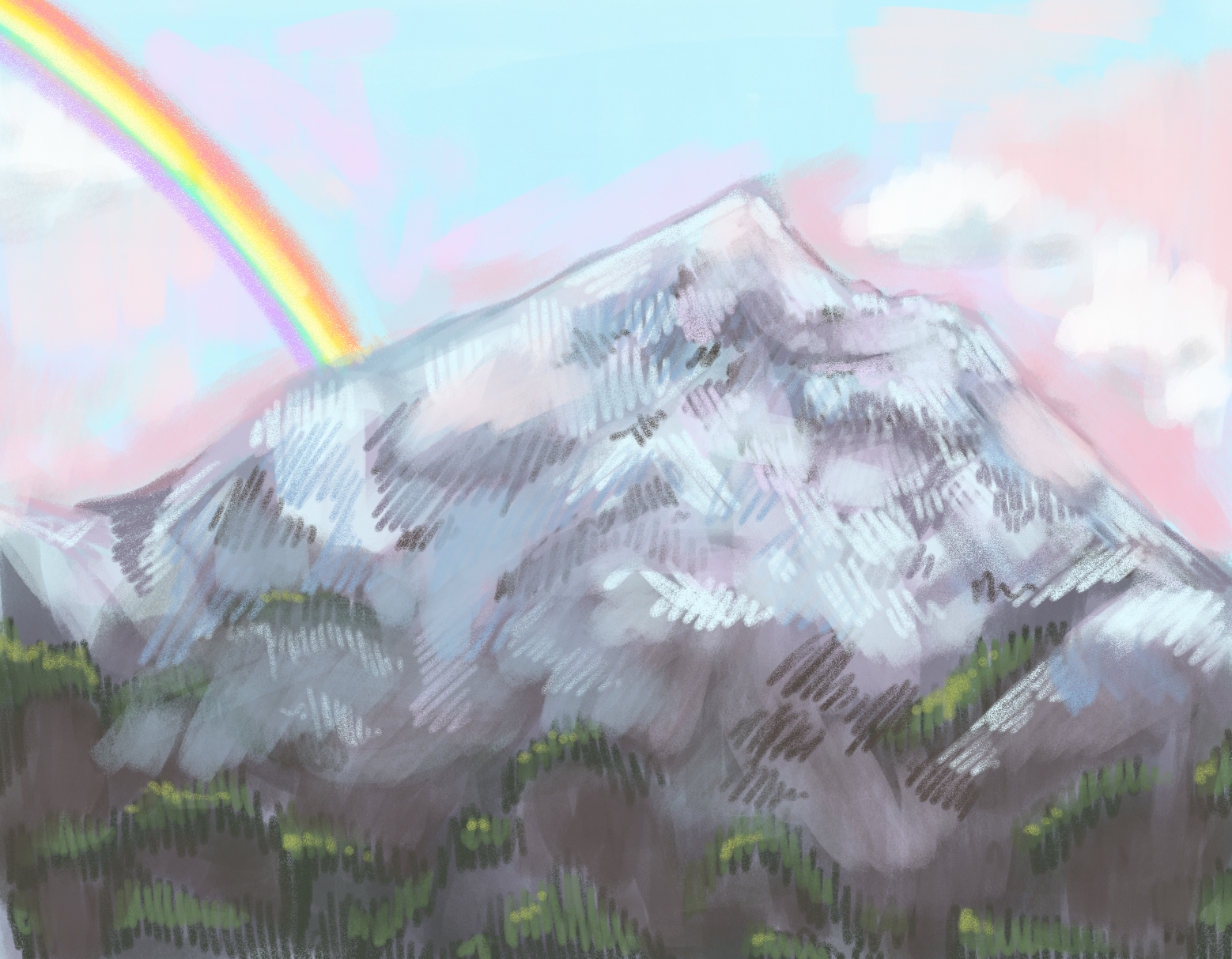
Early in the film, Brokeback’s Ennis establishes clearly his heterosexuality after a few too-long glances from Jack. Of his girlfriend, he says, “we’ll be getting married when I come down off this mountain.” As if the mountain maintains his queerness, as if the queerness is contained on the mountain.
—
Clara reminds me that in the case of Brokeback or Call Me By Your Name, these men might literally never have met another gay person. The final time Elio and Oliver kiss, she says — that might be the last time they see a gay man for years.
I’ve swam in very accepting waters — gay weddings, gay babysitters, gay preschool. At Princeton, Terrace. The experience of concealment is not one I’m quite familiar with; I’m not “out” (in a traditional sense) to either set of my grandparents, but they’re homophobic mostly culturally, my mom’s family having lived in Iran most of their lives.
It’s hard to fault them for this, really, when they come from a country where being gay is illegal and punishable by death. Recently, my grandmother sat me down and asked how she could “spot a gay person” on the street. “Like, what am I looking for, in terms of…clues.”
I wasn’t sure how to answer: there’s one sitting on the couch in front of you.
—
Clara sees a theme of bodily fluids in the movies; at one point it seems that Elio is so lovesick he gets a nosebleed, and Oliver asks, “is this because of me?” There’s also, notably, a puking scene in all four of these movies. Elio vomits upon seeing Oliver dance joyfully with a woman. Ennis doubles over in an alleyway when Jack leaves for the first time — “took me about a year to figure out it was that I shouldn’t a let you out a my sights.” In these moments, the repression of their queerness manifests as physical illness: it’s too much to hold inside.
—
Even if I hadn’t gone to church as a child, I would recognize the dead lambs in both Brokeback Mountain and God’s Own Country as a Biblical allusion: the Lamb of God is a religious title for Jesus, with the lamb representing the ultimate sacrifice for sin.
In Brokeback, the morning after Jack and Ennis’ first time sleeping together, Ennis rides back to his herd of sheep to find one dead — gutted by a coyote, flies already buzzing around its corpse. He’s disgusted, and guilty; the sheep died because he wasn’t there to guard it, he was busy fucking Jack.
An almost identical moment happens in God’s Own Country. Johnny, in charge of the sheep on his family’s farm, stays out too late having quick and dirty sex with a faceless man at an equipment auction. He returns to find a dead lamb, the result of a breach birth he wasn’t there to catch. His father is furious. His queerness is punished.
Reaching back to my days of Sunday school, these lambs confused me. They aren’t killed as sacrifices in atonement for sins; Ennis and Johnny have no agency in the death of the lambs, no moment where they decide to repent. The sin is so great that the dead lambs become their punishment, and the atonement is forced upon both young men. As a symbol, or perhaps a warning.
—
Parce que c’était lui, parce que c’était moi. A Michel de Montaigne quote that Elio’s shockingly progressive father repeats to him when talking about, or skirting around, his relationship with Oliver.
There’s no reason for it. It just is.
“Why are you telling me this?” asks Oliver. Elio: “Because there is no one else I can say this to but you.”
—
Before I joined Terrace, most of my close friends at Princeton were straight. This didn’t strike me as a problem particularly, but then entering Terrace felt like a kaleidoscope of color and cool shoes.
It’s not that I felt any shame or strangeness about my sexuality, but I couldn’t name more than two out queer couples on campus. It wasn’t concealment, or shame, but then what is the name for this feeling? My queerness became a marginal part of me, something unimportant.
When I joined Terrace, it was as if things shifted a half-inch to the right, and suddenly everything was in focus. I didn’t notice that I didn’t have a space for my queerness until I suddenly had one. Without Terrace, that part of me felt shoved to the side.
I’m “lucky” in that my queerness is something I can hide, if I choose to. But then, where does it go?
—
This summer I thought often about the history of queerness and concealment, queerness and repression. After, when you strip away this layer of shame, what is different? What is left?
It feels simplistic to say that in a perfect, non-bigoted, non-homophobic world, every queer person would be out and living joyfully with their partner. For Daniel and David, though I garner that they are very happy, it took some time. At the beginning, David says, “We were just figuring it out as we went along. Figuring out how this would work.”
I understand this sentiment most clearly in my queer friendships — that is, friendships with other queer women — of which I have many. These have been some of the most profound and intense relationships in my life, often straddling the line between platonic and romantic, switching back and forth with any given day or interaction. We almost want to pretend that we relate to each other in a “normal” way, but we don’t. It’s a constant game of chess, of — are we talking about us?
Is some amount of concealment inherent in queer relationships; if not from each other, than from ourselves?
Andre Aciman, the author of Call Me By Your Name, has another novel called Enigma Variations, which I personally prefer. It tracks the protagonist, Paolo, through the five great loves of his life; while each of them, and himself, truly remain enigmas. I flipped back through my copy this summer and saw this quote, which I’d underlined in blue pen:
I’ve been trying to disown what I wanted for so long that still today I can’t recognize it without first going through motions of disowning it (p.225).
—
“I’m not no queer,” says Ennis. Jack replies, too quickly: “me, neither.”
Leave a Reply