Behind the Carrefour in Aix-en-Provence, there was a parking lot closed off to regular customers. Rather than a sprawling terrain of asphalt segmented by clean white lines, the landscape was defined by five-foot-high piles of empty pallets, haphazardly strewn grocery carts, and dumpsters overflowing with could-have-been anniversary bouquets soaked in spoiled milk. Egg shells, and their yellow guts too, muddied the pathways carved between these makeshift barriers. It smelled of rotting, wasted food.
The stout waste manager lumbered about in an electric blue vest embroidered with the grocery store’s logo. He guarded his clipboard close to his chest, as though the inventory records were confidential, and barked orders in rapid French. I followed his instructions carefully, only touching the shopping carts filled with donations. Every morning, we packed the nearly-expired food from these carts into our van.
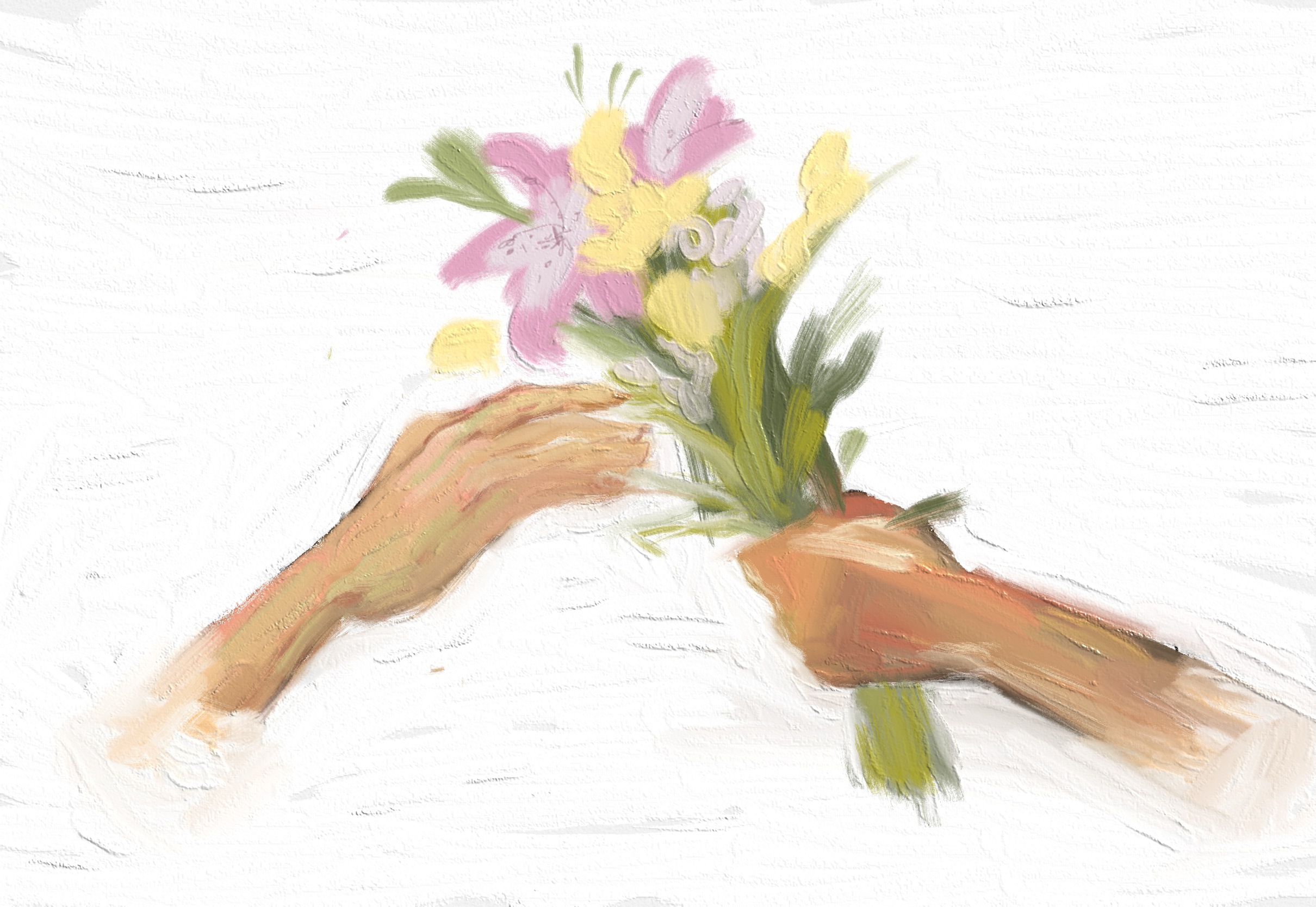
Most days, a single cart was filled to the brim with flowers, contrasting the muted hues that filled out the rest of the scene — brown dumpsters, gray compactors, black skid marks. The season, July in the south of France, offered a simple explanation for the abundance of donated flowers. Still, they seemed out of place in the trunk otherwise filled with crucial sustenance.
Secours Populaire is a French non-profit that serves people experiencing poverty across the country. This particular branch includes a subsidized grocery store, supplying fresh produce, preservatives, and, often, flowers. Anyone in the community making an income below a certain threshold is encouraged to sign up for a biweekly time slot to shop. The goods are inexpensive — 10 cents for a box of pasta — but not free. The choice of what to buy, and the act of buying itself, preserves the dignity of the customers.
While working there this past summer, I relished being assigned to the task of picking out a bouquet for the customer while they paid. I coordinated the flowers to the customer’s outfit, learned the pronunciation of obscure colors in French, and struck up conversations with the receivers about their preferred flowers. The act became routine, a key step in the customer’s experience. Until one day, no flowers were donated.
The first customer did not mention the change in routine, but the second, along with her daughter, noticed. While the customer paid, her child craned her head towards me and asked, où sont les fleurs? My chest tightened. I choked out the simple explanation — there were no flowers today.
The mother’s face fell, then broke into a mirthless laughter. Her head shook slightly, as if the movement would expel her disappointment. With a short exhale she hoisted her grocery bags onto her shoulder and placed a hand lightly on her child’s back to lead her out of the store.
Flowers are most commonly gifted to mark intense moments in our lives: sickness, success, birth, and death. In each scenario, they are emblematic of a deep care for someone, of their necessity to be noticed.
The question of necessity is often brought up in the context of food insecurity. The common perception of SNAP, which predates the current destruction of this crucial social program, is rooted in a healthy caution against corruption and an utter intolerance for greed. This perception is the result of the program being sensationalized.
On January 13th, 2017 an article entitled, “In the Shopping Cart of a Food Stamp Household: Lots of Soda,” was published in the New York Times. Just shy of nine years later, a similarly panic-inducingly titled article, “Should Food Stamps Pay for Soda?,” made the front page. The second article was published weeks after the Trump Administration’s budget passed, which set off a detrimental deterioration of SNAP.
The similarity of the titles over time signals the stagnant perceptions of food insecurity in America. The underlying assumption about people living in poverty remains the same: irrational and wholly avoidable choices, such as not wasting money on soda, lead to this situation. The identical data set used to write the article signals the stagnant efforts to find a solution. If policymakers and researchers indicated a need for this data over the past decade, surely a more recent survey would be available to reference.
The United States Department of Agriculture (USDA) survey used in the articles indicates that all households in 2011 spent more money on soft drinks than on any other food item based on point-of-sale calculations. Non-SNAP households spent an average of 4% of their grocery bill on soda, while SNAP households spent 5%. These findings suggest the need for a country-wide focus on nutrition, or at least they did in 2011. This evidence does not justify the mass villainization of families who rely on SNAP to avoid food insecurity.
Secours Populaire closes every August. After reminding a customer that this would be his last appointment before September, his eyes momentarily went out of focus, he squeezed his daughter’s hand, and the words okay-ça-va escaped in a sigh. I presented the produce, the option of pasta or rice, the preservatives in stock, and then what remained in the fridge. Restless from the wait, his daughter rummaged through the basket of candy next to the cashier. He attempted to calm her, attends mon chou, without turning towards her, and asked how much the candies cost.
“One euro for ten, bringing your total to 11.50,” my co-worker responded. The customer reached for his wallet, the metal inside clanging as it moved. He emptied the contents onto the counter and counted out the coins, just barely reaching 10.50. He looked at his daughter and shook his head, pas des bonbons aujourd’hui.
Some parents choose soda over fruit to quiet the whines of their children. Some cannot afford to make this choice. It would be impossible for any parent to simultaneously prioritize a child’s happiness and health in every decision. Yet, this premise is ignored when the decisions of parents reliant on food assistance programs are being considered. In these cases, we turn to well-established newspapers to find characterizations of this population as ungrateful, wasteful, and greedy. We compensate our communal generosity, which funds these programs, with the right to impose strict moral oversight.
Greed and generosity, especially on the communal level, are difficult to define. Broadly, if greed is giving others less than what we owe to one another, generosity is giving more than necessary. This interpretation seeks to balance, based on what individuals have to give. Matthew Desmond, while researching Poverty, by America, found that the top 20% of the income distribution receives 40% more from the government than the bottom 20% because of tax deductions and subsidies. This purely means-based conceptualization, however, oversimplifies these definitions, diminishing the beauty of generosity and underestimating the prevalence of greed.
Another aspect of my work this summer included walking around Aix-en-Provence once a week, dragging carts filled with water bottles and sandwiches over the cobblestone, pedestrian-only streets. Rather than rushing past the people sitting on the streets surrounded by plastic bags, we struck up conversations. After I placed a sandwich at the feet of one woman, she put her fist in my empty palm. When she withdrew her hand, she left behind three coins. I protested but she insisted, tiens, pour ceux qui en ont besoin.
When contextualized by the philosophical theories of Reinhold Niebuhr, generosity and greed transform beyond the confines of economic status. He argues that the recognition of the inherent self-centered nature of humans is what allows us to strive for higher morals. Essentially, most people are greedy most of the time. Thus, rather than the opposite of, generosity becomes the exception to greed. It is the rare act of giving to others, without comparison to what others give or care for how the gift is ultimately used. It is a conscious effort to notice others.
I bought flowers a few weeks ago for my boyfriend as a welcome-home-sorry-you-broke-your-collarbone gift. My heart warmed at the sight of his endearing surprise as I pulled them out from behind my back, and ached when he revealed he had never before received flowers. He had yet to experience this simple miracle. At each glance, the feeble petals emit a potent sense of care. Each time you notice the flowers, you are reminded that you too were noticed.
It is naive to suggest that the luxury of flowers must be afforded to everyone just to make them feel seen. Simultaneously, it is naive to suggest that the luxury of affording flowers is inaccessible to some because of their economic status alone.
In 2021, the top 1% of the income distribution stole roughly $175 billion from the federal government through tax evasion, based on a review by the National Bureau of Economic Research. Matthew Desmond estimates it would take around the same amount to lift every person currently below the federal poverty line above it.
People came to Secours Populaire to collect necessities for survival at the only price they could afford. In contrast, free flowers seem frivolous. But generosity is not confined to actions which service the needs of others, and greed is not defined by the demand for anything beyond these needs.
Flowers need not be added to any of the four USDA Food Plans, nor donated to every food bank. Still, their omission serves as an important reminder that the food aid currently provided in the United States is the bare minimum. Poverty is the lack of money. The poor treatment of those without money, however, is a lack of humanity. Everyone deserves to be noticed. Everyone has a duty to give what they can. Everyone appreciates flowers.
Leave a Reply