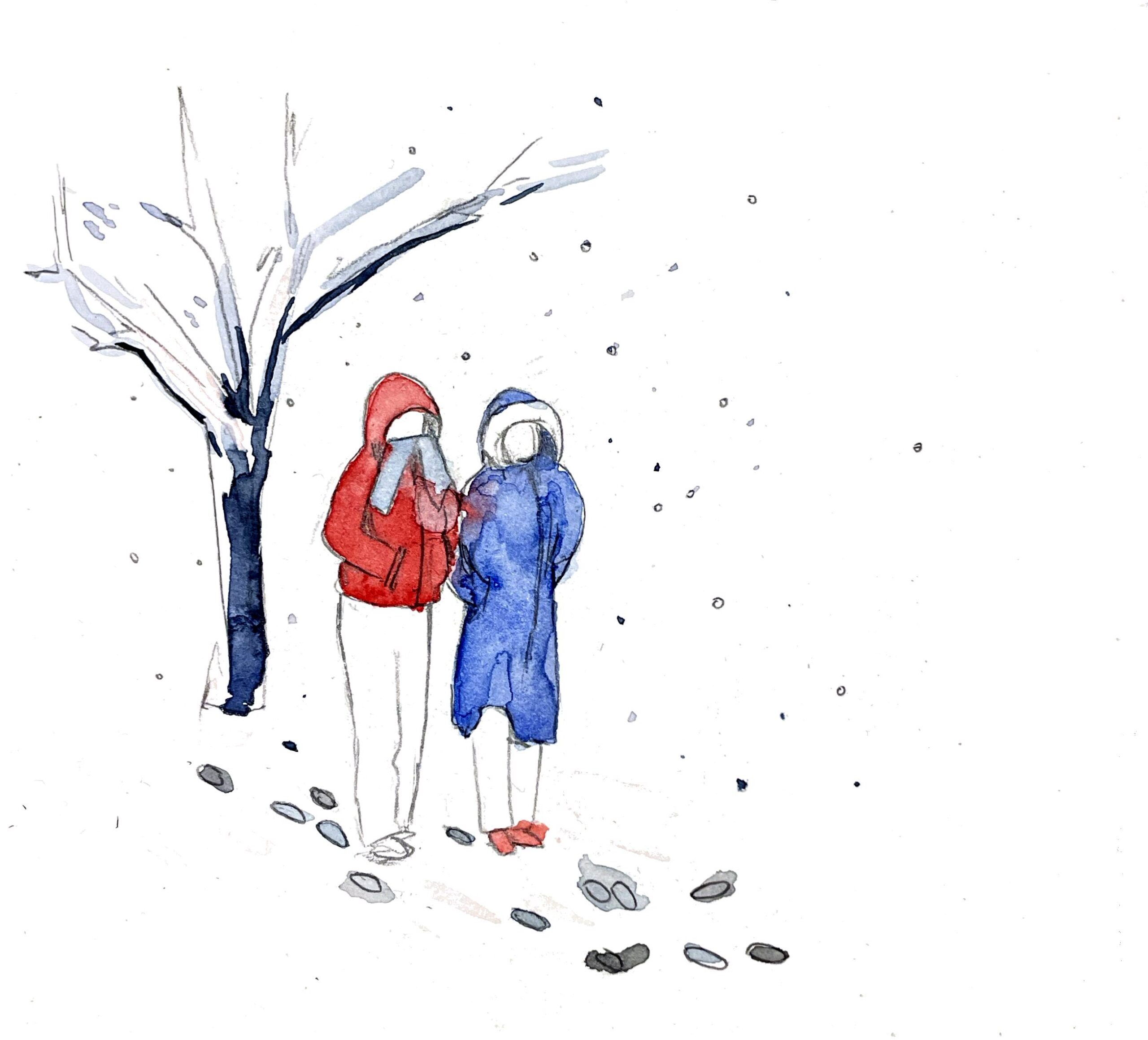
There’s a moment—brief and invisible—each year when the air turns against us, a departure of warmth that arrives without warning. Shadows lengthen, metal railings bite, and summer, once obedient, exhales its last breath. The days remain long enough to deceive us into believing that summer has lasted a day longer, but its mercy has already thinned. So one evening, without much ceremony, a shiver passes through my bedroom, and I reach for a jacket. There’s a ritual to it all. The zip, the tug, the little shoulder roll to settle the fabric. Routine but never meaningless, I perform each motion in quiet submission to the cooling weather.
It’s such a human thing to acknowledge that the world can be harsh and to prepare for it anyway. Sometimes I think about how extraordinary it is that humans evolved with cloth instead of scales or feathers or fur. I once read that humans invented clothing around 170,000 years ago, the same time our ancestors began to wander out of Africa and into colder lands. Anthropologists say the evidence is microscopic: head lice evolving into body lice as we started to clothe ourselves. Choosing to make warmth portable yet temporary was a human act of faith. When the cold fought against us, we trusted our jackets to bring us out of winter. It’s strange, isn’t it? Parasite becomes a clock. Discomfort becomes invention. Our ancestors made fabric, and bugs clung to what we wove. A biological fact, yes, but also a parable (even parasites adapted to our belief).
At Princeton, the weather has redrawn the world into a liturgy, and the wind is testing the devout. On slow days, I like to people-watch from classroom windows. Students walking quickly with their heads down and shoulders hunched; a woman’s red scarf unfurling to reveal redder cheeks (air bruises everything it touches); Canada Goose-clad seniors on street corners with arms folded across their chests, leaning into themselves, carrying the same soft confession that the world can touch us. A visiting family’s child skips through a muddy puddle and delights at the simple evidence of existence. On my walk home, I try to hop over the puddle, but splash my white Converse. The water is cold. The long season of heat has made me careless, lazy and half-dreaming. Now, I feel completely awake.
My mom always told me that warmth starts at your feet. Now my feet are wet and shivering. My footsteps squelch, and I feel ashamed. The human body can be humbled so easily.
Were the first humans undone by the apple, or the shiver that followed?
~
Then the eyes of both were opened, and they knew that they were naked; and they sewed fig leaves together and made loincloths for themselves. / They heard the sound of the LORD God walking in the garden at the time of the evening breeze, and the man and his wife hid themselves from the presence of the LORD God among the trees of the garden. / But the LORD God called to the man, and said to him, “Where are you?” / He said, “I heard the sound of you in the garden, and I was afraid, because I was naked; and I hid myself.” / He said, “Who told you that you were naked? Have you eaten from the tree of which I commanded you not to eat?” / The man said, “The woman whom you gave to be with me, she gave me fruit from the tree, and I ate.” (Genesis 3:7-12)
And to the man he said, “Because you have listened to the voice of your wife, and have eaten of the tree about which I commanded you, ‘You shall not eat of it,’ cursed is the ground because of you; in toil you shall eat of it all the days of your life; / thorns and thistles it shall bring forth for you; and you shall eat the plants of the field. / By the sweat of your face you shall eat bread until you return to the ground, for out of it you were taken; you are dust, and to dust you shall return.” / The man named his wife Eve, because she was the mother of all living. / And the LORD God made garments of skins for the man and for his wife, and clothed them. / Then the LORD God said, “See, the man has become like one of us, knowing good and evil; and now, he might reach out his hand and take also from the tree of life, and eat, and live forever”— / therefore the LORD God sent him forth from the garden of Eden, to till the ground from which he was taken. (Genesis 3:17-23)
~
Something tells me the first prayer was not spoken but breathed between Adam’s chattering teeth. Exiled from the Garden of Eden, Adam and Eve do not merely know that they are naked; they feel the cold press of God’s verdict against their skin. Knowledge wounds only when it becomes sensation. The mind falls, but it is the body that hits the ground. Now on earth, God’s act of mercy—“garments of skins for the man and for his wife”—settles into double meaning. Scripture calls the gift “kuttonet ore,” meaning “tunics of skin” when spelled with ayin (ע) and “tunics of light” when spelled with aleph (א). Many theologians prefer the former approach to biblical interpretation, insisting that Adam and Eve were clothed with tunics of light before they sinned and were subsequently stripped of these in exchange for ones of skin. Clothes of skin, they say, symbolize the first sacrificial death, an animal’s life taken in exchange for human lives preserved. In actuality, though, the first death is Adam and Eve’s own. By eating the forbidden fruit, Adam and Eve sign their death warrant; they are expelled from Eden to a world in which they can experience pain, illness, and, for the first time, cold. The wages of sin are death, so death only enters the world as a consequence of sin. In the Zohar, when God created the world, each Hebrew letter came forth to demonstrate why it should be the first letter of the Hebrew alphabet. Ayin, implying avon (iniquity) lies; “I imply anavah (humility),” and God responds, “I shall not create the world by you” (Zohar, Introduction 6:27). Ayin represents man—sinful, lying, and painfully insignificant. You are dust and to dust you shall return. Raised hairs and goosebumps tell us that the body remembers what the mind has forgotten: we inhabit a world uncalibrated to us.
If cold entered human experience only after the fall of Adam and Eve, every jacket is a technological response to that divine problem; when we put on our coats, we are continuing to chase the tunics of light we lost in the Garden of Eden. The zipper rises, metal against metal, confession against confession. Faith, too, is a fastening. The gesture is small, but it belongs to the oldest human instinct—to reach for what burns. Maybe that’s why jackets seem to glow faintly under streetlamps; humans wrapped in their own contained flames. Or maybe, our jackets are just one gesture of survival, emptied of their original fire. But perhaps, in our jackets, there are still two things to be sought: the warmth that we once had, and the meaning for why we must stand exposed. Maybe that is all ritual really is: an attempt to recreate the warmth that used to just be there.
In fact, I always forget about jackets until the first shiver arrives. For half of the year, they live in suspended condition in the back of my closet, sleeves folded in prayer. They’re like umbrellas or dollar bills to slip into hotel Bibles, the kind of thing you forget you own until the minute you need them. We attempt, with coats and fires and ordinary rituals of winter, to correct towards the warmth we once had. Therein lies the human condition: we are porous and profoundly foolish. Our jackets are testament to mornings spent choosing the right amount of layers, of the effort to survive each day’s weather. But beneath the gestures, conversations, and false composure, we still negotiate with the same invisible elements: the chill that slips through seams, the wind that tests the edges of our will. No matter how well we prepare—fleece, wool, down, cashmere—the cold, the damp, the unpredictable will all seep in (it always does). But we choose to believe, believe that jackets are our dignified reply. Each one prays, let me stay warm, let me stay alive. We wear vestments of a secular church dedicated to chasing warmth, and our coats are benedictions from one body to another. Sometimes I pass a stranger wearing the same coat as mine, and there’s a brief moment of recognition. I see it and think, Ah, you too are surviving this day. We are of the same denomination.
In the evenings, when the light withdraws early and the windows turn black before dinner, I hang up my jacket. It slumps, empty of purpose. The season has begun its long procession.
In Greek mythology, Prometheus was punished for bringing fire to humans; Zeus chained him naked to a rock, his liver to be eaten and remade each day. We are his disciples, and alongside him, we continue to zip up, knowing the cold will return tomorrow. Our ancestors founded our human faith when they chose to cover themselves with tunics. As such, warmth became ritualized into a temporary solution repeated over and over again. So, I keep the jacket close. I baptise myself in its heat and step outside anyway, rejoining the stubborn ritual of man: all of us wrapped in what we have and facing the wind that began in Eden. Simple, repetitive, and slightly holy, we declare our wish to stay alive for another year. But perhaps it isn’t faith at all, only habit—one more daily gesture to keep panic at bay.
It is the same cold as yesterday, and yet it feels new. I shiver and tighten my jacket around me. It smells of smoke, and I think of Prometheus and of the tailor’s cigarette (both burning to keep something alive).
I, too, am fragile.
I, too, am enduring this.
I, too, reach for what burns.
Momo Sonoda is in desperate need of a warmer jacket.