He’s compact, twenty-five, staring at a line of mathematical notation on a whiteboard. He’s in a mostly undecorated, windowless office alone. He rakes his fingers through his hair and rubs the back of his neck. The air is humid and he can hear distant thunder. A beer he hasn’t enjoyed, with a film of condensation slowly shearing off of the bottle, juts up from the overlapping sheets on his desk. A rivulet of dew spills off the beer and runs to be absorbed by the dry edge of a page, seeping in, becoming a watercolor of blue ink. He picks up the handwriting to examine the damage, but his eyes do not focus.
The door had been left open as his mother brought in groceries, covering her head with a jacket each time she made a trip out, and each time the rain increasing its intensity, and each time some strange wind tugging him away from the book he was coloring in. He would look at the void of the door and feel some exotic gravity pulling him into the night. On her final trip she carried bags of produce to the kitchen before returning to the door to close it, and he darted out into the night whooping. He remembers it feeling magnetic, some animal impulse pulling him straight by the chords of his being. Shirtless and barefoot – he ran out across the muddy yard howling and cackling. In each bound his heel would dig in inches and once he slipped onto his back. He scrambled up, glancing back, smeared in wet clay, skin cold, glistening – and he kept sprinting as his mother, silhouette at the door, called out after him .
The atmosphere was humid and heavy and electric. The street was flooding. Lights flickered in each of the tidy houses on the block and a transformer sparked at the corner, arcs of power fracturing the air around it and the wires buzzing. Kicking water and his tiny heart kicking blood he whirled into the center of the street and spun circles with his thin arms whipped centrifugally around him, the blood at the fingertips pressed against the outer walls, his physical boundary, but his life-blood — his awareness, consciousness, spirit — the thread of his attention, was out of reach of his being. It was braided, bundled, coiled in his core then shooting upwards at those dark masses above him, the monsters blocking the stars, collapsing into slick sick liquid to inundate his town. He yelled out all the vigor in his small body in absurd spite.
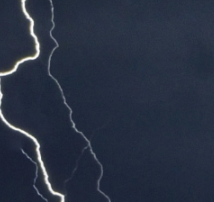
He started to curse the storm in nonsense, primal yodels – his lungs and eyes wide in the cold rain and his arms and hands exploding at the dark sky. A bolt cracked out of the clouds – the thunderclap immediate and immense, resonating in his ribs, his scream inaudible. He danced furiously, stomping and shouting and a second bolt cut a jagged line downwards to the transformer, which exploded. As he turned towards the flash in his peripheral he saw the ball of plasma expand from the transformer, an aurora of luminescent purple, and then he started to cry. He ran back into the house as the trees at the end of the street caught fire, running into his mother’s legs and grabbing her, his tears and sweat and the mud soaking into her sundress, his skin chilled and pricked with goosebumps, as she watched the flames and drew her phone to call the firemen.
To this day, this has been his eschatology: the end of world would come swiftly, the only admission of its latent pregnancy a sudden swelling, a thickening heat, a palpable capacitance. When doom broke, the world would run into it feral – eyes wild and almost rabid, nearly naked and basically weightless. Life would roar at whatever was crashing down on it, and fling its head back, and bare its teeth, lips peeled back, knuckles white, arms thrashing, feet flexed—and the bolt would run through its core.
He turns away from the window as a woman walks into the room. They don’t speak. She sits down, taking a sip of tea before paging through a textbook. He stretches and yawns and leaves for another beer. When he returns, he opens his mouth with a comment, but then bites his tongue and sits down. They’re both quiet – she’s disassembling a pen and he’s peeling the label off her bottle. They don’t know each other well. The rain patters. Neither wants to work. Long past midnight, they compare notes. The problem is unsolved . They banter lightly as she packs up. She leaves, he stays. He watches the parking lot dry until the sun rises.
Leave a Reply