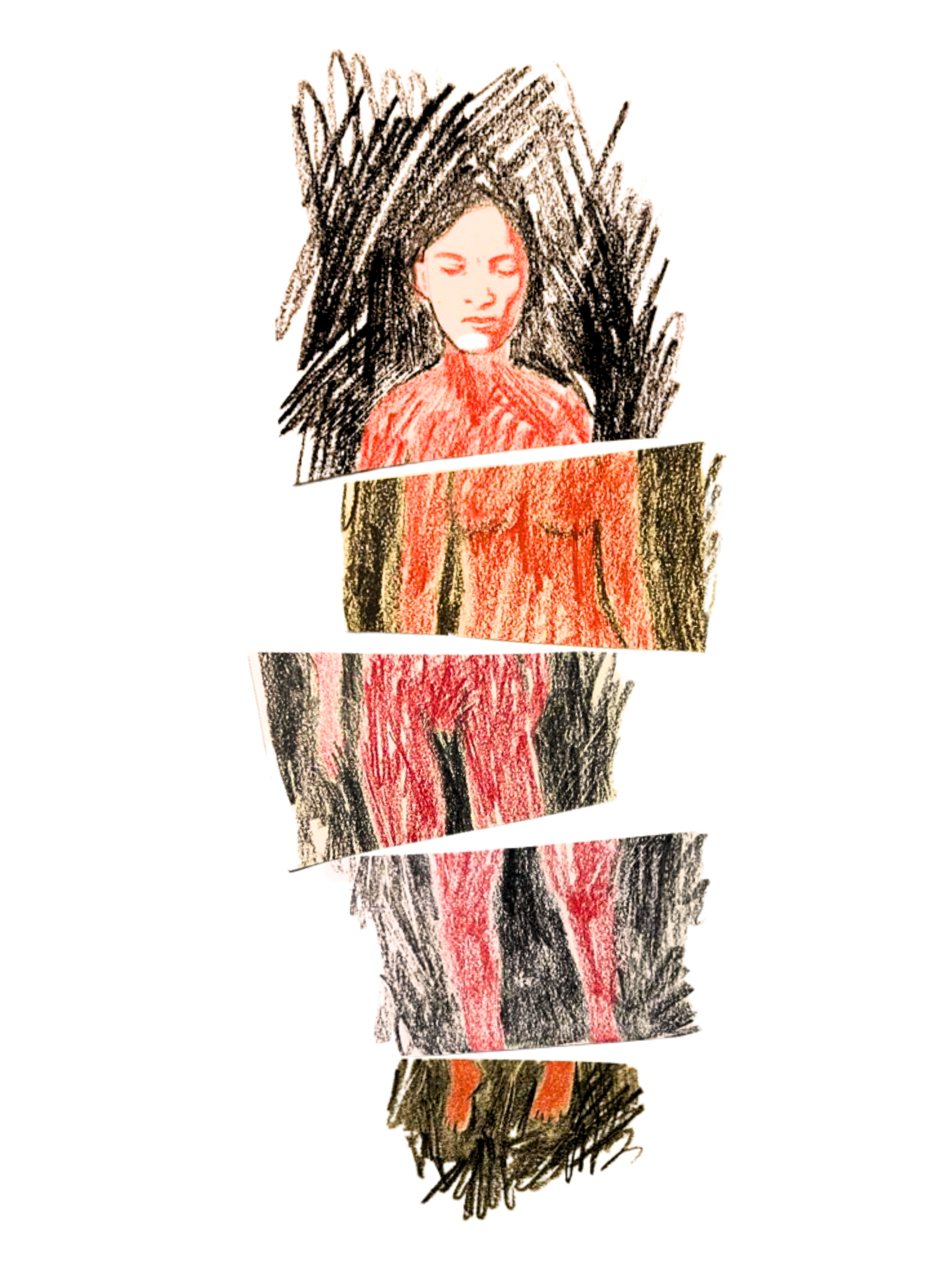
Recently, I went to the doctor’s office, and they did not believe me. I lead with this fact because in most aspects of my life, I do not experience a great deal of sexism. But recently, I went to the doctor’s office knowing exactly what I had: an ovarian cyst. My primary care doctor told me that it was likely just my IUD. The nurse practitioners at the health center questioned me for twenty minutes about yeast infections and UTIs before begrudgingly recommending an ultrasound.
I had exactly what I thought I had, only a little worse. An ovarian cyst that was 6cm big, almost the size of my ovary. I had a ping pong ball lodged in my guts. I did not know how to write about it.
—
The discourse about performative men has only exploded since the beginning of the year. Actually, I’ve gotten a little tired of reading the words. The more it’s repeated, the more it seems to lose its meaning and gain traction. The archetype itself is fairly easily recognizable: as the writer Chibuzo Emmanuel describes, “he never passes up an opportunity to wax lyrical about women’s rights. Tote bags decorated with sprightly colored Labubus, T-shirts with texts like ‘THE FUTURE IS FEMALE,’ and feminist texts…deployed loudly to signal his progressive leanings. Bonus points if he drinks matcha and shops at the female section of clothing stores.”
If you’ve been on the internet in the last year, you get the concept. At best, many of my friends seem mildly amused. In more recent months, what they feel is closer to disgust. As Cosmopolitan magazine so eloquently notes, there are “worse things that a guy could do.” So why the increasing ridicule?
—
I was raised in an Islamic household. The self, in this household, held no inherent quality. My parents told me all the things that you hopefully tell your children: that they are smart, that they are kind. However, there were no such comments when I did something mean — in a framework of discursive formation, you can only be kind if you are being kind. You can only be intelligent if you are being intelligent. The soul, then, has no absolute. Being neither evil nor good, it simply is. You must urge it, through action, towards good. In the context of the hijab, this presents itself through the ideal of modesty — that it does not exist as an inherent quality in us, but can only be performed as a task. We are not inherently modest. We must make ourselves that way.
In this context, the performative man is fascinating. In the Western mode of discursivity, the ethical body is one that is formed through its conflict with the world. Therefore, the performative man is something of an abomination. If we define their hobbies — primarily those which are ‘rewarded’ societally, at least in the sense that they are things that women value and may catch their attention — as integrating into society, then we define the disgust against them as an inherent assumption that the inside does not match the outside. We are assuming, then, that they are betraying themselves and, indeed, us, who adopt these hobbies of the intelligentsia against the brutality of the world. Therefore, we go about it the correct way: forming ourselves through struggle. While they, whose actions are incentivized, are derided precisely because it is assumed that action could never change what is inside of you — that this is a fixed quantity. A man, in other words, will always be a man.
—
When I went back to the doctors after confirming that I had an ovarian cyst, the only thing that they told me was to take Advil. A month later, I went back complaining about severe pain and discomfort. The Sunday after that, the cyst burst and started hemorrhaging blood into my uterus.
In her article “The Grand Unified Theory of Female Pain,” Leslie Jamison says of the ‘sick woman’ trope that “the moment we start talking about wounded women, we risk transforming their suffering from an aspect of the female experience into an element of the female constitution, perhaps its finest, frailest consummation.” Then how do I control my discursive self? If I have no choice but to be ill, all over the place, constantly, unmanageably, depressively, what occurs to my femininity? If men are told that their selves are warring with the world, then maybe women are told that their selves are made sick by it — hence the constant warnings to us: that birth control is overly hormonal, that food makes you bloat, or otherwise its toxicity will overtake our delicate nature.
Jamison continues: “A 2001 study called ‘The Girl Who Cried Pain’ tries to make sense of the fact that men are more likely than women to be given medication when they report pain to their doctors. Women are more likely to be given sedatives.” My illness is viewed as a discursive truth of my being, then. I am sick as in my soul is sick; I am drawing attention to my soul, not my body. In this way, the performative man and I are strikingly similar; we are assumed to be manifesting symptoms that are false to the inner being — that are, in some way or the other, well-intentioned but fake.
—
Here an inconsistency in discourse arises. Most ‘liberals’ (whatever that means in the US anymore) would agree that gender is fluid. Or if not fluid, at least that it is subject to change, precisely because it functions as a societal construct with which one defines oneself. Therefore, the enchantment with the sick woman or the bad man cannot stand. It is an inconsistency in terms.
Judith Butler says, “If there is something right in Beauvoir’s claim that one is not born, but rather becomes a woman, it follows that woman itself is a term in process…an ongoing discursive practice, it is open to intervention and resignification.”
Gender is formed cumulatively through a series of actions, similar to the self. For example, I am not really a woman because there is a woman inside of me, which is how it is often explained to kindergarteners. I am not even a woman because I wear women’s clothes, which I don’t really. I am a woman because the series of actions and mannerisms that I adopt identify me with the idea of a woman, which society then takes to mean that is what I am. The more we view certain expressions of gendered being as untrue, the more we reinforce in ourselves and others that there is a ‘true’ way to be a woman or a man, trapping ourselves in the same conservative discourse we claim to abhor.
Perhaps there is, too, a possibility that through their action, ‘performative’ men can also change the core of their beings. Our cynical belief in their unchanging betrayal of the self perhaps betrays something more sinister in ourselves: that we do not believe that we can change — or rather, that we believe there is something in other people and in ourselves that is always and unequivocally harmful.
—
I was in a lot of pain. I was not allowed to skip any of my classes. I was sleeping, mostly, and hiding from everyone I knew, and wondering why I was so miserable. My doctors would not give me painkillers.
—
Jamison’s conclusion to the ‘Grand Unified Theory of Female Pain’ is that “The wounded woman gets called a stereotype, and sometimes she is. But sometimes she’s just true.” What I want to add to her commentary: that this is precisely what gender is. Sometimes, the way we perform it is a stereotype. But sometimes it’s just true. And by framing some things as inevitable parts of our experience, we fail to interrogate their existence. If we tell women they will always be in pain, then we fail to take that pain seriously — and fail to seriously look for alternatives to it.
If my doctors had taken me seriously the first time I complained of pain, I could have had a surgery that popped the cyst two or three weeks after it started developing, saving me three months of pain and severe depression. But that didn’t happen, because I had to convince them of the pain, and by the time they did believe me, they didn’t think the surgery was ‘necessary.’ It was not necessary to save me pain because presumably, I’m used to it.
Who would Sylvia Plath be if she hadn’t been unable to leave an abusive marriage? Who would my grandmother be if she hadn’t been forced to marry young? When we refuse to think past the ‘conditions’ that are thought to be inherent to our souls, we refuse the discursive form of our souls: that in the presence of different choices, the pain did not have to exist at all.


Leave a Reply