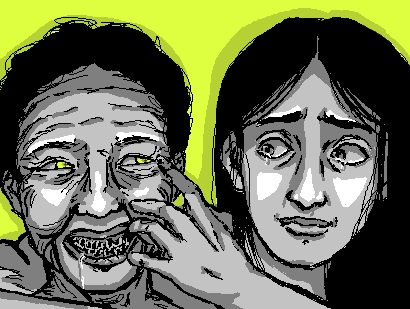
Not long ago I had a nightmare about greatgrandma. She was sitting in her plastic chair, bright red, curved backrest, in the living room of the house I grew up in: Avenida Alameda del Corregidor 2857. When alive she had been confined to her room, dumping her wardrobe on the floor and blaming us for the chaos, losing the threads of our conversations and braiding them with those in her head. I had come out of my room when I found her, sagging and silent, under the San Damiano cross.
Was my mind not letting me escape the truth or was the truth so deeply buried in my heart? Because with one glance I knew she was dead: her head sinking deeper into her shoulders, her eyes unblinking, her body reeking of formaldehyde. Dead. Deceased. Passed away. Though there, with her brown knitted socks and her lilac pajama set with fuzzy wool inside. Dead. Deceased. Passed away. Formaldehyde or not, I wanted nothing else but to hold her.
So she woke up.
Her eyes were yellowish-green, the color of sulfur, and she babbled “Good morning, child.” She emerged from her seat as if emerging from the soil: reaching, grasping. I felt the tears soaking my neck before I felt them soaking my cheeks. She tripped. This time I caught her.
Right after inhaling the formaldehyde off her skin I started breathing.
I linked my arm with hers as we entered the hallway and headed to my room. Her every step was doubtful but heavy. When I saw the shape of her patella I had to look away. Even then I wished it would take us long enough we could forget why we were walking at all. My prayers were heard— sort of. After every step, the hallway grew in size. At one point I could barely glimpse the end. Greatgrandma never stopped walking. My shaky hands hovered over her arms as she wobbled between my fingertips, humming and creaking.
In the middle of my room was one of my coworkers. They handed me a piece of paper. “Don’t forget to send a postcard.”
It read LATAM airlines. I blinked once. Twice. Thrice. Everything remained the same except greatgrandma who was trying to talk but her tongue kept getting stuck to the roof of her mouth. There was no emotion in her eyes as she struggled. Her gurgle and empty eyes didn’t let me think.
“Why?” I asked.
My coworker smiled, “Your family realized it was time.”
“How?”
Their chin pointed at the door.
“Thank her.”
When I looked beside me I met my greatgrandma’s glimmery, yellow gaze.
Once we entered the hallway I fluttered around her, stepping on her footsteps. The excitement of coming back to her clouded my need for an explanation. Was greatgrandma alive or could this be a last bodily reaction, the last effort her body had managed to pump? But this was not a sudden jerk or a soothing death ho-hum neither was it some unconscious tossing and turning, the body becoming stiff only to sag. She was alive. Still cold. Still stiff. Still dragging her feet on the ground and still reeking of formaldehyde but when I hugged her, she was the greatgrandma who could not resist putting her hand over mine when it was close. And she was still holding onto it now. Though the smell and the feel of her skeletic fingers made me recoil, I was grateful. Of course I was.
For a second I thought about calling a hospital but even in my dreams I was selfish. If death hadn’t robbed me of her, nobody would.
“Child,” she said. I dropped everything to lean into her. “Seeing you happy makes me happy.”
Life had been returned to her—the one she squeezed every drop of, the one she did and redid in her stories when it was just the two of us in the living room of our first house. That life (where she fed me, clothed me, held me) suddenly remembered it belonged to her. I hugged her tighter.
On our way back, the hallway had returned to its original size. She had almost slipped twice before entering the kitchen so each time I pressed her against me, linking my arms against her stomach to stop her from falling on her face. As I held her, I pressed my ear against her back—partly out of old times’ sake and partly out of morbid curiosity. Her heart did not beat. It whirred.
“I’m fine,” she panted each time she did not hit the floor. “Don’t worry about me.”
How could she ever ask me that?
Everything was white in the kitchen– white tiles with white marble, a white roof with white cabinets. I took a step back. It was the kitchen of our second apartment.
“Mama,” I said, and I did not know why I said it. On our last video call she was sinking in her wheelchair as she hovered over a spoon of bland oatmeal she kept missing. Before that she would see me through a screen, 3465 miles and 7 countries between us, and at least waved. Three months after I moved to America and she stared at me as if I were another pill, another syrup, another bandage, another prescription forcing her to stay alive, “Mama, why do I feel like nobody loves me?”
She let go of my grasp and I hovered around her. I did. I really did.
She smiled. Fondly. “If only everyone could like us-”
Then, she slipped.
She blinked, confused by her own weakness. Bright, yellowish-green eyes opened and closed. Opened and closed. Even before she landed I knew she had cracked her head.
And the scene, oh, it was horrible—no blood because corpses cannot bleed, no resistance because corpses have accepted they are losers, no coherent sentences because corpses are not supposed to do anything with their mouth except give a final exhale.
I woke up crying.
Music played from my phone. Bad girls – Donna Summer. My room was pitch dark. I had made a mess of my sheets tossing and turning. Behind my windows the tree and all its creatures were fast asleep. I heard a lonely creak from outside my door.
Ever since greatgrandma died I had kept dreaming of her: disappearing, withering, evaporating from my hands. And ever since great grandma died we had been reduced to roles: she, the object, I, the observer, and like the object and observer we knew our parts; she would stand there and disappear and I would watch her leave.
And suddenly I was not on that bed that squeaked every time I moved and I was not under those 100% polyester covers that always made me itch. Memory flew me 3,465 miles away from my bed, 7 countries to the south of America, to the small church by the side of a major avenue where her body rotted in that coffin. And I was humbled. In the face of death there were no winners, just future losers, and as the loser I was I cried over my defeat. Even when I joked with my coworkers or wrote long essays or dissected everything anyone would say, I cried. I cried even when I raged for having no tears left —and maybe because I cried all the time, I was dry.
That night, however, my tears returned, carving an unfolding emptiness in my chest. At the thought of her cracked head and the loud thud I cried harder, but I also seethed at myself. Had I only been able to believe in what everyone around me was saying, maybe I would have had some comfort. She is in God’s glory; she is in heaven; she is watching over you now. But how could she, if glory had been her laying on her anti-bedsore mattress, draped under her purple blanket with fuzzy wool inside? How could there be another heaven than the moments she sang about hummingbirds and a longing that lasted a century? How could she be watching over me now when she always had?
In the weeks following her death, my family attended masses every day. Once she was cremated, a loved one and I sat on a bench, staring at the smoke from the crematorium’s chimney—and whatever consumed her was gone in that white plume going almost in a straight line as if in one-way to heaven. I just watched it go.
At that moment he claimed we were different: he had the tales of eternal glory to hold onto, but I had nothing. No tales. No eternal glory. Nothing to bury my truth under.
Why? Why couldn’t I believe in a God and convince myself she was fine, out there, wherever she was? Why? Why? Why?
Why did she die? When could I hold her again? Her face, the one I filmed as I said goodbye. Her impossible soft onion skin. Her cheekbone I used to leave kisses against. Her complaints when we carried her out of the shower and cured her bedsores. Even irritating things like sitting on the bathroom floor and hearing her pee, or brushing her fake teeth, or hearing mom say God, we’ll have her until you want her back. We would sit with great grandma and watch her suffering and watch her watching herself suffering. Sometimes we all dreaded the waiting, sometimes we all waited with patience but more often than not, we were eager for death to come. In the beginning I felt ashamed until it became another uncomfortable but bearable truth.
I called mom.
She picked up after the second ring, and was startled by my sobs. I found more comfort in her tone than in her words (I know you don’t believe in a God, but she is somewhere else. If you are worried, go pray to the universe for her well-being).
But the comfort quickly turned into despair. What if my mom died and I did not get to hold her hand? What if the loved one with the cruel words died and nothing between us changed? But I also fixed on other things, like the dream and the pitiful babble that robbed my greatgrandma of her words or the fact that everyone she loved had died. She had missed them daily in front of my eyes so how could I dream of wanting her alive when death fulfilled her wishes?
But was that what I dreamt?
In her prime, great-grandma had sat in our living room and recalled her childhood in a 1930 Latin American port. She had taught me how to read and she had taught me how to use a fork and a knife. In less than a decade she turned into vestiges —sweet, caring, motherly but also confused, angry and often resentful. At some point in my life she became the object I took care of rather than a member of my family, and at some point in my life, I sat on the front row of her suffering, watching her die little by little, day by day, breath by breath.
So maybe I dreamed about why she died.
That morning I fell asleep at four and I woke up around eight. I went to the bathroom. I got dressed. I took the bus. I attended class. I went to work. I went back to my house. Life without greatgrandma was house arrest and at any time, grief could knock on my door to check my attendance. On November 29th I was present. And so was all my unexpressed sorrow. All my unexpressed love.
Leave a Reply