I
The cell was a nightmare. It was loud and hot and small — twelve square meters, if that. In the days of the former government it had only ever held one or two inmates at a time, but now the enemies of the Taliban stood packed shoulder to shoulder, civilians and soldiers, protesters and police, waiting for their turn to be tortured. Many had already been beaten. One man was unconscious, shaking, splayed out on the cell’s only bed with his hands broken and his back bent. Lutf Ali Sultani watched him die. Sultani was 26 years old; he was newly wed; he was a journalist at Etilaatroz, which had in recent years come to be one of Kabul’s premier newspapers. He was by all accounts bright, enthusiastic, and brave, a reporter in the early years of a promising career. Now he was in a cell, watching a man die. For all he knew, he was next.
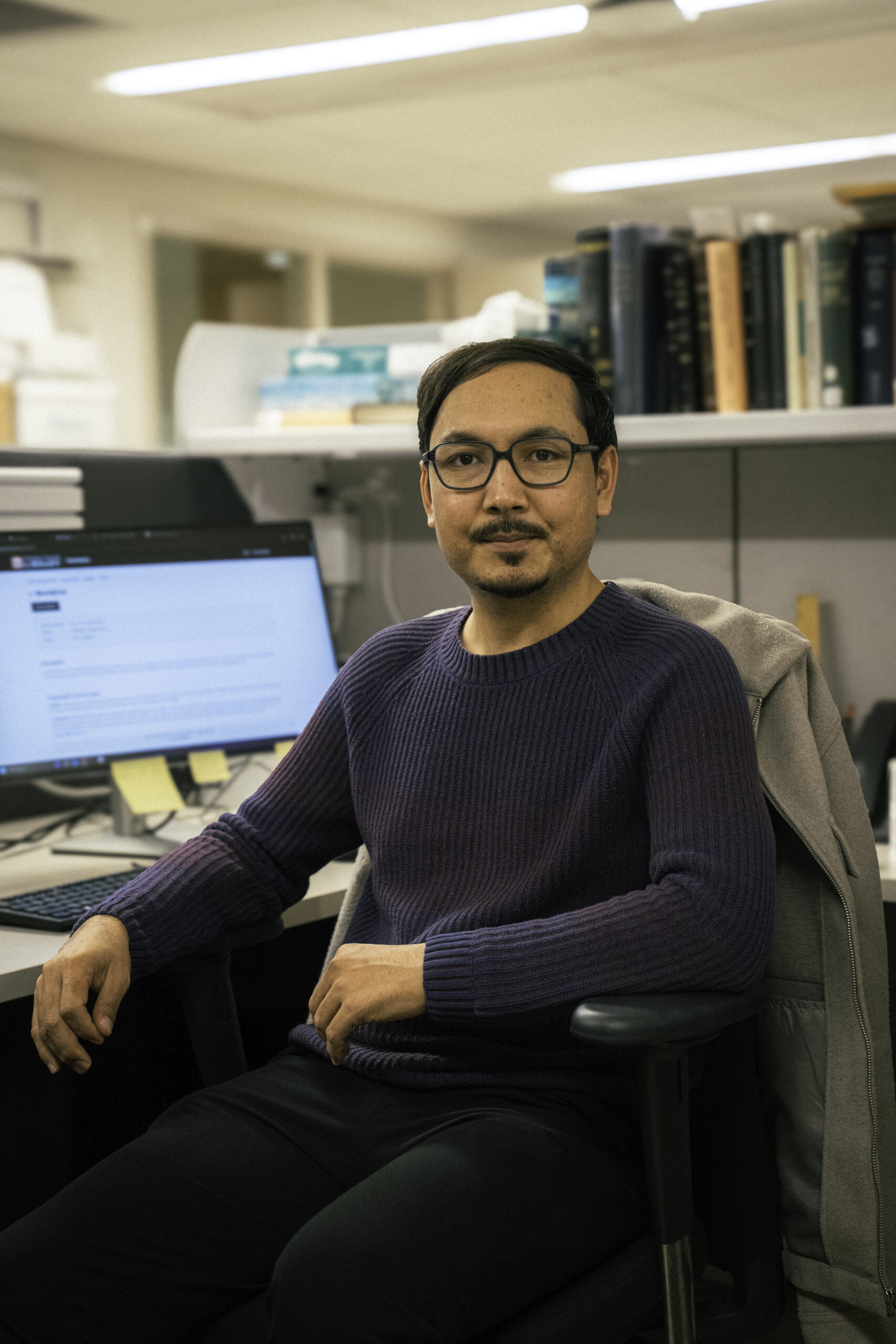
Four years later, Sultani remembers the feeling. “I was really frightened,” he told me. “The waiting, it was like torture. I was thinking to myself: ‘eventually, your turn will come.’” Sultani’s speech is measured. When he talks about the cell, his words come deliberate but soft, almost playful, with the unhurried cadence of a late-career author. He looks his age — he’ll be 31 in April — but he seems in his measured demeanor somehow older. He’s been working at Firestone Library for two-thirds of a year. He is kind and handsome — his face, awfully gaunt in the months following his imprisonment, is now round and full. He likes to read and, sometimes, to dance. And he’s lonely. Sultani is lonely. His world has split and the pieces have scattered. He felt it all break in the cell.
Sultani was jailed on September 8th, 2021. The Taliban had taken Kabul on August 15th, less than a month earlier. After the city fell, the United States was given a fortnight to evacuate its citizens, alongside any Afghans it deemed especially vulnerable (human rights activists, special visa holders, and the like). Late at night, Sultani would watch planes roar out from Kabul’s airport in a constant stream, one after another, carrying U.S. allies to safety. It was an impressive operation. Still, most Afghans were left behind. “Tens of thousands of people just gathered at the airport,” Sultani recalled. “It was unimaginable.” A canal of human feces formed around the perimeter of the airfield. People would climb up through it and jump the fence.
Sultani hoped that he would make it onto the evacuation list — Etilaatroz had ties with several prominent NGOs, and its employees were clearly at risk in a city controlled by the Taliban. Surely, he thought, the National Endowment for Democracy could get him and his colleagues on a plane. The evacuation window was closing, but he still had hope it might be extended. And maybe so, were it not for a suicide bombing that ripped through the gates of the airfield on August 26th, killing 170 Afghan civilians, 13 U.S. soldiers, and any hopes of U.S. presence in Kabul past the end of the month. Once midnight came on the 31st, Sultani says, “Kabul became silent… we had lost every hope of leaving the city.”
But some things were not yet lost. Agents of the Taliban hadn’t descended on the Etilaatroz offices. Instead, Sultani says, “the Taliban was telling us that, you know, ‘we respect the freedom of speech.’” The Etilaatroz staff distrusted this posture, but what else could they do? “The only route,” says Sultani, “was to go back to the office.” So he returned, beleaguered and wary, to his reporting. Aber Shaygan, an editor of the newspaper and one of Sultani’s closest friends, told me how dour the mood had become. “We felt a kind of guilt,” he says. “And that guilt made us continue to work.”
On September 8th, Etilaatroz sent two journalists, Taqi Daryabi and Neamat Naghdi, to cover a women’s rights demonstration in the center of Kabul. They were supposed to capture a short video for the newspaper’s social media feed, and then return to the office. Instead, they were arrested at the protest and sent to an overcrowded detention center that had served as a police station before the Taliban took the city. When they heard the news, Sultani, Shaygan, and another Etilaatroz editor marched down to the prison and demanded that their colleagues be released. They imagined that their affiliation with the newspaper would keep them safe. Instead, Sultani says, “as soon as they heard we were journalists, the Taliban commander ordered his soldiers to take us.”
The men were dragged from the office, pistol-whipped, and shoved into a cell. Worse, they could hear the colleagues whom they had come to rescue screaming from another room. “We could recognize their sounds,” says Shaygan. “It was so, so horrible.” Daryabi and Naghdi were tortured for hours. They were kicked, whipped, beaten with batons, battered with electrical cables. “I thought they were going to kill me,” Naghdi would later recall. Sultani heard it all. At one point, the guards brought in a man with broken hands. He lay on the bed in the corner and died.
By then, Etilaatroz had published the names of its five missing journalists. The Taliban, which had controlled Kabul for a mere 24 days and still feared major international pushback, decided to release the reporters. First, though, it asked for concessions: Etilaatroz’s writers were no longer allowed to cover the protests, or any event with undertones of resistance. “The commander asked us to sign a paper,” Shaygan recalled. “He kind of warned that if we continue, we will be in jail for all our life.”
Sultani had only been imprisoned for half a day — five hours, by his estimation. But it was time enough for him to realize that his life had changed for good. He had no future as a journalist in Kabul. He had no future as anything in Kabul. Before he left the prison, the commander gave him one last speech: “You want democracy?” the man had asked.“You want freedom? This is the freedom. We’ll show you the freedom if you do it again.”
II
The Taliban was founded in 1994, but Afghanistan had been at war with itself since the collapse of its Soviet-backed government in 1992. By 1996, the Taliban had taken Kabul, which they would hold until 2001, the first year of many that U.S. missiles came screaming overhead. Sultani was born in 1995, at the height of the civil war, in the mountainous province of Maidan Wardak. His was a family of farmers, and they had been stretched thin by the fighting. “For my parents, it must have been a pleasant moment,” says Sultani of his own birth. “They have brought one more into the world. But for the kid, you know, it must be very hard to be raised in the middle of the war, and the poverty.”
Sultani is the fifth of eight siblings. Even so, he was often alone — “when you grow up in a very crowded family,” he says, “you don’t get a lot of attention.” Being a boy, he was expected to help out with the livestock: by the time he turned six, he was tasked with bringing the family’s goats through the hilly outskirts of their village to pasture. The family made do, but their hillside pastoral was tinged with violence. Frenzied fights would break out between the siblings — once Sultani saw one of his brothers chasing another with a knife. There was always news of the war, and the news was never good. A few days after the Taliban lost Kabul, Sultani was shaken awake by his mother in the dead of the night. Armed men were coming, she said. They had to get out. The family fled to a neighboring village, and waited there until the coast was clear.
Sultani’s father, Abdul Rahim, was a deeply religious man, cautious in his business dealings and overbearing at home. At 14, his parents — Sultani’s grandparents — were taken by agents of Afghanistan’s Soviet-backed regime and killed. Years later, he seemed lost in the family he’d managed to rebuild. “He was violent with my mother,” Sultani says. “And he was very violent towards us. I’ve lost count of how many times he was beating me, and for really silly things, for things kids do. But he himself, you know, he was just 14, and he lost his dad.”
“For a long time,” says Sultani, “I was blaming my dad for all these violent things he did to me. But that’s when I did some self-reflection, I read some books… he was a victim of violence, and it affected him, and he transferred it to his kids, to me, and I feel that I’m the one who can break it.”
The violence, the chaos, the war: these are things Sultani would like to leave behind. But it wasn’t all bad. Sultani remembers one moment in particular, an afternoon out in the grasslands, peaceful and free. “I was 4 or 5,” he says. “It was land in the middle of two streams, and I lay down, and it was hilly, and it was in the summer, and I was just lying and rolling on that. And that’s the most pleasant moment I’ve remembered.”
When Sultani was eight, his family moved to Kabul. His father opened a metal shop, but Sultani was deemed too young to work there. Goats are one thing, angle grinders are another. He was sent to school, which, to Sultani’s disappointment, comprised all of one dingy room and a correspondingly dull instructor. For the first few years of his education, Sultani was a mediocre student, a half-hearted writer and a hesitant speaker. By the sixth grade, though, he had come to enjoy his work. “I became the third in my class,” he says. “That was a huge achievement. I remember it.”
Sultani had high hopes for college. “Getting into Kabul University was, for the Afghans, like getting into Princeton,” he says. He would submit to the school a single number: his score on the “Kankor,” Afghanistan’s university entrance exam. “It was like a bridge between limbo and paradise,” he told me, invoking one of the great images of Islamic theology. “It’s very thin. It’s as thin as a hair, and as sharp as a sword.” Sultani did well, and he entered the University in 2012, set on pursuing journalism.
Unfortunately, much like the last one, this new school proved closer to limbo than paradise. “They teach you the curriculum from the ‘70s and ‘80s,” he says. “It was not very relevant.” In his journalism classes, Sultani wasn’t asked to conduct interviews, or even to write stories. “We just had these chapters [in our textbooks], and we were reading just to pass the exam.” So Sultani looked elsewhere: he found peers who were similarly underwhelmed by the school’s curricula, and he spent most of his time with them. Together, they hiked up the mountains that bordered the campus. They would tell stories and jokes on the lawns for hours. And they threw parties — “underground parties,” says Sultani, with drinking, dancing, and the rest. “They were not allowed, but we were doing it, and it was fun for us.” A few months after Sultani graduated, one of his friends introduced him to the editor-in-chief of Etilaatroz. Sultani started there the next day.
In 2016, Etilaatroz was publishing out of what was essentially a three-bedroom apartment: one room for the reporters, one for the administrators, and one for the editor-in-chief. For Sultani, it might as well have been paradise. The newsroom was tight-knit — there was little bureaucracy, and less competition among the writers. You were friends with your boss. Your editor sat two feet from you. In the days you would write, and at night you would dance. “It was like a family,” Sultani says, and he means it. He had never felt so accepted.
In the late 2010s, Kabul was awash in suicide bombings, and Sultani was often the writer that Etilaatroz sent to the scene. In 2017, Sultani covered the bombing of a German embassy by profiling one of the building’s electricians, who had no way to provide for his family after the literal obliteration of his livelihood. The most notable victims, Sultani reasoned, were already being covered by the international outlets — telling a smaller story was “something meaningful that I can do.” The article took off. In the years to come, Sultani would write many more profiles like it.
As Sultani found his beat, the paper grew alongside him. In 2019, Etilaatroz moved from the apartment to a large two-story building. They became “The New York Times of Kabul,” Sultani told me — but the spirit of that first newsroom prevailed. Reporters played Ludo with each other at their desks. They took breaks for matches of table tennis in the back yard, or games of volleyball in the front — there was no net, but the writers pretended, and the games, according to Sultani, were fiercely competitive. In 2020, Etilaatroz won Transparency International’s Anti-Corruption Award for their reporting on Kabul’s government. They soon received honors from the Open Society Foundations and the National Endowment for Democracy. Many of the journalists worked 70 or 80-hour weeks. In the days they wrote, and at night they danced.
Through it all, Sultani saw his future taking shape. He would continue at Etilaatroz, but not before finishing his education — like many young Afghans, Sultani hoped to study in the U.S., to “go abroad and see and learn.” He began applying to scholarships, and he signed up for an English course, which he was soon looking forward to for reasons beyond its plodding curriculum. Sultani had fallen for one of his classmates, a sharp, charming young woman named Zahra. After a harrowing few weeks (try talking to your crush in a third language), Sultani asked her out on a date. They married a year later, in early August 2021.
By then, though, everything else was coming apart. The Taliban took Kabul mere days after the ceremony. Sultani feared for Zahra. He feared for Etilaatroz, for its newly silent newsroom, for its writers, his closest friends, who had in better days been so loud and young. Then the cell, the proof: his paradise was lost. He had been shunted back out onto that wire-thin bridge, and it had snapped beneath his weight. Nothing was ever the same.
After their release, Daryabi and Naghdi, the colleagues who’d been tortured by the Taliban, made international headlines. The State Department took notice. Nine days after his imprisonment, Sultani was on a plane to a U.S. airbase in Doha, Qatar. He’d made it out unscathed — how many Afghans would’ve climbed up the fences and fought through the airfields for that? But something was lost in the cell. Something was left in Kabul.
III
Sultani works on the A-Floor of Firestone Library in a room with eight cubicles and no windows, unless you count the large sheet of glass that divides the space from a hallway that runs past it. On the off-white office walls are books: tubs of books, stacks of books, folders from which books can be extracted. Broadly speaking, these books are of two sorts: some are fat, and some are thin. The fat books are reference books, often bilingual dictionaries, sources meant to help Sultani and his colleagues do their thorny work. The thin books are texts to be translated. Across their pages run Kanji, Chinese characters, Cyrillic, Perso-Arabic script, Devanagari script, graphs galore, languages in books that stretch and thin out into magazines, papers, poems.
It’s a strange place, this office. It’s quiet, for one, much quieter than the newsroom ever was. And even if a conversation does break out, there’s a good chance it’s in a language that Sultani does not speak. Each collections specialist is responsible for a different group of languages; there’s something Babelesque about it all.
Sultani is good at his job, thanks in no small part to the skills that made him an excellent journalist — he speaks three languages, he’s innately curious, he’s an avid reader and a thoughtful writer. Still, much of the work is rote. Sultani spends his work days collating texts, cataloging texts, moving texts from one bin to another. Sultani gets coffee with his colleagues at lunchtime, but he’d hardly call them his closest friends. The office is just that: an office. He leaves before dark, and he drives home alone.
There’s no one waiting in the driveway. Sultani lives alone — his wife is finishing her degree a few states away. He sees her only once a month. “It’s been very hard,” Sultani says. He doesn’t like to talk about Zahra. He’s protective of her, and for good reason — she’s all he has. “I cannot imagine that I can continue without her,” he once told me. His tone was not grave but gentle, almost serene.
Sometimes Sultani calls his lawyers, just to talk. They are a married couple, Patricia Pickrel and Vincent Gentile, New Jersey attorneys extraordinaires. They met Sultani over Zoom, in January 2022. At that point, Sultani was sequestered in Fort Dix, a U.S. airbase 40 minutes out from Princeton. Pickrel and Gentile were used to calling up Afghan refugees — in recent years, they’d taken an interest in asylum law. Still, there was something special about Sultani. He was enthusiastic, Pickrel told me, and smart. He was humble, too — a steady, affable sort, “not a self promoter.” (Aber Shaygan, the editor from Etilaatroz, used the same exact language to describe his long-time friend: “he’s not a huge self promoter.”)
By mid-February, Sultani was awarded a Green Card, but Fort Dix wouldn’t release him until he had found a place to live. Hearing this, Pickrel and Gentile offered him an office space in the backyard of their Princeton home (they’d built it during the pandemic, and were happy to turn it into a sort of auxiliary apartment). “It was the human thing to do,” Pickrel explained. Sultani moved in on the 19th, and stayed for six months. The lawyers kept him company — eventually, they became Sultani’s good friends. Even so, it was a bleak time.
“When I came here,” Sultani says, “I felt so lonely.” He missed his family, especially his sisters. “Girls in Afghanistan are at risk of horrible things,” Pickrel told me. “And, you know, that really weighed on him.” He missed his wife, too. But more than anything, Sultani missed Etilaatroz. He missed his friends. Back in Afghanistan, Shaygan explained, Sultani was “the fun guy, the guy that… makes jokes.” He wanted everyone to get along — “if something happens, or we get upset,” Shaygan told me, “he’s the one who always starts to talk.”
This time, though, Sultani could do little for his community. His friends and colleagues were hopelessly distant, both geographically — they were scattered across North America — and emotionally. Everyone was reeling from the shock of fleeing Kabul. “That was the most difficult time in all my life,” Shaygan said. “I had social anxiety, depression, sleep problems… I didn’t know how to deal with it.”
It’s a potent thing, loneliness. It breaks you slow. It pulls you from yourself. This is clichéd, but also true — the space between “I feel alone” and “I will always be alone” is thinner than it looks. If you are, in fact, alone, or close to it, it takes real courage to resist the second statement, which offers in its comforting finality a sort of ontological coatrack on which to drape your bitter and continual resentment. All this is to say that Sultani’s choice to live with his loneliness, his choice to beat it back, little by little, as he builds his second life, is somewhat remarkable.
On his worst days, Sultani would ride his bike down to Kingston or Montgomery, watching herons splash in the shallow banks of the canal, breathing all the while soft and slow. It was like the grasslands: a space between two streams where Sultani could, for a moment, revel in the freedom of his solitude.
Sultani also turned to the Firestone stacks. “He loves books,” Pickrel said. “He loves history.” He gained access to the library through the lawyers, and kept it after he was awarded a 2-year fellowship from Princeton’s School of Public and International Affairs. He spent those years studying the plight and resilience of Afghan women under Taliban rule. He was thinking of his sisters and his wife.
Sultani misses journalism, but he doubts that his English will ever be good enough for him to make a living off his writing in the States. Instead, he hopes to turn a scientific eye toward the many stories of his home. “Afghanistan could be a very good case study for social psychologists,” he says. “That’s what I want to do, if I get a chance.”
For now, he waits in his cubicle, in his driveway, in his empty house for his wife to return. She graduates this year, and once she does, she will join Sultani in Princeton. “I feel that, when we will be together, life will get easier for us,” Sultani says. He smiles, a little sadly. “We are both so young.”
IV
Sultani is driving. He’s watching the leaves go by. The drive is long, but not unreasonably so — besides, it’s beautiful out. It’s mid-October, and the Airbnb is in rural Pennsylvania, and the leaves are a glorious quilt, ragtag, resplendent, rolled out to the edge of the world. A special sight. And a special weekend, for the pieces of Etilaatroz, the men of the newspaper, the closest friends Sultani’s ever had, will soon be reunited. They come together once a year. They come from Salt Lake City, from Seattle, from Chicago, from New York. There is little writing to be done but they come, once more, to dance.
Sultani gets in at 6 p.m. By then it’s cold out, but his friends have lit a fire and formed a circle. In the uneven light Sultani sees Taqi Daryabi, one of the journalists who was arrested at the women’s march. “I ran toward him,” Sultani would later tell me. “I got out of my car and I just ran, you know… I hugged him tightly.”
Before long, the music comes on — Afghan pop, the songs that would play in the newsroom at night. Sultani dances with his former colleagues for hours. Later they eat, as Sultani puts it, “very tasty Afghan food,” and in the morning they hike, and play in the backyard the sort of games they would play in Kabul. Throughout it all, says Sultani, “we talked about our days in Afghanistan, when we were at our office.” There are anecdotes and inside jokes and uproarious confessions and the pain of losing it all is blunted, somehow, in the ceaseless noise. “It’s the highlight of my year,” says Sultani of the reunion.
Three days later, when it’s time to go, few attendees leave alone. Some carpool. Others have spouses, or kids. Sultani is the only one headed to Princeton. He will drive himself back home.
This time the trip is long and bare. Already, the trees are browning — the edges of the woods are fraying in the cold. A leaf, cracked and curled, comes drifting down from overhead. Sultani watches. He wonders what it’d take to put it back.
Leave a Reply