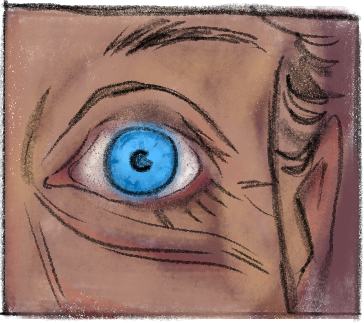
I walked out of You Can See Everything with a strange feeling in my stomach. It wasn’t exactly delight, it wasn’t exactly confusion, and it wasn’t exactly frustration—it was simply, indescribably, strange. I was reeling from three hours of head-spinning action, from Elizabeth’s constant, wide-eyed, piercing gaze to Billy’s full-frontal nudity and his snatching of a bowl of eggs from a dissociated, unfazed Elizabeth. Co-director Nathan Fielder shows Elizabeth the famous “Who’s on First” sketch, and she displays a shocking inability to understand homophonic miscommunication. We watch Amanda Seyfried watch Liz and Nathan watch Amanda’s performance in The Dropout—an awkward, meta-dystopian nightmare. An AI hologram of “Liz,” the rebranded, post-conviction persona of Elizabeth, reads her letters from prison aloud to her children. Billy proudly declares he carries a gun on him “24/7, 365.” Liz claims she has never told a lie in her life. Billy has power of attorney. The two are starting Theranos 2.0. Elizabeth’s father reveals she was raped.
In the final scene, Nathan and Elizabeth swim together, in their underwear, and the audience, awestruck, questions whether Nathan has fallen in love with the subject of his own documentary. Any viewer would be affected by a film with this much shock value. Though I couldn’t even begin to list every jarring moment of the film, somehow what threw me off the most was the fact that it was shot entirely like a feature A24 film. By far.
Like most A24 films, You Can See Everything looks pristinely, meticulously, and perhaps ostentatiously cinematic. Every composition has been perfected, the lighting is moody and crisp, each close-up is crystal clear, and almost every cut maintains continuity. The reason this style is unconventional for a documentary is that it takes an incredible amount of planning and time to achieve. In one moment, Elizabeth and Nathan sit on her couch. The camera frames Elizabeth’s face in a medium close-up as she proclaims her deep love for her family. “I could be taken away from them,” she admits, a tear rolling down her face. Then, we cut to a wide shot of Liz and Nathan from behind. There is no camera visible in front of Liz. Yet, the tears running down her face remain. Her positioning is exactly the same. The conversation seems to progress seamlessly. Continuity is maintained completely. What does this mean? Perhaps, like in most narrative film productions, they asked Liz and Nathan to repeat the conversation twice in full, each time with a different camera angle. This seems unlikely. Still, the filming style gives the impression that they did this, and subsequently, it makes one question the film’s authenticity. Similarly, in an earlier moment, Nathan, Billy, and Elizabeth talk in the kitchen while Liz, very slowly, beats a bowl of eggs. As they discuss, the camera pushes to a close-up of the bowl. Billy reaches over, grabs the eggs from Liz, and resumes her mixing for her with increased vigor; Elizabeth simply continues on in conversation like nothing has happened. This moment is one of the most talked about from the film because it is so unbelievably representative of the dynamics within Elizabeth and Billy’s relationship that it is almost hard to believe they caught it so perfectly on camera. How, for example, did the cameraman sense that the bowl of eggs would be important enough to linger on in close-up? How did he know to anticipate Billy’s movements? Again, perhaps it’s merely luck or skill, but the fact that it happens in such a close, focused frame nevertheless makes the viewer wonder: is this too perfect?
Co-directors Nathan Fielder and Lance Oppenheim explain their filming technique as follows: three cameras, two super zoom lenses, one wide lens, two operators, and no artificial lighting. They chose filming locations in areas of the house where several cameras could be most hidden, and for this same reason, a large majority of the film’s shots are in close-up or wide. This combination, Oppenheim explains, as well as serving a practical purpose, evokes a feeling of closeness in which a viewer can feel as though they are actually in the room with Elizabeth and Nathan. Shots cut back and forth between extreme close-ups of Elizabeth’s uncanny face and Nathan’s equally disturbed reactions, bringing the audience into their conversation in a way that traditional documentaries simply do not. In interviews, Fielder and Oppenheim reiterate exactly this—that their foremost intention was to convey the weirdness of the filming experience in the final product. Their task, they explain, was to find “different ways of telling and reacting in real time” while also “making aesthetic choices.” Likewise, every shot in the film—even a one-off establishing shot of Elizabeth typing on her computer, filmed in a low-angle wide shot with lighting that perfectly highlights the shadows of her face and her piercing blue eyes—looks almost comically cinematic. This look cannot happen by accident. Though Fielder and Oppenheim are hesitant to acknowledge this outcome as intentional, the style of You Can See Everything reflects a deliberate creative choice to shoot the film as if it were narrative fiction, inviting us to watch it that way too. I’m not claiming that all documentaries don’t require time to plan or to make creative choices; however, I’m pointing out that this particular nature of planning and filming is unique. And yet, the film presents itself as a candid exposé on the true life and person of Elizabeth Holmes through which we can “see everything.”
I didn’t know how to proceed. I entered the theater expecting a classic documentary with insight into the truth behind Elizabeth Holmes, but as I watched, I struggled to believe the trustworthiness of the exposé. After all, how could something so unconventionally formulated be trusted to give the raw truth? Nathan Fielder’s central involvement in the documentary didn’t make this any easier. He, the director, appears in essentially every scene. He asks the questions; he determines the cuts, the tone, and the central gag of the film—his awkward, awestruck stare at Elizabeth and Billy. In one scene, Liz, Billy, and their children walk down the beach towards the horizon. Then we cut to a low-angle shot of Nathan Fielder, headphones on and monitor in hand, staring out from the Holmeses’ balcony toward Elizabeth and her family—the shot color-graded to look as though it had been shot on film. His hair blows in the wind and his head tilts downward as his eyes look out, seemingly stunned, appalled, and fascinated by his subjects as the camera slowly zooms closer to his face. It’s very funny, but it’s also very much constructed and absolutely planned. The joke, additionally, relies on the audience being on his side. It relies on us all agreeing, “Well, of course, these people are crazy.” This framing is, once again, unconventional. Usually in a documentary, there is an attempt to give its subjects the space to prove they’re crazy before we decide that for ourselves. Elizabeth Holmes, however, is an unconventional subject, and maybe that is why she deserves an unconventional approach.
Perhaps, then, this is the point. The film’s style intentionally provokes the viewer to struggle with pinpointing the truth, mirroring the exact reason why Elizabeth Holmes is so perplexing. Is she being truthful? Is she manipulating us? Is the documentary manipulating us? Is Nathan Fielder? It’s frustrating to watch, and yet, it’s fascinating. When Nathan Fielder discusses Elizabeth’s statement regarding whether Theranos “could” perform any test or was “capable” of doing so, he struggles to make her understand the different connotations of these two word choices. He cycles through each wording’s indication of Theranos’ development while Elizabeth stares at him blankly. Billy remarks to Nathan, “I know how you feel.” And Fielder responds, “No you don’t.”
Though Billy may not understand what Nathan feels, Nathan’s artistic manipulation makes sure we do. This feeling, a combination of awe, frustration, curiosity, and confusion is perfectly encapsulated in the experience of the film itself. The contrast between the presented intention of the documentary and the filming style results in a sensory, immersive viewing experience reflective of how it might actually feel to engage with Elizabeth. Thus, rather than discovering the “objective truth” about Elizabeth Holmes, the documentary shows us why this task is so uniquely difficult.
You should go see the film. You should watch it to gain insight into Elizabeth Holmes and to have fun making a judgment about her story and theorize about what she’s “really thinking.” However, prepare to be reminded of our perpetual inability to decipher the objective truth. The juxtaposed content and style of the documentary result in an invigorating showcase of film’s unique ability to capture and convey nuanced and complex feelings to an audience. Thus, the film immerses us in a joyfully meta experience of the Elizabeth Holmes dilemma rather than asking us to pick a side. So don’t just go see the film to play detective; see it for an intensely gratifying artistic experience and for profound insight into the far reaches of the film medium and human complexity.
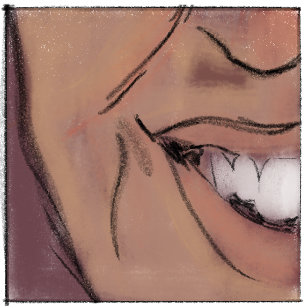
There is no objective truth, and Sylvie Plouffe knows it.
Leave a Reply