“Ever since the flood,” said Vasilis Dados this July, at the only café left in Metamorfosi, “our everyday life includes antidepressants. When the water receded, and I came back here with my children and my grandchildren, and… we saw what we saw… I held my head in my hands. I said, ‘now you can do whatever you want.’” Dados is 79, with big hands and big feet and silver, slicked-back hair. As he spoke, he fiddled with a strand of worry beads, and cast indecipherable glances at the five other septuagenarians who had joined him, as per usual, for a mid-morning espresso. “We’re living in fear,” he said. “We’re afraid the water will come back.”
Metamorfosi—a small farming village at the lowest, flattest level of Thessaly, Greece’s agricultural epicenter—has flooded thrice in Dados’ lifetime. Each time, explained Litsa Rita, a 70-year-old woman with kind, glaucomatic eyes and a proclivity for Winston-brand cigarettes, the flooding got progressively worse. In 1953, the water reached a meter high. In 1994, it rose to three. In 2023, when the nightmarish Storm Daniel swept through Thessaly, “only the roofs” of Metamorfosi were visible above the murk. The whole region was flooded—sixteen people died—but damage was concentrated in Metamorfosi. Entire neighborhoods were lost. The houses that survived were caked in so much mud that residents had to shovel it out in wheelbarrows. Once-fertile farmlands were strewn with stones and soaked with petrol. “It was impossible to cultivate them,” said Dados. Three years on, it’s still “not like it was.” Before the flood, almost 300 people lived in Metamorfosi. Today, that figure is closer to a hundred.
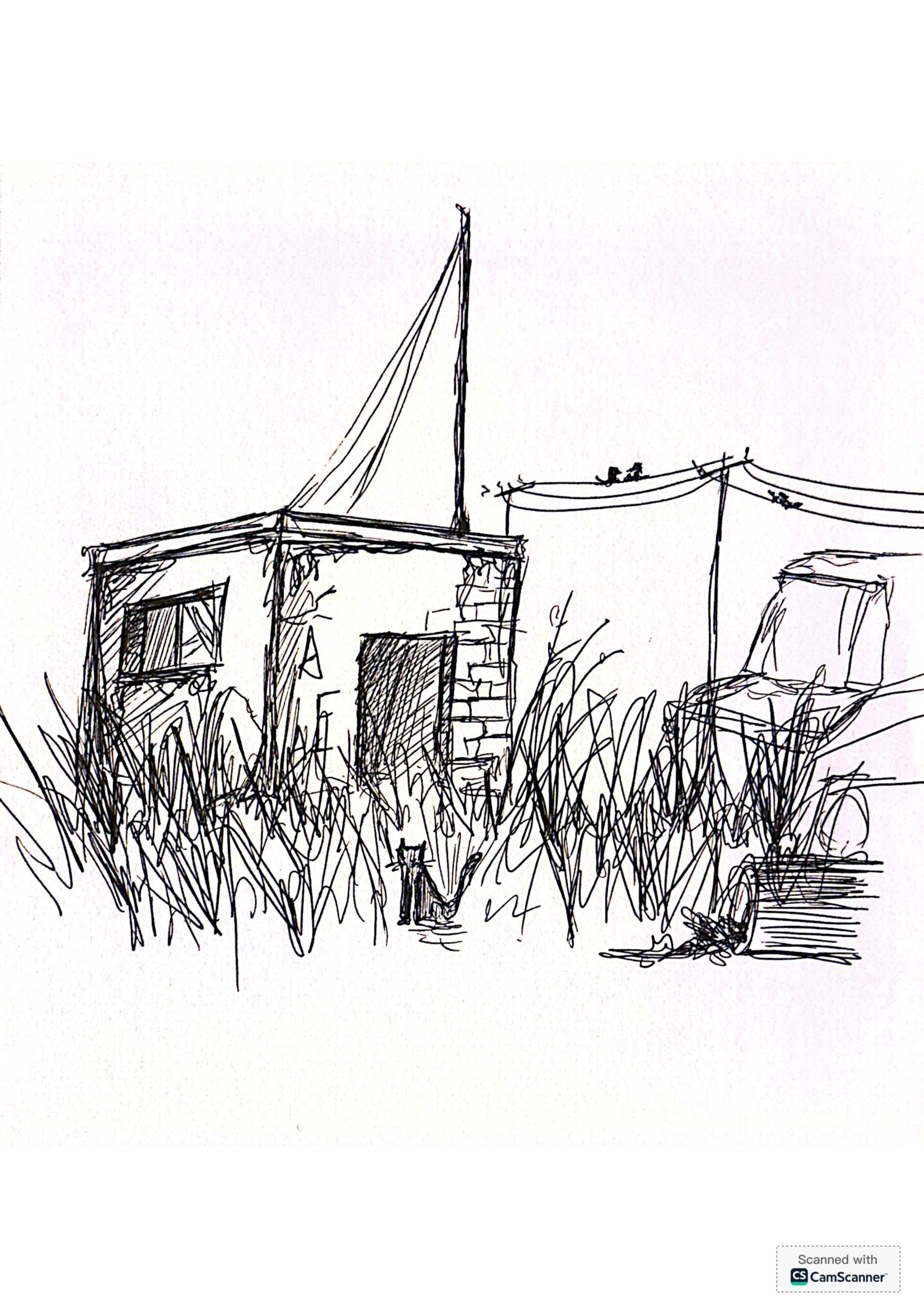
Those who stayed had lived in Metamorfosi for sixty, seventy, eighty-odd years before the flood. They crack jokes and chain-smoke and ride their rusty Yamahas to church. Theirs is a town of shattered windows, of empty paddocks, of mildewed swing sets. Despite this exodus—or maybe because of it—Metamorfosi teems with life. Cats lounge on abandoned, mud-stained porches; cicadas whir and buzz in the summer heat. Next to the town square, a pair of storks have made a nest atop a splintered power pole. In the café, a goldfish flits this way and that in its small, rectangular enclosure. The effect is of a battered, postlapsarian Eden. At one point in my reporting, I was chased for several hundred feet by a small and vicious dog.
Until 1957, Metamorfosi was named Kortiki—the name was changed, Rita says, because Kortiki was “too Turkish.” The village has existed since at least 1454, when it was recorded in the first Ottoman census, but Stone Age ruins and prehistoric arrowtips have been dredged up from its farmlands. “There are many stories as to why the village was called Kortiki,” Rita told me. The most popular of these tales holds that the town was named for a Byzantine general who was stationed on a neighboring hill during a conflict with the Franks in the early 13th century. Whatever proof there might once have been for this claim has long since washed away.
The village itself will be the next to go. Many of Greece’s river-side settlements are “doomed,” explains Kostas Lagkouvardos, a meteorologist and Research Director at the National Observatory of Athens. Storm Daniel was a gale of historic proportions—still, an ever-warming Aegean has rendered another catastrophe all but inevitable. “You cannot stop such rainfall,” Lagkouvardos declared. Instead, he recommends investing in municipal warning systems—or simply relocating towns.
Metamorfosi has gone for the latter option. By the time flood warnings rang out from the town’s municipal office on the morning of September 7, it was too late for many villagers to evacuate; Rita, for example, stayed to tend to her sickly aunt and uncle. She brought them to the office, the only two-story building in town, mere hours before an overburdened levy on the Karambalis river collapsed, sending a reservoir’s-worth of fetid floodwater barreling down toward the village. “It was like a horror movie,” Rita recollected. A mother and her son drowned in their attic. The community leaders who had been trawling through the floodwater for survivors were stranded atop their tractors. One such vehicle petered out just a few meters from the municipal office, with several residents on top. “They were yelling for help,” Rita explained, “but we were helpless, too.” There was a steel canoe tethered to the building, but it would almost certainly have capsized in the churning waters.
Come morning, however, the floodwaters resembled less of a rapid and more of a swamp, and a pair of boatmen were sent out to scour the roofs. Overseeing the process was the community’s president, Petros Kontogiannis, a handsome, square-jawed 41-year-old who not only looks like he works as a firefighter but does, in fact, work as a firefighter. His heroics during the flood—Kontogiannis spent most of the night on a tractor, directing other farmers to safety with his iPhone flashlight—led him to be unanimously reelected in late 2023. “It’s become a lot more personal for me,” he recently explained. “You feel so much responsibility, but there’s only so much you can do. You don’t have a lot of power.” Still, “if it hadn’t been for the boats and the tractors,” Rita told me, “37 more people would have died.” By the time governmental rescue crews arrived in Metamorphosi, there were 70 residents huddled on the second floor of the municipal building.
Back at the cafe, the conversation shifted to the signature policy initiative of Kontogiannis’ second term: the relocation of Metamorfosi to an undeveloped field outside of Palemas, one of Thessaly’s larger townships. Rita related something that her uncle Luido had told her: “I survived three floods. I will die anyway. But it will be a curse for my children and grandchildren if we don’t move.” So-called “New Metamorfosi” was all the more necessary, a resident named Apostoloa Katsanos chimed in, because although the government had promised each remaining Metamorphosian 100,000 euros to repair their houses, they’d only ever received €6,600. Before the flood, he said, the town was nicknamed “Little Paris”—“We knew how to party, that was the spirit of the village. Work all day, and party all night. And everything was paid on time.” Now the white-haired denizens of the village sleep in half-renovated houses, supplied with only the bare necessities. Their children or grandchildren have moved to larger cities, to work and play and build a future for themselves. Those who remain are old, and proud, and achingly wistful. “We cannot stay away,” said Katsanos. Even after his evacuation, Dados added, he would drive down to the village every morning, just to see it. “I had nowhere to stay,” Dados recalled, “my house was in a wreck.” Even after the construction of New Metamorfosi, Katsanos agreed, the villagers would drive down every morning to the ghost town that they loved, would take their coffee at the same café they’d frequented in their teens.
Without warning, a man slammed his palms on the table. This was Dimitrios Panagos, a polo-clad 78-year-old who’d been a baker before the flood, and he was furious. “I promised not to talk,” he said, or maybe yelled, “but I cannot hold it any more. The Prime Minister came here twice, and promised us a relocation. He presented the design for the village, and it was great, 400 square meters per house—and three years later nothing, literally nothing, has happened. We are sitting around this table and telling stories and making dreams about relocating, about our children, our grandchildren, about finally having a safe space. But we are just telling stories here. Nothing will ever happen.”
Silence at the table. The café crew are a jocular bunch—they’ve had the better part of a century to develop countless inside jokes and references and superstitions. But there was death in the tone of Panagos, and death hanging over the village. “Too many have died since the flood,” Rita said. Her aunt Olga had been buried the night before. She’d sat by the cafe as the funeral bells began to ring. On the second chime, a trio of ink-black birds took flight. As the droning chimes continued, Rita’s face grew grim. She apologized politely, stood, and left, heading toward the church. I watched her go. She must have been hot, I thought. It was a sunny afternoon. The air was almost brittle. The houses of the village appeared bleached, like ash, or bones.
Leave a Reply