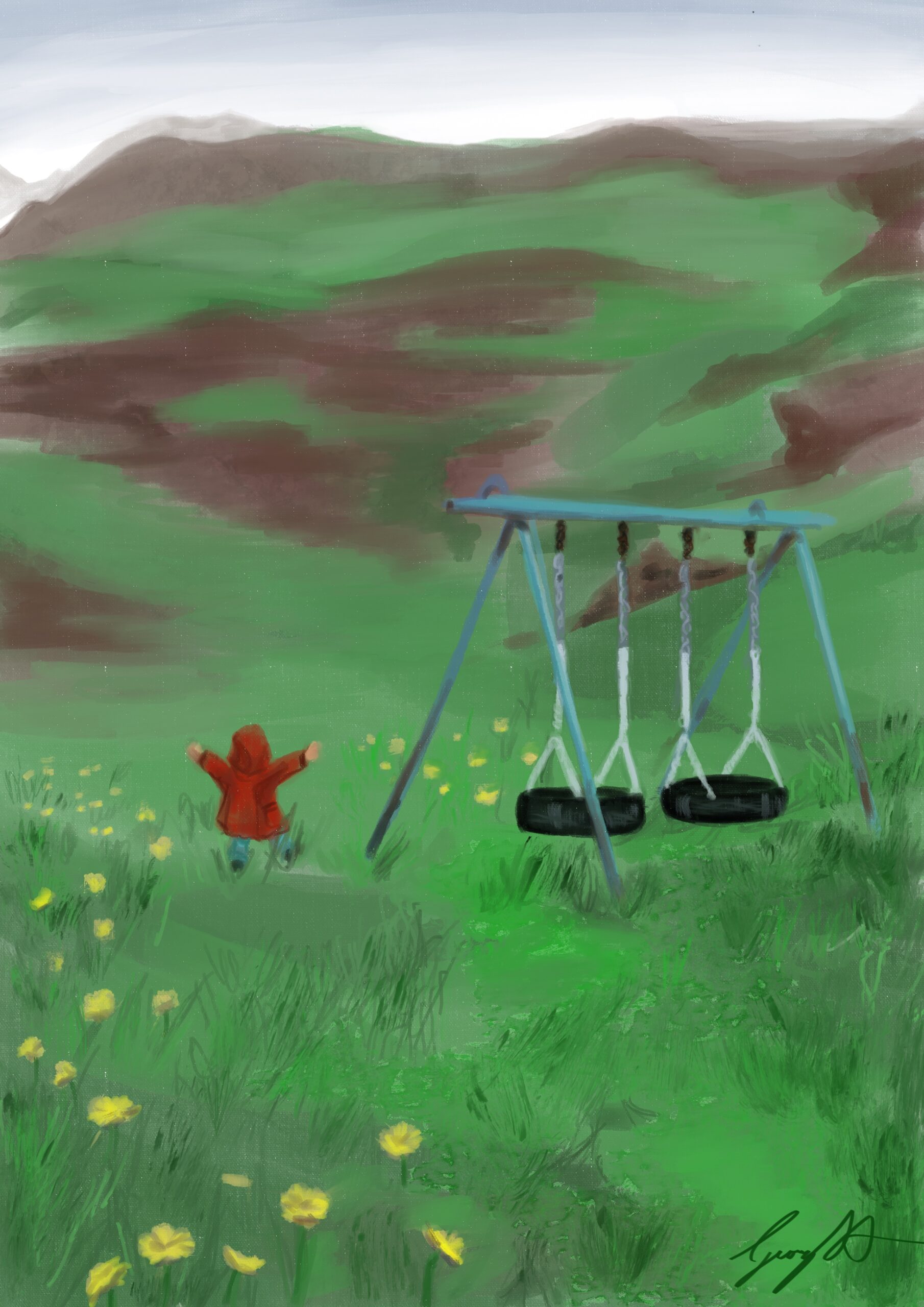
I. HANDBALL COURT
At the end of summer, the air is lukewarm, and every movement feels like swimming. Before it starts to rain, I sit on the pavement of the handball court, my knees drawn up in front of me, my back curved like a shell. It’s a juvenile posture, and I relish the scraps of concrete stuck to the undersides of my legs.
You’ll forget me, you say, you’ve said every day that summer. And I say no, I won’t, and you don’t believe me, and so it goes. But I know that I am right, because every time I walk by my elementary school and peer through the chain links of the fence, I see myself standing there, poised to run to the next painted circle. So much pity for that empty space, who doesn’t know that in eight years she will stand on the other side of the fence. I see her in front of the shop window where we stopped on the way home to critique the dresses; she is sipping hot chocolate — one of those rare mornings when we made it to school early — in the Starbucks on the corner. Commercial, particular. It closed, boarded-up non-space for a year or so, and now a bagel store: commercial, no longer particular.
II. HIPPO PARK
We walk downtown through the park because you want to go to the gym and I want to go home. To the left is the playground with hippos close to my preschool, large ceramic hippos full of little children. They bend around each other like intestines. The mouth, open — a head peers out. Limbs always disappearing up through the gap at the bottom, in between the legs. I have a recurring dream in which I slip through a gap close to the ground, but it is too small and I get stuck. Or maybe I make it through, but then I am inside the hollowed-out hippo, surrounded by children who slide in and out of the walls. I cannot make it through the gap again. This dream feels like a memory; I once cried inside a hippo for three days.
It starts to rain, a few drops and then everything. I start to run, because I was here when I was younger. My arms grow slick and water slides down my face — when you cry lying down, the tears run sideways into your ears, except I am vertical so they run straight down, gathering at my hairline and spilling over my forehead. I am leaving tomorrow; I am desperate to feel youthful. When you told me you would come to my house every day, neither of us believed you. In spite of ourselves, this has been an August of scraped knees and frisbees run over by cars, of shrieking half my words. But I feel the weight now, of summer extended past its boundaries. A sort of loan.
I come to a stop in the middle of the path. To my right, the highway, and then the river. When I turn around you are gone, no, you are in the bushes behind the bench. I walk toward you, unsure of how to be witty about this. Sway a little, but not too earnestly. Seems like effort has been ground into me, stuck to my seams. A step to the left, towards you, a step to the right, like a waltz. I want to learn to use my body somehow. A step to the left. I want to be pre-packaged and safe, with collapsible arms.
You meet my eyes, behind the leaves, and come out looking chagrined. In this little play, my role is cheerful. I am dancing. It is raining. I spin in a circle, palms upward and incomplete, and see myself through your eyes: small and refusing to put on my jacket in the winter cold. You walk in a straight line. But neither of us is good at parties. We once left the music in the other room and sat on the cold floor of the kitchen and talked about feeling time withdraw like a disenchanted lover. We both had an awareness of the days we had left. You were keeping count. I thought about the fractions of things — a half of a half, time splintering off. It feels wrong to not be enjoying yourself properly, you said. To not be in that room next door, with the perfect way to move your shoulders. She slid forward, shimmering. The gears turned. I could feel myself shimmer on the kitchen floor with my hair hanging around my face, not windswept.
III. REVOLVING DOOR
You’re going to forget me, you say outside the revolving door. I stand on my tiptoes to hug you, and you are rectangular and remarkably unpitying. I once asked you if you’d ever composed music. A string quartet, you said, and it was pretty good but then you listened to Beethoven. I stopped writing years ago, after reading too many words and feeling like there weren’t enough left. I tried to say something about how it feels impossible to make anything from scratch, how creation is more like foraging. Had you really thought you were better than Beethoven, I asked instead. You shrugged. Beethoven didn’t go to Juilliard.
You didn’t mourn your compositions, and you won’t mourn me. You are practical and you have another prediction to satisfy, another argument to win. You confront the passage of time, pinning numbers to days so that they’re easily identifiable and there’s no escape. As for me, I number the times we sent the frisbee spinning around the tree as golden dusk sliced into our eyes, lulled by your refrain — only half-irreverent — and the repetitive smack of plastic against my palms. Wasp-ridden, it was: we find out only later, our unpricked skin a miracle. I number the movements of your hands as you stumbled by the river, and the circles we looped around the same block as night settled down, a ground-level apartment, shutters closed. I create a map out of momentary flashes, I walk across the street and across five years, two days, six months at a time, retreading the same paths, calling images to my mind: they always fall short.
Your hair hangs down over your eyes, and you are not accusatory, just soft, and I feel like nothing can be helped. Wet with the rain falling, I do not get any wetter.
IV. BELOW THE XY-PLANE
You call me five minutes later. The gym is closed. With the phone pressed to my right ear, I listen to the rain in the park; with my left ear, the rain of 76th Street.
We are both silent. The gym is closed. I am always struck by how much meaning relies on novelty; a prolonged ending grows tiresome eventually, must lose itself. You know this, and I wonder, briefly, why you called.
You say, suddenly: you have to take math in college. It’s like vegetables, essential to a healthy diet. Without it you’ll get scurvy.
You’ve said all of this before. Every line is almost scripted. I know exactly how you take out your familiar abrasiveness and turn it over when you’re feeling homesick.
You accuse me of leaving the plane of reality by graphing our respective coordinates. This, too, resurfaces in our conversations. Like motivically-driven narrative, speech always circles back, consoles itself with the same patterns. You, (1, 1, 2), hovering around the origin. Me, (1, 1, -1000), far below the xy-plane. You have a point, because even as I listen to you list malady after malady which I will inevitably contract as a direct consequence of studying English literature, I see you wandering beside the river, your voice warmly irreverent, retracing our steps from this afternoon: the artificial river which runs all the way through the playground, the monkey bars where you broke your arm the summer before second grade.
My perception of time is distinctly geometric: I trace the progression of years in counterclockwise circles that thicken like layers of pencil. I wish I could distinguish between them. If only they expanded a little each time — flattened, they would look like the rings of a tree. I delude myself, on occasion, into thinking I can start at the center and run my finger outward, skipping from year to year within the stillness of one day. In reality, they are stacked one on top of another: each day with the hum of its previous iterations running underneath it like an old videotape. I stand at the top, peer down, toe the ice. Sometimes I wonder if I retrace my steps enough times, maybe I’ll fall through. This path is not only ours — I walked along the river one January, attempting to think myself back in time. But thinking is time-dependent, and I felt myself moving forward instead. When I checked the ice, there was no imprint.
I know that this is not you. It is not January, you are warm and damp, you do not dwell. Do you watch yourself swing through the air, weightless as your hand has not yet missed the next bar? You pass the benches we sat on, sprinklers we ran through; we used to stare across the river without seeing. Do you slow down for a moment to stare at the two figures on a bench? One leans forward, his hand hovering over a chessboard. It moves like a waterbug, flashes of stillness. The same jokes, the same gestures. But I enjoy every one of your iterations.

Leave a Reply