I
In the driver’s seat of the car, a body curled up into itself. It was a pitiful scene, that of a fetal figure frozen in stillness. Then, racked by violent shakes. Then, still again. At one point, a hand extended out from the body to reach for the door. But the fingers were stiff, like those of a plastic doll, and unable to grasp the handle properly. The hand fell and retreated back into the body. Still again, save for an eyeball flickering beneath the eyelid and puffs of crystallized air hovering over dry lips.
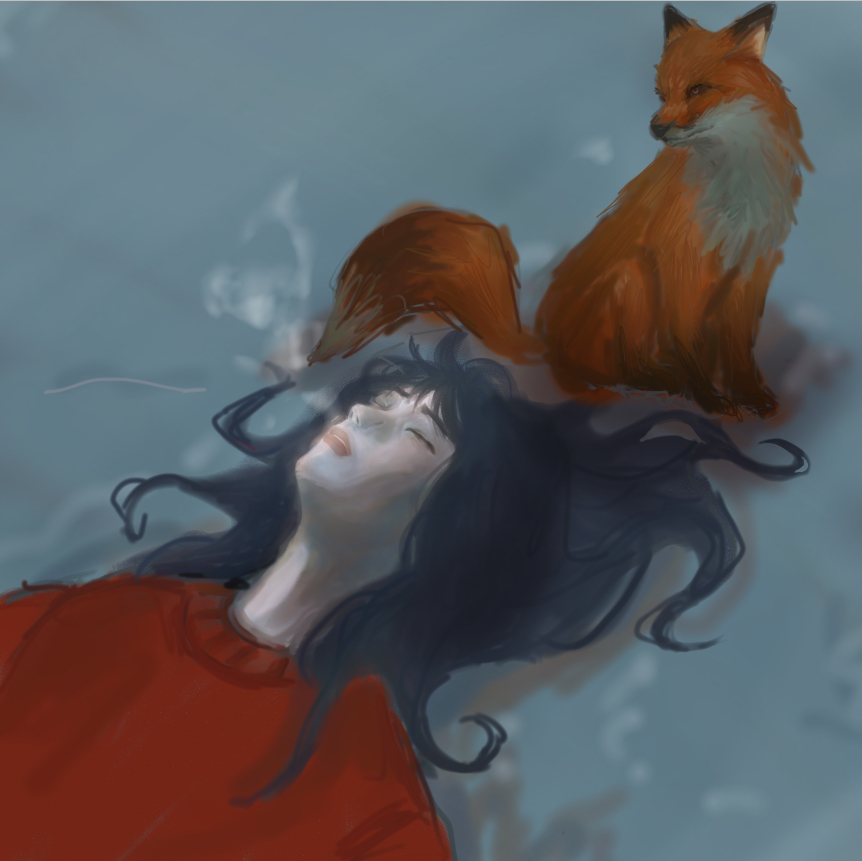
The woman knew death came for her. Death, like a fox creeping out of a frozen burrow. It treads tentatively, but always advances.
When her eyes darted open, she sensed the fox was already on the hood of the car. She imagined it had leapt up noiselessly, gracefully—a smile twitched across her face as she thought of her cats at home, warm before the fireplace. The smile disappeared, though, when the fox’s gaze pierced the windshield. She strained to lift her head and meet its eyes. In their amber irises, she searched for the glimmer of human apology. But instead, the black slits of pupils narrowed, striking something soft within her. The instinct to protect this softness—like a mother shielding her child—overwhelmed her fatigue. Her body bolted up, and she scrambled to open the car door. She pushed, but the door would not give against the packed snow, so she pushed again. She threw her shoulder into the door. She shoved again and again until the pain flowered from her shoulder, spreading to warm her fingertips.
Then, her body fell out of the car, into the snow. She limped to her feet and stumbled through the woods. The fox stayed perched on the hood of the car, watching her leave.
II
The woman arrived at the bank of a river, frozen over. She lay herself down gently in the center of the ice. If she had visited this river years ago, she would have seen how the water levels rose after a night of hard rain. She would have noticed how, overnight, the beaver’s home was wrecked and the little paper boat impaled by a stray tree limb. She would have crouched by the riverbank, trailing her fingers through the rushing current, delighted by the cold shock on such a hot summer day.
Or perhaps, if she had come days later—once the waters had calmed, and sunlight dappled the landscape where tortoises hid among rocks and ferns blanketed the ground—she would have spied the lone fisherman. He waded until the water reached his waist. He cast his line out, then swung it up over his head—back and forth, he lengthened the whole of his stocky frame—and the woman would be thrilled by his precise choreography. After the fisherman had long left, the cold would descend and the river would freeze. Then it would thaw. Then freeze again. Somewhere in that time, the woman would die. Somewhere after the woman, two sisters will race on the ice, weaving plaits with their skates. One of the sisters will fall on her hands and knees and cry out from the cold.
But returning to the woman: her arms and legs were splayed on the ice as if to make snow angels. This, she thought, was better than the car, which trapped fear like stale air. The fear built pressure, making her contract around the childlike softness. Out here, everything was open. She could extend her limbs and press her shoulders into the ice. Her labored breaths grew steady. She waited for the fox. For the fox to emerge from the woods, to linger over her, perched on the riverbank. For the fox to leap down and rest on her chest. For its warm mass to rise and fall with her breath, until it grew still. She waited. But the fox did not appear.
Instead, there was a crack—a collapse in the ice a few feet from her—and desperate Life bursting forth. Nails clawed at the smooth ice, but slipped back into darkness. Knuckles tried to punch the ice from underneath, but grew bloody. The eruption of water struck the woman’s body, sharp and stinging. Sluggish, her eyes fluttered open and searched for the disturbance, when another splash of water spurred her onto her knees. She clambered across the ice, towards the disturbance. When she was hovering just above the gap, she took a short breath and reached into the waters to grip a pale, slender arm. She used all her strength to pull the body out.
III
The man standing before her wore a neatly pressed black suit. His hair was combed over and plastic-looking. He was so clean he looked as if he should work in government, save for the flashy belt strapped around his waist, which suggested an affinity for old cowboy movies. The water seemed to have fallen off of him like latex—he betrayed no evidence of the violent scene she had witnessed just moments before.
She stood staring at him, until he took note of her, breaking the silence:
“Can you point me in the direction of the playhouse?”
“What?” she gawked.
“The playhouse…where they put on plays,” he responded with annoyance.
“Sir, are you okay?”
“Tell me where the playhouse is.”
“I’m sorry, I don’t know.”
“Where is the playhouse?”
“Please, I don’t know where the playhouse is.”
“Where is the playhouse?”
“Please, I CAN’T HELP YOU.”
…
Three paces of silence separated the two figures. Looking at each other, their breaths began to fall into the same cadence. The man’s eyes softened:
“Oh child, no need to get worked up.”
He stepped forward and scooped her up into his arms. He cradled her head as one does for a newborn—her grown-up legs dangled just above the ice. She surrendered to his embrace, thinking, now this must be the rest. She would die here, having saved one life to let go of another. Here, with this strange man.
This strange man whose hand was now traveling from the crown of her head to the nape of her neck, letting her head fall slack. Whose fingers began to grip the soft flesh of her neck. Whose second hand was joining the first to wrap around her throat, gripping tighter and tighter. When she looked up at his face, for a moment, she thought there was no cause for alarm, for his composure remained the same. His eyes were cool and untroubled. Then, she felt her breath escape her—her eyes widened and she tried to scream, but she let out only a faint gurgle. Now it was she who clawed with desperation, pulling at his hands, scratching at his face, and kicking at his legs. She was not supposed to die like this, flailing about like a wounded animal. Images of sadistic burials flashed through her mind. Tears streamed down her face. She thought of her body gently sinking to the bed of the river, something lost.
IV
Then, by some miracle, she wrestled free from his grip and fell onto the ice. She scrambled to her feet and ran. She ran and ran, like a bullet just fired. Pumping her arms, she closed her eyes so as not to be blinded by stray branches. Still, she was scratched and tripped and marred by the forest. She ran on. She ran until she found herself in a clearing. Driven forward, she spun in place, and as she spun, she craned her head upwards towards the trees and the stars in the black sky. Until she finally found stillness.
She stood there, shuddering in place. She shook from the cold, from the fear, from the pain. She shook for what she had lost—something she knew could not be put back. For she now understood that Fear was not something lodged in her chest like shrapnel, but rather something that was taken away. She began to think that it was not even something the strange man had taken, but something she had lost long ago. It was already lost to her when she shivered in the car, when she looked the fox in the eyes, when the man cradled her in his arms. It was already lost when she woke from dreams—heaving, sucking in air, still crying. When she placed her hand to her breast, trying to slow down her heart. When she pressed her hand through her ribcage, past her flesh, to feel around her chest. Her fingers were caught in a tangle of arteries, searching for the bad thing stuck there. Back then, she did not know there was nothing to be found.
Now, to fill the cavity, she sucked in all the air around her. She caught her breath faster than it could escape her.
V
An owl flew overhead and saw the small figure standing in the clearing. The owl’s eyes were glazed with pity, thinking, she will collapse, she can not go on.
The owl watched as the woman straightened her back and walked up to the door of a small log cabin. She did not hesitate before turning the handle and crossing the threshold. She sat herself down in a pew in the back. No one in the audience turned back to look at her. Had they looked, they would not have been able to make out her battered form, as the stage lights cast her pale skin into darkness. On stage, a boy no older than sixteen stood in full armor. He raised his wooden sword high above his head as he cried out declarations of legacy and glory. With a swift lunge forward, he impaled his opponent. The audience cheered. The opponent stiffened his body, his tongue lolling to the side.
Leave a Reply