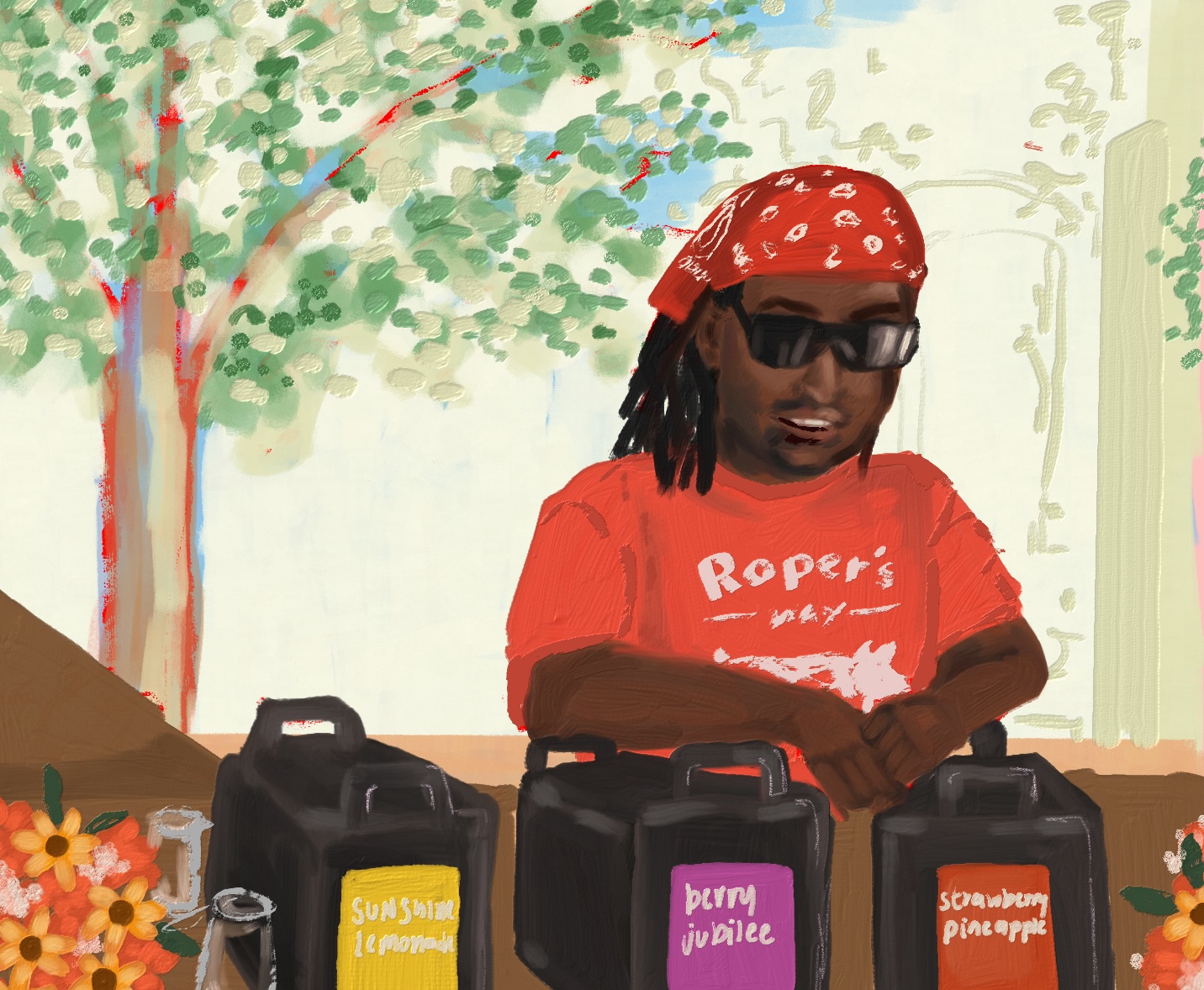
The Princeton University Farmers’ Market is unique in that its theme is juice. I came to understand this just the other Wednesday, when I made my way up to Firestone Plaza and found that, save one particularly delicious empanada joint, lines had formed only for stalls that offered some sort of juice. This enviable camp included Tico’s Eatery & Juice Bar, of course, but also Ooika (matcha is basically juice), Ice Dreamz (water ice is basically juice), and Terhune Orchards (apple cider is about as close to juice as you can get). Other stalls were juice-themed, too: thirsty Princetonians could buy a glass of RiceWich’s “signature Yuzuade,” or a briny jar of Pickle Licious’ fare ([sic]).
According to Jarad Roper, the stout and ebullient proprietor of Roper’s Way Farm — they do jams, jellies, and lemonades — it wasn’t always this way. A few years back, he says, the market was missing something: when it came to drinks, “there was only coffee.” Given that the market runs on Wednesday mornings, Roper reasoned, an average customer was more likely to grab a lemonade on the way to their next lecture than they were to tote a bag of organic produce — or a jar of jam — back to their dorm. If Roper’s Way was to turn a profit, the farm would have to develop some juice.
Thankfully, Roper was game. He got right to work: “I’m a flavorologist,” he tells me, “so I love taking, you know, a challenge.” He came up with three lemonades, flavored to match his jams: a “berry jubilee,” a “strawberry pineapple,” and a classic “sunshine.” During my three hours at the market, Roper sold out of each variant. In the same time period, he sold two ounces of jelly.
Roper wears a huge, angular pair of performance sunglasses. Dreadlocks spill from his orange banana, which is folded expertly around his head. He speaks with conviction and with ample gesticulation. He mans his stand with his dad, Tommie Roper, a thin and handsome man who, when the market dies down at 1:00 PM or so, lies back in his folding chair and has an unbelievably long conversation with a guy in a black quilted vest. “History!” this strange interlocutor remarks at one point, throwing a hand in the air. “History,” agrees Tommie Roper, somewhat glumly. They go on like this until the market closes.
Before he ran a farm, Roper was a competitive fisher. He did that with his dad too — their two-man team was sponsored by Yamaha. “We went after a species called the Crappie [pronounced kraw-pee],” he explains. “We were travelling around the United States, competing in tournaments for 20 years.” Saint Johns River, Kentucky Lake, the Harris Chain: you name it, they’ve fished it. Their company, Roper Outdoors, kept the caper afloat. “I’ve always been a manufacturer of things,” Roper says. “It used to be jig heads, apparel… now we’re manufacturing jams, jelly, and lemonade.”
There’s another throughline, too: conservation. Roper Outdoors was about “keeping the great outdoors great,” and with Roper’s Way, the father-son duo devote themselves to sustainable agriculture — food grown “the way God intended.” “People used to know exactly where their food came from,” says Roper, “and I think we need to go back to that.” To this end, Roper plans to expand into livestock farming. He told me at length about the Kunekune, a species of pig from New Zealand known for keeping small pastures healthy. Unfortunately, small pastures are hard to come by: in New Jersey, says Roper, it’s very, very expensive to lease land if you want to use it for traditional animal husbandry. Even so, Roper believes that something will eventually pan out — the logo for his farm features a large silhouetted pig.
For a farmer (or flavorologist) with a plan like Roper’s, the Princeton market might start to look like a stepping stone. It’s a weird place, after all. If you can’t appeal to the plebian tastes of a harried undergrad — if you can’t provide the quick thrill of an empanada, or the sweet kick of an apple cider donut — you shouldn’t expect to turn much of a profit. It’s hard to imagine anyone under the age of 40 buying pasture-raised Kunekune sausage on a whim.
But there’s a factor beyond the money that pulls vendors back each year: the people. Roper is about as gregarious as it gets, and he seems to know all of his peers — “we talk,” he says, “and we, you know, we become a family.” Roper goes out to breakfast with the owner of Nutty Novelties. His cousin runs Ice Dreamz. When the market dies down he joins a handful of business owners at the empanadas stand, and they chat for half an hour. He talks to the students, too. Once, Roper became such good friends with one of his customers that he ended up officiating the guy’s wedding. “He came up, pulled up a chair, and I’m like, ‘okay yeah, make yourself comfortable,’” recalled Roper. The two became fast friends. One day, the kid, then a Princeton senior, let slip that he couldn’t go back home for Thanksgiving. Roper didn’t miss a beat: “I said, ‘bro, our table’s open. You’ve met like, half the family already.’”
Roper’s grandparents worked as sharecroppers in rural Arkansas — Roper himself was an Arkansan until 2020, when he moved up north. His passion for livestock reflects these roots: “I would love to revisit the kind of things that my grandfather — we call him Big Daddy — did,” he tells me. For now, though, juice and jams aren’t so bad. At the market’s zenith, I watched a girl in a voguish cardigan order a lemonade. “How sweet do you want it?” asked Roper, already reaching for a plastic cup. “I mean,” she said, “I don’t really like sugar… Can you do it not sweet?” Roper cracked a smile, wide and warm. “Look, it’s lemonade. It’s gonna be sweet.”
Leave a Reply