6:50 pm. Thursday night. July 31. The sun slowly emerges after a day of sultry rainfall.
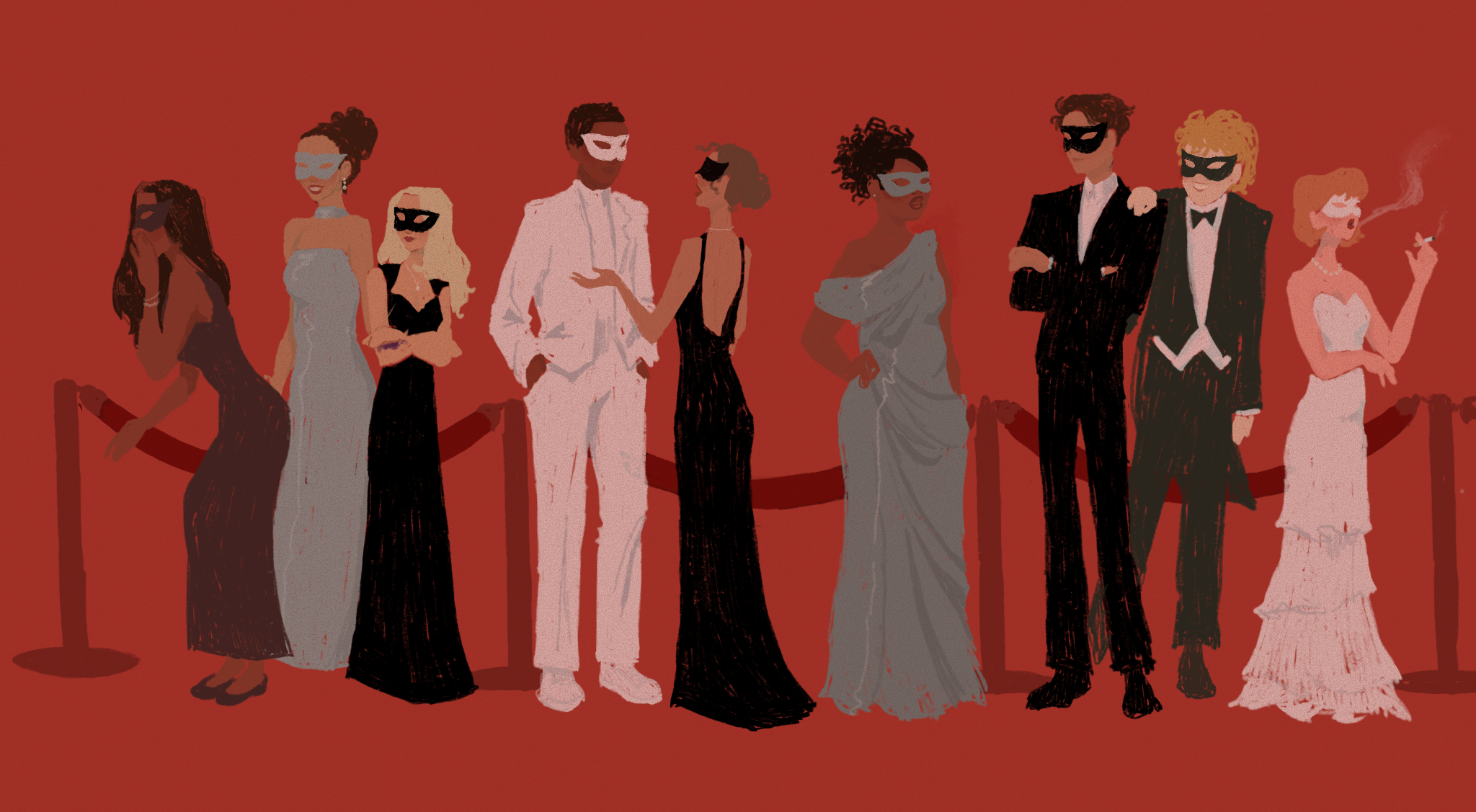
60 or so people, all draped in formal and cocktail attire — tuxedos, white tie and tails, ball gowns — all matching a strict dress-code of black, white, or silver only. With silk and lace masks covering their bedazzled eyes, they line up against the plush velvet ropes lining the crowded, cigarette-stained sidewalk. Black and white newspapers obscure the glass walls of the building behind.
Photographers flash their cameras, as groups of people smile behind their made-up faces and forgotten identities.
“What is this?” ask puzzled onlookers, sporting t-shirts and shorts, as they walk past the line; the ropes juxtaposing the two groups. Crowds form and subside, the flow of traffic pulling onlookers and tourists away from the happenings and onto 7th Avenue.
As the photographers’ flashes diminish, figures in black appear, checking IDs, glancing at covertly placed tablets, timely tapping the screens. Navy blue stamps with an imprint of a mask are placed atop the trembling left hands of guests, and carmine stickers with cursive text are placed over phone cameras. Sneakers, oddly contrasting the formalwear above, clap the ground as the line stumbles forward.
Two front doors, padlocked, stand parallel behind the line of people, making their way to another door—the door—on the side to the right, covered in crimson and white skeletal-inspired graffiti. In front stands a man of six feet and four inches, gently smiling as the line of people inches closer.
“What is tonight’s password?” he asks each guest as they approach.
Some guests proudly exclaim the phrases sent to them 24 hours prior in a discreet, cryptic email, while others struggle to remember the instructions delivered to them. Those who have forgotten the password stand to the side, as more prepared guests make their way inside. After a few moments of revisiting their inbox, guests recall the entry words and find their way indoors.
The door shuts.
Another group of guests comes to the ropes. The sounds of the iPad, the stamps, the stickers, the clatter of shoes, the brief moments of fear, the recital of passwords. The door opening. The door shutting.
Four more times the cycle repeats.
8:15 pm. The sun has set. All guests have entered the building. The door is shut for good — until the first of the guests exits.
Set at 218 West 57th Street in Midtown Manhattan, between Broadway and 7th Avenue, in the four-story gothic building built in 1897 and formerly home to Lee’s Art Shop, Masquerade began previews to adoring fans, “Phans,” with plans on officially opening at the end of September.
Masquerade is the off-Broadway immersive theatrical revival of The Phantom of the Opera, formerly the longest-running musical in the history of Broadway, running for 35 years, from 1988 to 2023. Masquerade, re-inspired by director Diane Paulus, the artistic director of the American Repertory Theater at Harvard University, combines the story, music, and lyrics of The Phantom of the Opera with the immersive environment of Sleep No More. The latter, an immersive theater production retelling Shakespeare’s Macbeth at the McKittrick Hotel in Chelsea, New York, ran for 13 years and nine months, opening on April 13, 2011, and closing on January 5, 2025.
Masquerade has redesigned the four-story building on 57th Street to become Paris’s Palais Garnier, or “Opera Populaire,” with the old art shop transformed into an opera house. Guests are prohibited from removing the stickers from their phone cameras and taking photos inside the building. There are no public photos available of what the interior of the building looks like or what the experience entails.
9:15 pm. The first set of audience members has just finished their experience.
The sounds of sneakers clapping the ground near.
As the people emerge, the sight of black clumps of faded mascara cascading down the cheeks of faces becomes visible. The wail of sniffles resonating; tears forming and falling.
Eyes scatter around, dropped jaws and incredulous glances fill the space.
“What the hell did I just watch?” a man of about 40 asks to himself, his furrowed head shaking in disbelief.
The question reverberates in the evaporating mist, the final remains of a stormy day.
Sighs erupt, charged with a tenacity ready to revolutionize New York.
“Undoubtedly, the best theatrical experience of my life,” cries a blonde-haired guest to her husband, gripping his waist so tightly, the seams of his jacket nearly rend.
The sunken cheeks of hers turn as pale as the porcelain hue of the guest’s mask, now clutched in her free hand.
“Theater is ruined for me. I can’t go back to watching anything else.”
masqueradenyc.com
Through November 30 only
Your obedient servant,
O.G.
Leave a Reply