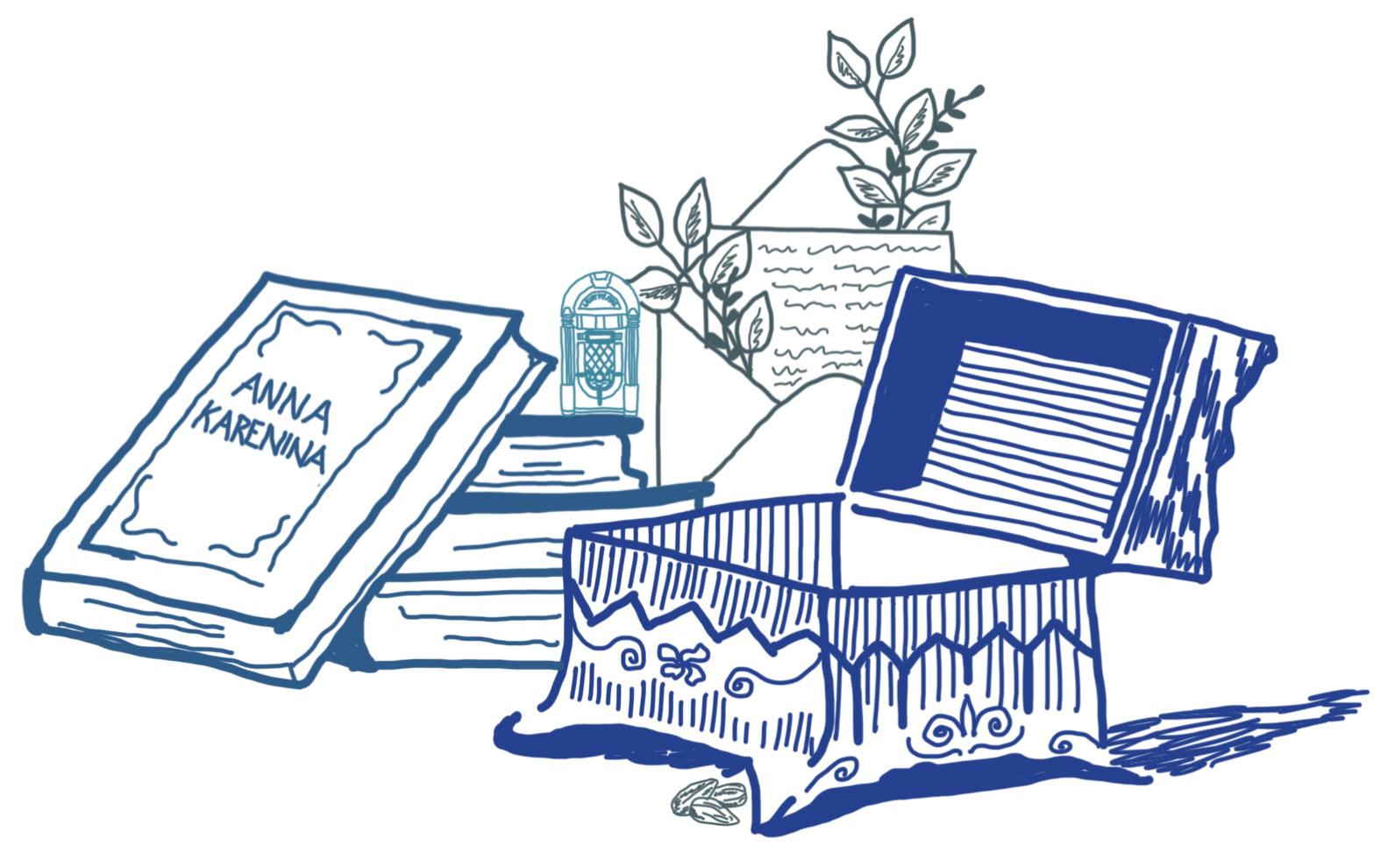
One of the first books I ever gave as a gift came from a “Little Free Library” kit. I found a particularly choice copy of Anna Karenina and was overcome with an evangelical zeal—despite my utter love for the book, I decided to pass it on to a friend who was soon moving to California. We had a shared interest in absurd history memes and a certain quirky UChicago philosophy professor, so it felt appropriate. I remember I wrote her a note somewhere deep within the text. It was something vapid, probably (“hi!” or maybe, “hope California sucks!”), but I do remember asking her to text me and tell me what she thought of the book when she saw my note.
I hoped the copy of Anna Karenina would be a material reminder of an intangible connection, a stimulus to jog my friend’s memory to think of me and break the emotional distance that would inevitably grow alongside the geographical. I knew I would miss her, and I yearned to connect beyond mere superficial text exchanges. I’m not a hypocrite, or if I am, I’m fully conscious of the fact—the stacks of books in my bedroom only pile up these days and they, too, could contain any number of forgotten notes, questions, interjections, exclamation marks, or requests to be contacted. If anything, my own delays convinced me to write it down—I didn’t know how long it would take her to read it.
These books are nominated: transformed from meaningless paper to pending revelation through the knowledge they made someone think of you. I think here of Marcel Duchamp, whose readymades work similarly—through an intentional selection—turning something as banal as a urinal or a bicycle wheel into a piece of exhibition art. He never altered the objects; this transformation lay in the added signification of the artist’s intention. Curiously, he conceived of the readymade as “a rendezvous,” a material object that looks toward the future “by planning for a moment to come (on such a day, such a date, such a minute).” In other words, the piece should retain a trace of the will that chose it; hence “R. Mutt 1917” scrawled at the base of Duchamp’s urinal. He writes that a readymade can “later be looked for. (with all kinds of delays).” Between the moment of nomination and its interpretation, then, is an essential latency; its meaning arises out of an encounter that is delayed, yet always anticipated. A far more selfish variant of this academic issue has beset me lately, though, as I’ve dug through my old books, notes, and memorabilia, but also tendered early goodbyes, pondered the lonely future, and reckoned with the looming end of my time at Princeton.
I have no idea where I’ll be next year. But it’s a different uncertainty that feels far more paralyzing. I’ve wondered more about what will remain of all the friends and faces I love here, especially those with whom my ties might only be tenuous, fleeting, or inchoate. As the years charge on, I feel that even the best-intentioned promises of contact often succumb to the inevitable whirr of life’s busy and immediate issues. I’ve begun to latch onto this idea of rendezvous, that somehow the traces of our lives here might not wither but reappear and, by reanimating our shared memories, bring us back into contact in the future. I don’t wish to freeze time; I know that we’ll all be different people. We already are from the first day we set foot on campus. Duchamp insisted that a readymade must always be inscribed with the circumstances of its creation (read: our time together) precisely because it would encounter a changed context (consider: the doldrums of middle age). At stake for me, though, is the next step—the sudden rush of fondness, good-feeling, or yearning that overcomes the inertia of everyday life and transforms the momentary nostalgia into concrete action through a phone call, a text, or a letter. What’s so daunting at the thought of leaving Princeton is not growing older but, without a trace of irony, the chance of growing older without these people I hold so dear.
–
A few weeks ago, I was in the basement, gingerly disinterring a cluster of banker’s boxes that contained old books from my grandmother’s family. They’re all in German, and I’m the only one who can read them now. I didn’t preserve these—my urge to collect is, importantly, an inherited trait—but they struck me as a piercing kind of rendezvous. I don’t even know which of my long-departed ancestors bought them, and yet I have this odd sense they’ve been waiting for me. Schopenhauer’s collected works, a Trotsky pamphlet printed in 1919, and classical art history encyclopedias lay dormant, cold, and yellowing for decades, only to resurface as the unwitting inheritance of a middling humanities student. But there is no rendezvous here, or if there was, I am an epigone late to it. Try as I might, with none of this branch still alive, I cannot quite reanimate their meaning to the figures behind these vestigial objects. Long the hopeless, muted sentimentalist, I’ve often asked: why bank on the dubious accuracy of future nostalgia when I could create an archive, preserving the tangible and intangible remains of life? Both in my academics and personal life, though, I’ve been forced to confront the insufficiency of material records without the presence of others—without the retellings, revisions, and additions that flesh out the contours of a memory when recalled together in conversation.
I’m writing my thesis on Austerlitz, the last of W.G. Sebald’s works, perhaps because of my inner frustration. I feel a strange connection to the titular character’s reckoning with material objects as he attempts to reconstruct his childhood before he was evacuated from Czechia and raised as a foster child in Wales. The book’s narrator importantly also reproduces the physical media that Austerlitz uses to construct a surrogate memory—objects that approximate the traumatic memories from his emigration that he can no longer recall. Interpolated into its pages are real photographs, letters, maps and film stills. Of these, photographs bear the most semiotic weight here, indices of a dimension Roland Barthes called “this-has-been,” i.e. the fact that cameras testify to having received the light emanating from historical objects. He, too, finds a curious feeling of images having waited for him: the sight of a cast-iron column at one of the train stations along his deportation route seemed to have “remembered me, and…stood witness to that which I could not remember anymore.” Austerlitz will never find his parents again, not really, for even in reconstructing their deportation and death, they can only ever meet him in imagination.
What can I make ready? What do I collect in these last few months to prepare for future rendezvous? It’s a question I’ve struggled with for a long time. As a young teenager, I started keeping journals laden with emotional reflections and banal chronologies. I began to hoard letters, cards, mementos, and other ephemera in a little drawer in my room. That was also the first time I began to annotate my personal books, thinking one day I would want to return and read my first impressions. In the face of a parade of momentous life occasions—experiences that I knew I should expect to think fondly of later in life, and yet had no idea how to live out in the moment—I delayed processing my memories and I boxed up their every trace for some future version of myself to reckon with. Even now I’m late to quite a few meetings with myself.
I think I have to fight my desperate archival impulse precisely because of its purported permanence. Amassing a physical record of my life gave me a pernicious license to forget, to grow distant from older friends, precisely because I thought I had outsmarted time’s cruel march. What’s the use of leaving my descendants with a box of sentimental junk if I don’t use it myself, using the physical traces to dredge up forgotten memories through which to reconnect or reminisce with the wonderful people I’ve met here? I’ll plant my own seeds too. I’ve already sent letters, given gifts, and chased the fullest memories with those I hold dear. I’ll only continue to. Maybe, like that one Anna Karenina, they’ll disappear into the void, or maybe they’ll spark a rendezvous of their own. But I see no need to wait. I’m not arrogant enough to assume everyone will look back with similar fondness, that every relationship will survive the departure, nor that I am even worth being remembered. A dear friend of mine recently asked me why so many of my thoughts revolved around memory. She’s right—I spend so many hours enmired in the past. This spring, though, I’m resolved: To think of you will always be to reach for you.
James Sowerby is trapped in a box of sentimental junk.