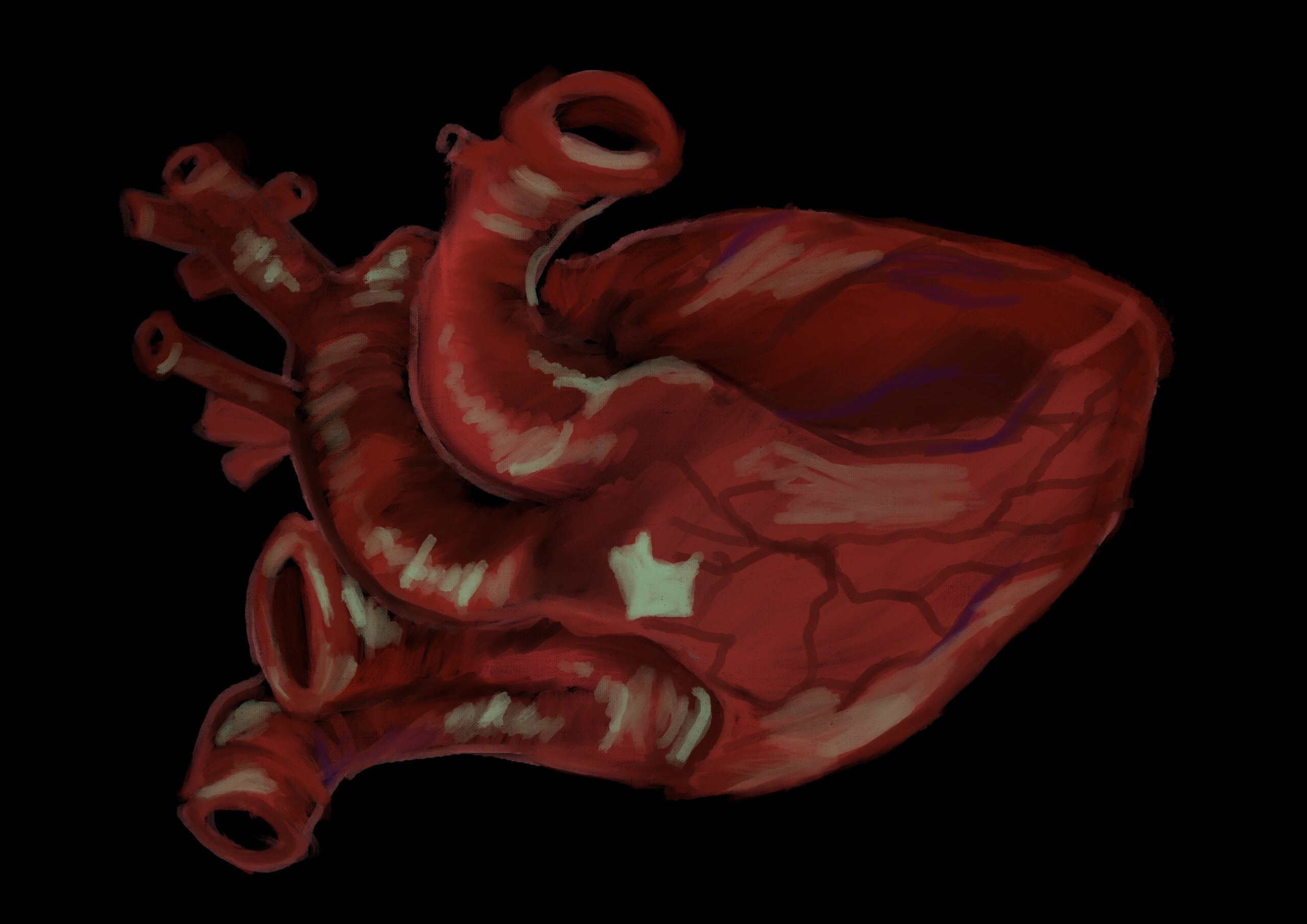
Every city has a heart. A heart beating for the streets we didn’t want to walk through.
For the goats dressed better than men. For the dogs who never bite and never get a bite of our chum chums, yet are teased senseless by their sweet, sugary scent. For the explorer. The skeptic. The gullible. The forgetful. For you. For you. For you. Every city has a heart.
Here it beats in the rikshawala pulling three fat ladies on an ubar-khabar road. An ubar-khabar city: unpaved streets, open gutters, frequent falls. An ubar-khabar heart: cracks and crevices, holes and gaps, no complaints, no complaints. He bumps into a scooter. No one yells. No lathis. I am surprised — I assumed the partisan saffron taints everything. Instead, it dodges the city’s heart, not interrupting its perpetual golden. Instead, the scooter-wala pats the unfortunate victim’s head.
Amidst the traffic — the Brahmins, their puja fee more morbid than the dead they bid goodbye to; the shamshan ghats, their overlooked hands and stolen shoes before stolen gods—there are gallis to walk through. Supposedly dirty lanes. Strangely brown alleys. Unfairly overlooked homes. No car can take you through. There is a river to melt into. There is no caste to stop you through. The hands of a few torch the dead — touching carcasses, flesh, and bone. The hands of others knead dough, read scriptures, and un-touch. Our skin, the same. Our palm lines bearing different destinies. Our wrinkles, the same. Our birth, pure chance. Who is an untouched god? Who is the better Hindu? Where does the saffron fade? Can the heart tell color? Can the heart learn touch? Can the city un-touch? Can you tell the heart’s last name? Can you place it within a bracket — a strata, a vedic text, a Yadav, a Mishra, an occupation, a jati, a limit, the sewage, the body, the ash? Can you? There is a film that does not look away: dalit directors, Indian cities, international platforms. It is the familiar poverty. The brown disdain. Sympathy instead of empathy. Shoes are stolen at the temple, hunted for through the crowd, and the thieves chased down. An expensive pair of Nikes gone. The police are called. The monkeys convene. The Gods discuss. Bare feet, bruises, stone, and gravel — the sacrifices one makes for God. And that too, for such a distant God — such a finicky one. The shoes are found again. The heart does not forget them.
There are pan shops to explore, there are temples next to death. There are lovers leaning against each other on the ghats, and roomless brothers sleeping on hotel lobby sofas. There are students with guitars. There are boats that take you places you never asked to go to. There are mosques next to temples and temples next to churches. There is a god alongside the mob. There are birds from places we will never visit, and a desert in the water. Not water in a desert. There is history in the water and a future on this ghat. It is the city of moksha, of salvation, of a mother’s blue saree, a grandmother’s grey death, of afterlife, of holiness and the lack thereof, of a majority, a minority, of kings and peasants, of journeys, and their endings.
Every city has a heart. It beats and beats and longs and longs for the fleeting explorer, the unfaithful skeptic, the gullible victim, the forgetful tourist, for you, for you, for you, to call it a home.
In a five-star hotel, with chocos and cold coffee, bacon and sausages, posh marriages and complaining customers — you don’t hear the heart. You only see fancy murals and paintings. A heart of bills. Of conversations. Of sneaky references. Of Facebook posts. Of a polished, well built ground. A well maintained, groomed heart. An unbroken heart. Not ubar-khabar. Not even the slightest bit. Who would want this one?
Every city has a heart: a heart common to all. Common but never worn out. Affordable but never cheap. Dismissed but never forgotten. Dismissed in pursuit of taller buildings. Grey concrete nothingness. Highways instead of gallis. The corporate instead of the community. The individual before the society. The head instead of the heart. Landlocked. Confined. Where is the water? The boat? How have we gone from creating to producing?
Every city has a heart. Unheard but never voiceless. Unpolished but never dirty. A thief you can call by her name. Orphaned but never unloved. A homeless heart, but never without its own warmth. A night without light. A boy without a room. A boat without a motor, but hands, hands and hands: praying, paving and painting. They hand light candles under the moonlight; hand blankets and love; hands that paint walls before they build walls; hands that never forget to wipe tears; hands that bear destiny and names and razors and nails; hands that love love, love, love; hands that feed Bhujiya to birds and Gol Gappa to visitors; hands that make chaat, malaiyo and lassi; hands that hold other hands as they walk over the boat. Over to the ghat. Over to the next day.
Every city has a heart, and a heart needs no God. A heart beats and beats. And its hands hand love and love. Every city has a heart. A heart, a heart, a heart. For you, for you and for you. Here, I have seen it. Held it in my palms. Seen its blood.
Its death. Its God. Its rebirth
Every city has a heart. It beats today. For you. For you. For you.
Leave a Reply