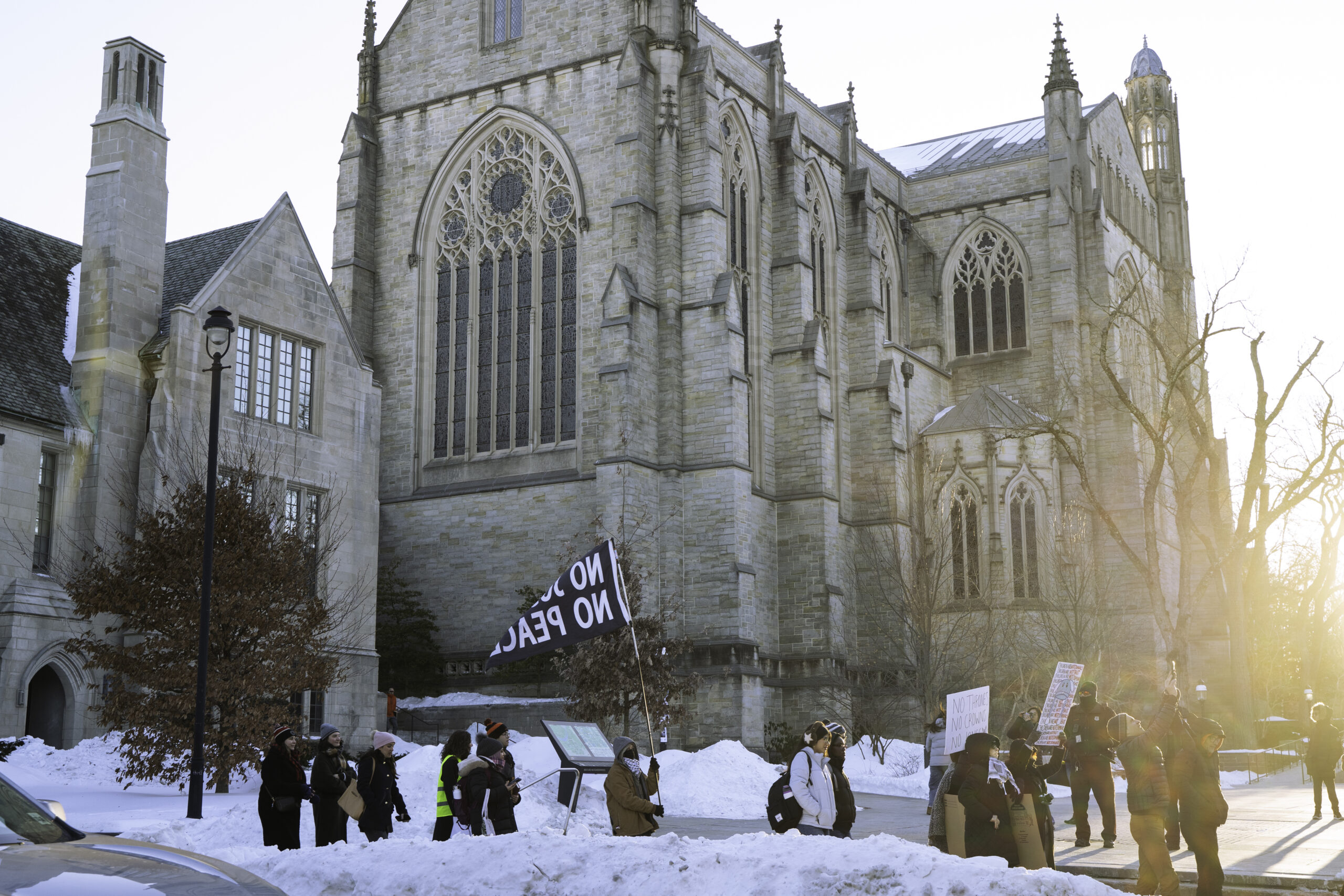
About 250 people stood around the School of Public and International Affairs (SPIA) Fountain of Freedom on January 30th, spilling out into the thick snow and onto the Washington Avenue sidewalk. Community members––– from toddlers to high schoolers to retirees–––accompanied a fierce cohort of University and Seminary students. Passers-by joined the growing crowd, which marched along Nassau Street for around two hours despite bone-chilling weather.
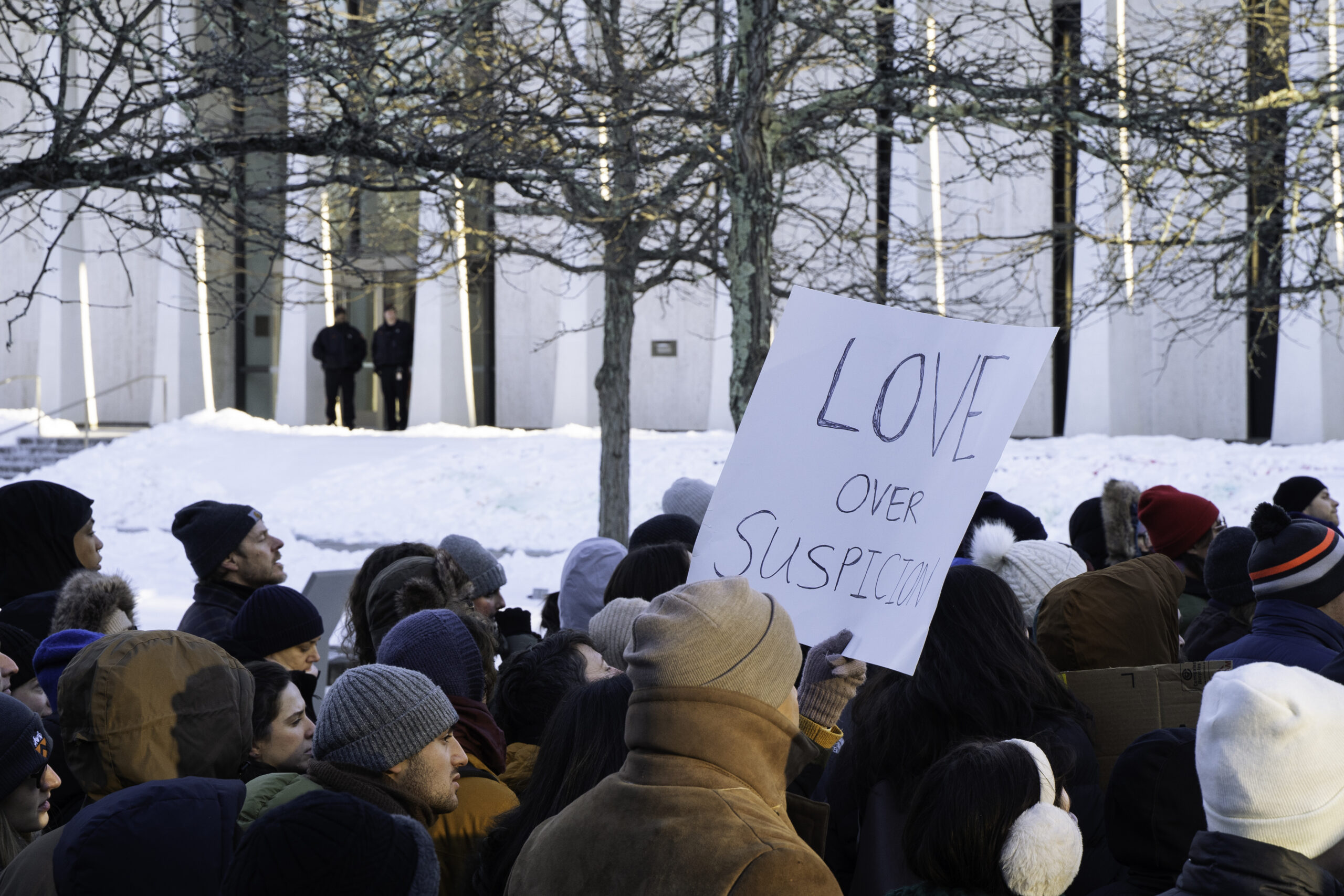
Colorful signs carried a unified message against increased Immigration and Customs Enforcement (ICE) activity in the Princeton area and around the country. Twin upside-down American flags hung on a mound of snow.Young children who couldn’t see sat on their parents’ shoulders, stiff from layers protecting against the 13-degree weather. People marched together, bolstered by laughter and fear; friends cried on each other’s shoulders.
ICE presence in the Princeton area and nearby Trenton has increased drastically in the past month. On February 3rd, five people were arrested in the New Brunswick area, and many communities in Trenton are on high-alert for ICE raids.
“My father was taken while my sister and I were at school,” said a high school volunteer with Resistencia en Acción, a New Jersey-based nonprofit which supports migrant and working class rights. Mira Ho-Chen ’26 of Minnesota gave a harrowing speech on the “murder of [her] neighbors, Renee Good and Alex Pretti.”
Protestors and speakers carried a certain confident defiance. One unidentified speaker turned the crowd’s attention to the PSafe officers observing the crowd. “Where were they when ICE went into Princeton and took parents from their families? They’re not going to save us, so we will have to!”
University officers surrounding the event did not show any hostility towards protestors, and helped many safely cross the street throughout the event. They did not react to her comments.
Rowan Johnson ’27, a tall, lanky Philosophy major with a gentle, welcoming smile, is the co-chair of Princeton Young Democratic Socialists of America (YDSA) and co-founder of the protest.
 For Johnson, protest “has less to do with exerting pressure on the power holder, and more to do with building community, giving people a space to speak out and find other people who are of like mind, and giving them a space to connect and grieve together.”
Community-building is an important part of life on a college campus where people come from a range of backgrounds. But the connection between increased political organizing – at its highest rate since the 1970s – and political polarization – also at a high – should not be taken lightly.
Protest brings people together, but it also forms a “bubble,” or singular narrative, discouraging conversations with multiple perspectives. Towards the end of the protest, a young man dressed in black approached departing people with a piece of printer paper taped to his chest. It read: “I support ICE. Let’s discuss.” Ignored by the crowd, he left within a few minutes.
Repeated protests against the Trump administration call upon the atmosphere of Princeton’s campus during the anti-Vietnam War and Apartheid campaigns. History professor Kevin Kruse notices one major change.
“Social media is a shortcut for expression; you can post on Bluesky or X or Facebook or Instagram or TikTok and see that as your contribution to a larger protest. You’ve got a variety of different small objections rather than the big thing,” he told me.
Online, protest takes on a whole new meaning, with more accessible pathways for dialogue and reaction. Yet, Kruse says that protest culture hasn’t completely changed. “This kind of expression has always been a part of university life, at least back to the 60s,” he said. In the 21st century alone, Princeton has seen hundreds of people gather, and even camp overnight, for issues they care about. University debates over divestment from Israel (2024), institutional racism (2015), and environmental advocacy (2014), are ongoing today.
The January Anti-ICE protest did not reach the numbers of the protests of the Vietnam War era, but it marked an increased interest in speaking out against the Trump administration in this academic year. Passing cars on Nassau Street honked their horns to the beat of “No ICE, no KKK, no Fascist USA” chants, and pedestrians stopped to take photos of handmade signs.
Ana Paola Pazmiño, Director of Resistencia en Acción, is always eager to bring her organization to protests, demanding a better response to the country’s immigration crisis.
“We had English classes for the last three years at Princeton, and this year the Pace Center said they could not make partnerships with outside organizations anymore. It hurt the program a lot, and broke that connection,” she said.
Pazmiño is excited about the relationships Princeton students form with the organization, but still feels a growing distance after the 2024 presidential election. “I think that the University tends to just listen to what they want to listen to.”
The University attests that the Pace Center “placed a temporary pause on new service projects… in response to the current budget environment.” They “continue to be engaged with many community partners, including Resistencia en Acción.”
Decades after the iconic protests of the ‘60s and ‘70s, even after the encampments of the late 2000s, recent protests have shifted to a more docile role, primarily offering a place to form meaningful connections.
On November 7th, 2025, Princetonians joined thousands of college students across America to condemn the Trump administration’s attacks on higher education. Most students leaving Firestone did not join the protest, glancing at the crowd before rushing by. Kristin Nagy ’27 and Mira Eashwaran ’26 walked up to the front of the crowd with a guitar, harminonica, and microphone. Eashwaran adjusted the tuning of her guitar while addressing the group: “Today, we’re going to be fighting fascism with music.”
A hundred voices united to the soundtrack of the Vietnam War and Civil Rights movement, “The Times They Are A-Changin’.”
Lilly Williams-Ameen is an associate editor for the Nassau Weekly’s Second Look section.