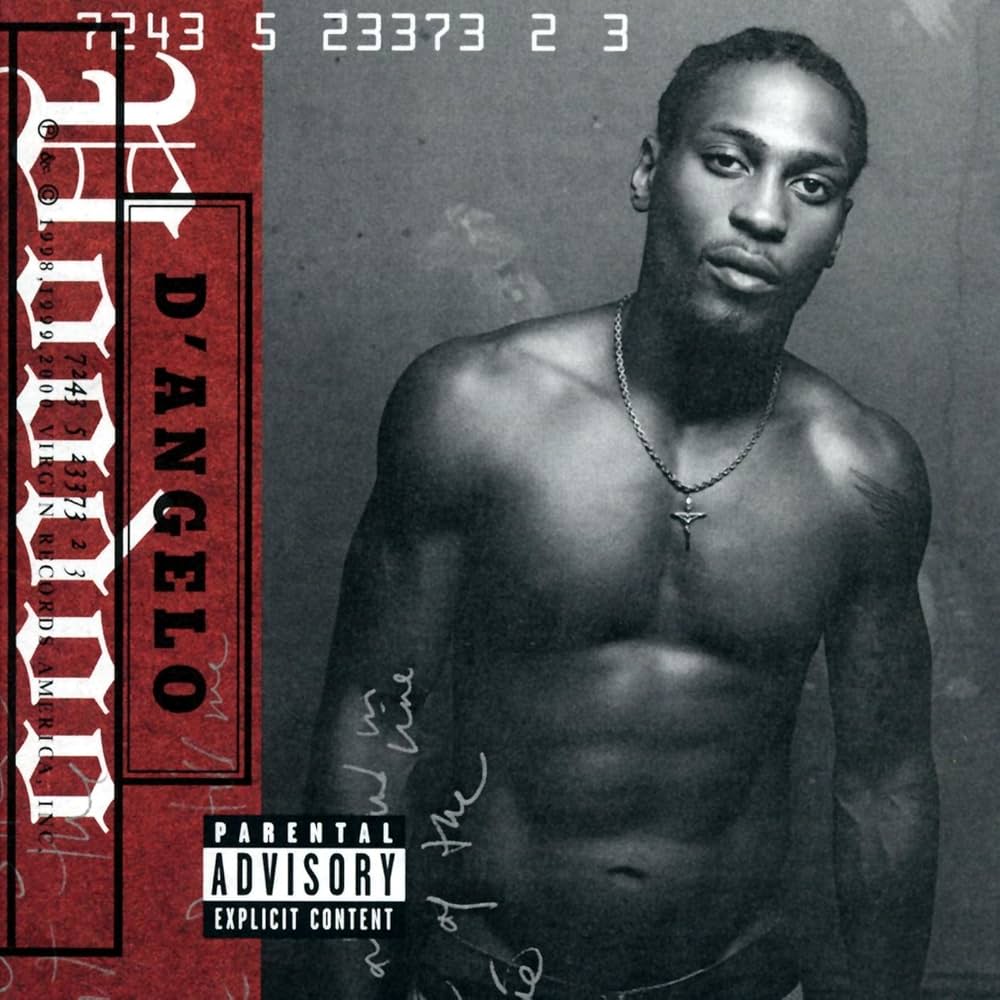
After the release of his acclaimed debut album Brown Sugar in 1995, D’Angelo wanted to trim the fat. The album, he later said, was too “buttery” for his taste. Yet its demos, recorded in his Richmond bedroom and refined with producer Bob Power, had felt right. Something was getting lost between the bedroom and the studio. Something that retained the grit, the dirt of a first take. Something that, in D’Angelo’s words, came “straight from the cow to the glass.”
Enter Voodoo. Released on January 25th, 2000, D’Angelo’s sophomore album is a set of stripped-down, airtight grooves. It is both retrospective and innovative: it’s a dedicated study of the “masters” — Prince, Jimi Hendrix, and Marvin Gaye, among other greats — wielded with fresh rhythms and production techniques. Voodoo reaches into a rich past to forge an even richer future. It’s a record that enacts the contradictions at the heart of its genre: neo-soul.
In terms of the soul of neo-soul, Voodoo wears its influences on its album sleeve. Saul Williams’ liner notes read, “The distilled ambiance of an Al Green song, the ambiguous sexual majesty of a Prince song, the creative genius of Stevie Wonder … D’Angelo has made his choices…” D’Angelo assembled his cast of musicians with a vision in mind. Producer and drummer Ahmir “Questlove” Thompson, bassist Pino Palladino, and jazz virtuosos like trumpeter Roy Hargrove and guitarist Charlie Hunter helped him capture a classic sound at Hendrix’s famed Electric Lady Studios. No doubt, D’Angelo was aiming to conjure the spirits of soul, jazz, p-funk, and R&B with the right people at the right time.
The sounds of the album echo such alchemy. Jazz flares suffuse the record in its instrumentation: Roy Hargrove curates close harmonies with his horn arrangements on “Playa Playa,” “Spanish Joint,” and “Feel Like Makin’ Love,” and Charlie Hunter takes us to a smoky New Orleans club about two and a half minutes into “Spanish Joint.” Beyond strict jazz, the chord progressions of tracks like “Untitled (How Does it Feel)” and “Send It On” evoke gospel, while the rhythm section, anchored by Questlove’s sparse drums and Pino Palladino’s syncopated basslines, is drenched in funk.
It is not wholly surprising, then, to discover the composition process behind these tracks. D’Angelo asked his band to study the work of the masters and participate in live jams. In an interview with Rolling Stone upon the album’s release, D’Angelo remarked, “It was definitely school, man … I ain’t never went to college, so this was my equivalent.” Poring over old albums, books, and videotapes of live shows, D’Angelo and Questlove submerged themselves in the sounds of those who came before them, encouraging the band to play through entire albums and catalogs of the masters. On one occasion, they played Prince’s Parade until they happened upon a groove that would become Voodoo’s final track: “Africa.”
Despite its adherence to his musical heritage, the album is remarkable in its ability to conjure the neo of neo-soul, particularly through its hip-hop stylings. Along with DJ Premier, Method Man, and Redman, D’Angelo employed record scratches and sly sampling on tracks like “Devil’s Pie” and “Left And Right.” Voodoo similarly showcases the hip-hop tradition of reversed samples: Hunter’s guitar peels back midway through “The Root,” and a flurry of reversed tape sweeps through the intro and outro of “Africa.”
What is most striking about these production choices is the way they blend so seamlessly with Voodoo’s analog feel. Using the technique of vocal overdubbing, D’Angelo’s voice expands into duplicated harmonies and collapses into one line within nearly every song. On “Feel Like Makin’ Love,” the layered vocals resemble Hargrove’s horn arrangements in their lilts and bends. On “One Mo’Gin,” they resemble the call-and-response of the background vocals of old soul tracks. And, on “The Root,” as musicologist Loren Kajikawa observes in his essay on Voodoo, they work to “simulate and enact a version of spiritual ecstasy,” as the final chorus loops with such a dense antiphony that it evokes transcendence.
These tensions between the analog and digital extend to the record’s rhythms. The rhythmic patron saint of the studio band of Voodoo was the legendary hip-hop producer J Dilla. Dilla was known for a particular rhythmic invention in his work: the juxtaposition of the uneven long-short pulses of swing against the steady, even beats of straight time. Dilla used “quantization” — the digital correction of rhythm — to displace notes just before or after the beat’s primary pulses. The rhythms that resulted were wobbly, swampy, and strangely human.
D’Angelo and Questlove set out to see how Dilla’s “sloppy” drum-machine sound could be replicated on a live kit, by a human drummer. Prior to the recording of Voodoo, Questlove was intent on achieving machine-like precision — to be “as meticulous and as quantized and as straight as 12 o’clock.” However, upon hearing Dilla’s style, with its scattered kicks and swung snares, he realized the possibilities of stretching his rhythms. He laid them even deeper in “the pocket” — that ineffable lock-step of drum and bass that makes your nose wrinkle and your brows furrow.
In recreating “Dilla time” on a live kit, D’Angelo and Questlove complete the loop; they use a human to achieve the technologically-mediated “humanness” forged by Dilla. It is no surprise that these beats are notoriously difficult to play. They require drummers to deprogram from standard straight or swung timefeels; they demand mentally separating the kit into independent elements, each at different paces. But the result is an infectious beat that is perfectly imperfect.
Voodoo, then, is a well of paradoxes. The instruments are analog; the instruments are hyper-produced. Rhythm is precise; rhythm is sloppy. The classics are respected; the classics are subverted. The album is neo-; the album is soul.

Leave a Reply