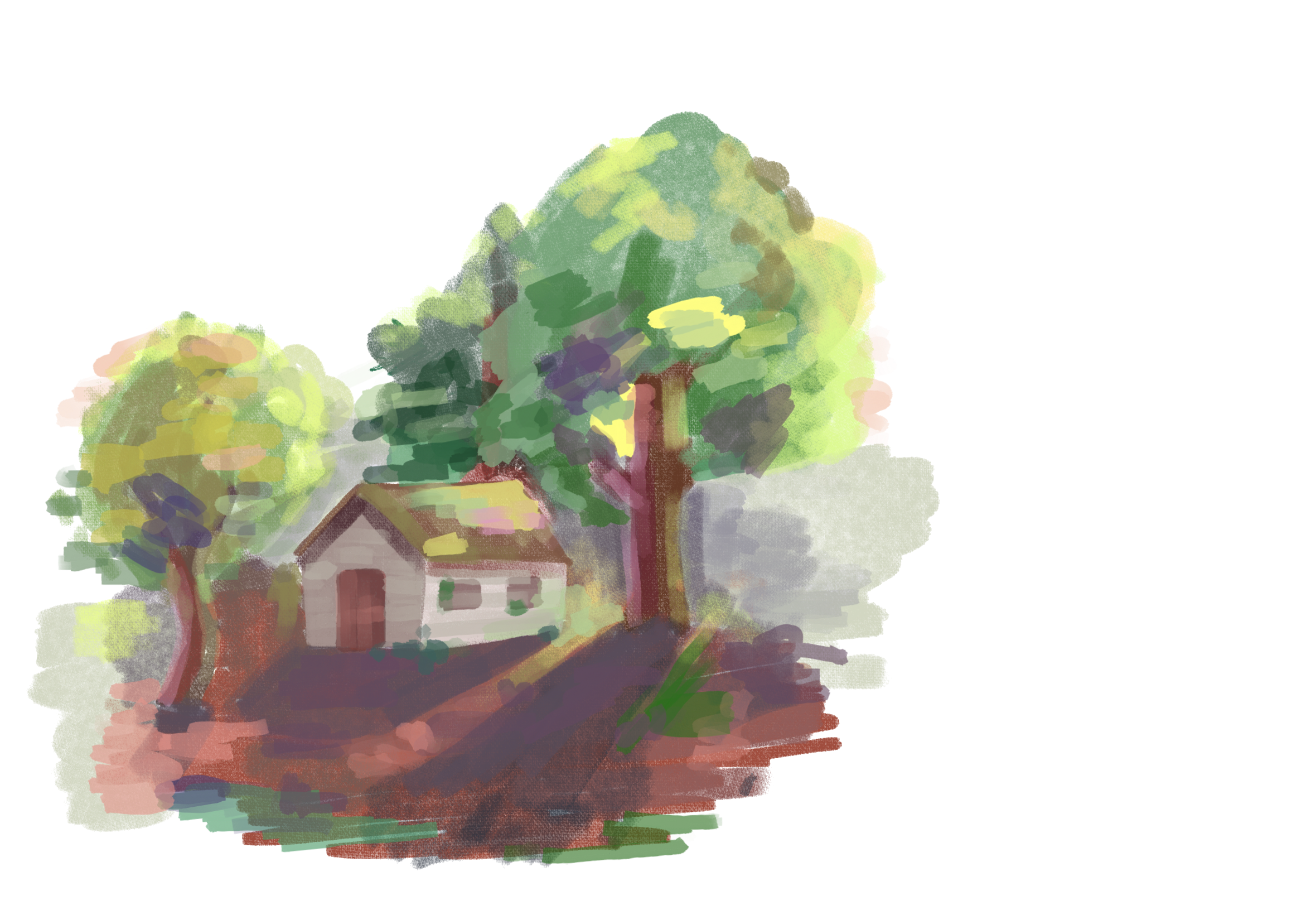
Our neighborhood had several streets, and each sounded like the names of trees. Some streets were named Thistlewood Drive and Woodard Road and Glenn Oak Lane. I lived on Gladewood Street, and none of these were names of real wood.
My friend lived in a different neighborhood from me, which had a neighborhood security guard and a gate. Dad said the houses there were too big for a family like ours. Another friend lived in a neighborhood more like mine, where anyone could drive in and out but only the people that lived there actually did. The other friend had a twin sister, two cats, and two dogs. Things in her house came in pairs, but their house was about the same size as mine. The houses in their neighborhood all looked identical: blue and grey color schemes, stout frames, and two stories tall. If you drove down one street, it would be like every other.
The houses in my neighborhood looked different. Some houses had white vinyl siding, others had red brick. One house had a blue door, and another was green. There was a steep hill that led down to Gladewood Street, and on the way down the hill, one of the houses on the hill had a tree with crab apples. The apples were the size of my thumb and green, with flexible stems like ones attached to cherries.
Gladewood Street was at the edge of my neighborhood, so we lived closest to the tracks. The trains that ran on these tracks carried cargo, not people. During the day, the horn blared, and wheels squeaked and clacked against metal rails. At night, the trains were just as loud, but I always slept through noise.
A long, wooden fence separated Gladewood–and most of the neighborhood–from the train tracks. But behind the fence by the tracks, there was a house so small that it looked like a tool shed. A boy around my age lived there, and from the deck in my backyard, I often saw him playing with his dog. The boy and dog were both skinny and had short brown hair. Perched from the deck, I could see him swinging a tree branch from his hand. His dog would run after it, and the boy would chase after his dog.
In the first week of June, families in the neighborhood went on vacation, and Gladewood Street was empty. In the summer, it was hot, and I always wore these flip flops studded with silver squares. From the inside of my house, I listened to the trains as they passed. When the trains were gone, I listened to the low humming that came from the air ducts and could hear the boy yelling at his dog from outside. Bored and alone with the other neighborhood kids gone, I decided to venture behind the fence to actually meet the boy and his dog in the first week of June.
When I went behind the fence, the boy was quiet; he wore a blue t-shirt rimmed with sweat along the neckline. His dog jumped on me and the legs pawed at my shoulders. The boy snapped at the dog to get down. He was shorter than I thought. But still, his chin lined up with my forehead. Though the boy didn’t say much to me, I was more entertained by his quietness than I was with the emptiness on Gladwood Street during the first week of June.
A few days later, the second time I went behind the fence, the boy showed me his backyard, which didn’t have a deck or fence like mine. We were right by the train tracks, which felt strange, because adults always lectured us to stay away from the dangerous train tracks. There were no other neighbors, and the grass in the lawn was long. There was, however, a tire swing tied to a tree.
We took turns trying to guess each other’s age. He said he was going into third grade. I asked him if it was hard and who was his teacher. I asked if he liked the fourth graders, since they had recess and lunch times together. The boy’s face altered, and he retracted his first claim. He was actually going into second grade, like me. Not understanding why he had lied, I knew he still wasn’t telling the whole truth because I had never seen him at school before, let alone in my grade. He didn’t say much more after that, so neither did I.
One day later in the week, the sun stood directly above us. The dog lay in the tire swing tree’s shade, and I sat beside it in the grass. The boy said he wanted orange juice and asked if I wanted anything. I would take the same. We went inside the house as the dog slowly stood up to follow. He offered me the juice in a glass jar. It was my first time inside his house, and my first time drinking out of a jar instead of a cup. The inside was bigger than I imagined, but the house was still much smaller than those on Gladewood. We sat at a small, circular table in the kitchen that felt more like a nightstand than a place for a family to eat meals together. From there, I could see a staircase but never saw what the second floor was like.
The glass of orange juice was cool against my palms, and the orange juice tasted sweet. The dog drank water from a metal bowl as the boy and I sipped on juice. Aside from the dog’s panting, the house was silent. That was the third time I went behind the fence in the first week of June.
When I got home that evening, Mom said she saw me go behind the fence from our backyard. She scolded me and told me it’s not safe to be near the tracks. When I argued that there was a boy who lived by the tracks, she sternly said she didn’t want me going near the boy either.
When everyone returned during the second week of June, I went back to playing with the kids that lived along Gladewood Street. We always stayed where our parents could see us from the front yard. During the day, my hands felt soft from chalk dust while my knees were red from the driveway pavement I drew on with the other neighborhood kids. The girls liked to play hopscotch in the road and draw on driveways when the guys wouldn’t let us run races up and down the street with them. When the trains passed through, we covered our ears with our hands, looking at each other and laughing. We played outside until the sun disappeared.
I didn’t go behind the fence again, and the boy spent less time in his front yard. I figured he stayed indoors more as the summer heat grew. It wasn’t until July when a silver truck showed up in his front yard— the first time I saw a car there. All the houses on Gladewood had a driveway leading up to a garage, but the boy’s house didn’t have a garage, and it only had a dirt road leading to it. The truck stayed for about a week and then disappeared.
On Gladewood Street, we spent our last week of summer doing the same things. During the school year, we would have more time indoors doing homework at our dining tables with only weekends to play. Not long after the truck disappeared from the boy’s house that summer, I heard our neighbor tell Mom the crack shack was finally gone while she was checking the mail. A few days later, on the first day of second grade, my friends pointed out that my face had freckles. I looked around but never saw the boy at school.
I thought about him very little over the years. When I was older and experienced my first summer away from home, I lived with a roommate in an apartment that was smaller but more expensive than my childhood home. We were working different jobs in the same city, one in a different time zone from Gladewood Street. Sometimes my roommate would come back so late at night that it was early morning. She would slowly enter the unit, trying to move quietly and not wake me. With one step on the creaking floorboards and the soft click from the closing door, my eyes would open to the dark room. I had become a light sleeper and missed how easily I used to rest on Gladewood Street, even with trains passing by at night.
Thinking about the loud trains reminded me of the boy who lived even closer to the tracks than I did. I couldn’t remember the boy’s name, but I turned over the words crack shack in my mind. I was surprised that an adult said that in front of me then, and even now, I can’t tell if it’s the truth. I tried to recall if the dirt road leading up to his house connected to roads that led to my neighborhood streets. I thought about how loud the trains must have been from the boy’s house and his room upstairs that I never saw. I wondered if he could drown out the trains as he slept in his empty house, and if he ever found himself in a home quieter than the one behind Gladewood Street.
Leave a Reply