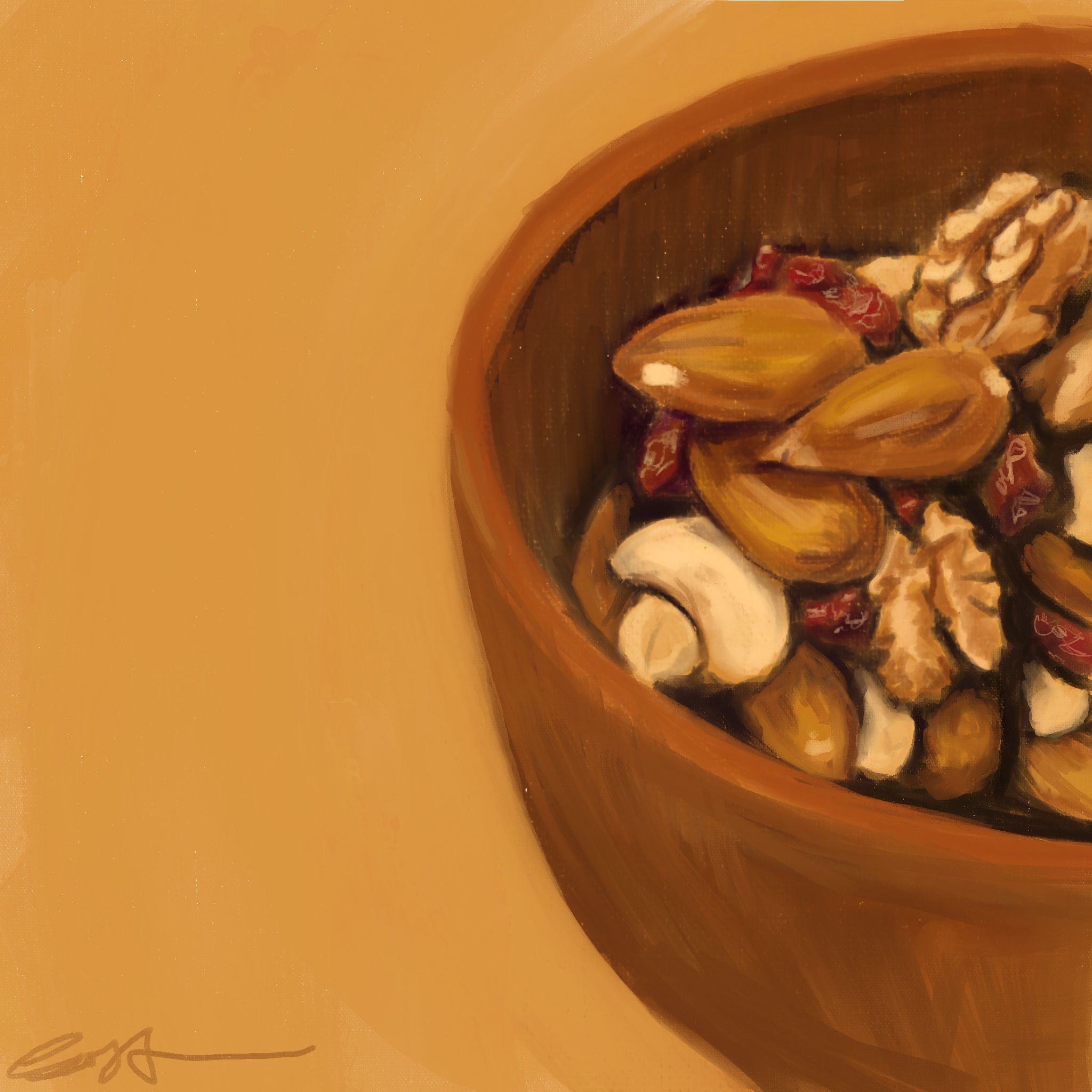
Recently, I came up with a metaphor. When I picture the face of a person who comes up with a metaphor, it’s not my face. The face that comes up with a metaphor is old, decidedly Greek, the face of someone whose name could also be the name of a gold standard vibrator, like Diogenes or Heraclitus. This metaphor-face is wrinkled and wise and worn and weary. I thought I was too young, too a bunch of other things to become the face behind a metaphor, but I guess not, because today I present to you my very first metaphor:
Airplane Nuts and Washi Tape.
This metaphor offers a binary through which to view the world. I get it—we’ve largely moved away from binaries, deeming them over-simplistic and generally inept at conveying that which we’ve for so long relied on them to convey (gender, to name a crowd favorite). But I wonder if sometimes they can actually be useful.
This idea came to me on the plane, a place where a disproportionate number of things seem to come to me. Likely because there is no Wi-Fi on the plane, keeping me from mentally teleporting to Instagramland, and there are also no friends with whom to speak, seeing as I have lied to my friends, claiming that the seats next to them were already booked (though phonetically similar, “plane time” and “play time” are not actually the same).
Alone and not scrolling Instagram I sit, when something very exciting happens. The flight attendant comes around with a special delivery: airplane nuts. Thank you ma’am, for these airplane nuts.
In front of me sits a runty little bowl, not even ⅔ full. But the runtiness ends there. They may as well be glowing, these nuts, lounging about in their United Airlines bowl. I’m almost like, is this sex appeal? I guess ultimately no (not sex appeal) but the nuts are awesome and I want to snarf them down in four seconds or else eat them incredibly meticulously with the care and attention such glorious treasures deserve. I begin with the latter approach—meticulousness—but progressively transition to the other—snarf.
Before boarding this plane, before I’d ever met these nuts, I’d been in the terminal. And guess what the terminal had offered me, for the small price of something exorbitant but ultimately feasible like $9? Nuts. Yes, the terminal offered nuts, as did the gas station I stopped at on my way to the airport, as did the home I left at seven this morning to get to the airport. Nuts are ubiquitous, is my point, which is relevant as it makes mysterious the seeming glee I derive from these specific ones on the plane. The sixteen nuts at which I gaze, wistfully, strike me as the only sixteen nuts on the entire planet. They are presented to me with abundant scarcity (oxymoronic but true), and thus I experience them as something like religious talismans (talismen?).
To segue from nuts to washi tape there’s no natural route, besides their shared status as oft-overpriced products adored by people who love the farmers market and (think they) know a thing or two about hormone balancing.
–
My mother has taught me a few valuable lessons in this life: Don’t walk through Central Park at night. Leave a cash tip in the bathroom of your hotel room where it has a better chance of falling into the hands of the person who actually cleans the room. People are mean because they’re sad. If you decide you’re having an existential crisis, eat a banana, and then reassess. Canned tuna is magic. Do not greet PhD-ed females with “Dear Ms.” And the washi tape you see in the store, next to the thirty-five other pretty colors of washi tape: That is not the same as the washi tape that will sit on your desk once you’ve purchased one roll of it for $16. This one here in the store is magical. The one on your desk will be on the floor under your desk (right next to the roll you bought last month) come nightfall, transformed from coveted specimen to clutter in less than a day.
What washi tape is, besides the girly, impractical cousin of masking tape, is the perfect antithesis of airplane nuts. Bear with me: As a member of the symphony—laid out among all the other colors—it glows. But on its own, it comes to inhabit its true status as a role of tape that isn’t actually sticky.
Now I endeavor to apply this binary to any and everything there ever was, to milk it ‘til it becomes a sad, deflated udder. That way I avoid the risk of having to come up with a new idea or original thought ever again. I sit here basking in the glory of having a face that is the face of a person who has come up with a metaphor.
One application of my metaphor/binary that I am especially interested in entertaining is: friends (a subject I’m always particularly interested in entertaining).
Say there’s a guy named Keith. Keith is in your friend group, one of the boys, if you will, and when everyone else is doing the thing—watching the football game, playing Uno, comparing Hinge profiles—Keith’s presence, also doing the thing, alongside everyone else doing the thing, is inoffensive at least, additive at best. He is funny, this Keith, adds to the dynamic, makes a good joke that you and the others laugh at (awesome).
One day, over winter break, everyone else is gone; it’s just you and Keith in town. You meet at 1 p.m. for turkey burgers, decide you should probably hang, seeing as he is one of the boys. Third of the way into the burger, you realize the guy is pretty boring, answers your questions and gets back to the burger or the TV screen (he is big into hockey).
Keith is a washi tape friend, you (would) conclude (if you knew this binary). He contributes to wholes of which he is a part. To these, he is a solid addition, appears to glow with humor and a sense of can-hang. But, isolated from the whole, he’s kind of whatever.
In the way that there is Keith, there is also Francis. Francis, too, is one of the boys, and though the group isn’t so big, when you’re in it, the dynamic of the whole, you sometimes forget about Francis. The guy doesn’t talk that much, his personality kind of pales in comparison to the more gregarious others, the ones who crack more jokes and crack them louder. It’s not that if you found your namecard placed next to Francis’s at a dinner party you would be actively upset, per se, but it’s not as though you would jump with joy, either.
Well, it turns out this hypothetical dinner party really happens—surprise!—and seeing as the host is a serious micromanager, namecards have been laid out, and yours—you guessed it—sits right to the right of Francis’. You oblige, draping your sweater over the back of the chair—this host is scary and no one wants to face his wrath by screwing up his seating chart. You nod across the table to the friend you wish you were sitting next to, and then gear up for an expectationless hour with Francis. Right away, you note that because the acoustics of the room are so bad, you really will only be able to hear each other. Francis and you, you and Francis (sucks, you think).
But the next time you re-enter your conscious mind, you realize that your initial boring discussion of AI eventually turned to something you don’t even want to repeat here because it only made sense then and there, between the two of you, you and Francis. By the time everyone gets up, when the food is all gone (the host underserved, in wont style), you two remain perched right there where you are. This guy Francis is pretty cool.
Francis is an airplane nuts friend. As a part of the whole, he is easy to miss. It doesn’t occur to you to seek him out when you have other options (friends). In isolation, however, he’s totally awesome. Some anal partygiver decides he’d like your left elbow and Francis’s right one to bump into one another periodically throughout supper, probably without much thought at all. Suddenly, here you are, thinking, maybe platonic soulmates are real, where has Francis been all my life? It is a similar feeling of discovery to when the flight attendant gives you the nuts, and you’re like, Holy Nirvana this is the best thing I’ve ever tasted, nothing will ever be so good again.
So, per my metaphor—yes, the metaphor of my very own construction—there is this binary, and I’ve tagged it Airplane Nuts and Washi Tape. What it tells us is: background matters; context matters. Washi tape, the experience of perusing its many colored and patterned forms when you’re there in the store, amidst all the other colors and patterns, is a magical, delightful experience. When you bring the washi tape home, separating it from its tribe, plopping it into the reused Chobani yogurt container you’ve designated your miscellanous-shit-tub, the tape and its $16 price tag become much less glamorous.
Keith, around the rest of the boys, is totally awesome. But when you’re with him one on one, though remaining fundamentally the same person, he is made, by the context, less obviously appealing. You are still glad he is one of the boys, but he is not, at least for now, the other tête with whom you would like to be engaged in many tête-à-têtes.
Well, there is a happy solution, I am here to tell you, and I hope you’ll trust me despite my face’s status as not that of a pained old Greek man, and my name as not that of a sex toy. In this life, we have space for both: Airplane Nuts and Washi Tape. It is useful to realize that we don’t actually have to leave it up to fate (a seating chart forcing us next to Francis, United Airlines blessing us with only sixteen nuts) to get our hands on the real or metaphorical airplane nuts of the world. That which is not immediately appealing or flashy may ultimately be quite additive to life, a fact it’s good to remind ourselves of.
And while I do aspire to avoid bringing washi tape or any such impractical cousins home with me—anticipating their sad futures at the bottom of yogurt tubs and under desks—I know that entering stationary stores to ogle at washi tape is a wonderful pastime. The key is in remembering that the context is essential to the enchantment. It is worthwhile to note when and how Keith’s company is enjoyable, but the fact that he is not perfect in all settings ought not discount his value altogether. Not every person can be a Francis, a diamond in the rough, or a diamond of any kind. We need crowds, and we need individual people to make up crowds.
Mia Mann-Shafir is no ancient Greek man, but she creates a new metaphor anyway.