I traveled like a nomad through the crowd at Jeanie Chang’s fashion collection preview, Hôtel Tassel. Jeanie stood near the drinks table, decked out in a bold yellow-and-black peacock print dress at once floral and scaly that unforgivingly wrapped around her figure. But somehow, she seemed to me more regally Korean than ever. The dress’s silhouette could not have been more different from the dress of the Chosun Dynasty’s royal women, tending to spread out voluminously like ships’ sails, but its images of a peacock feathers and wings carried a reminiscent formality. Young-chin Wangbi, the wife of Chosun’s last prince, was depicted wearing a royal blue wedding robe embroidered with 138 pheasant pairs, and its edges adorned with yellow clouds and phoenixes in an abstracted display of heavenliness. The shared symbolism of flamboyant birds representing regality — pheasants and phoenixes of Korean royalty and Hera’s peacock — instilled a strange sense of recognition within me. This methodology of abstraction — which I recognized as functioning here as a visual alignment that allowed traditionally antithetical cultures to meet — also inhered in Jeanie’s previous collections, which I had seen. She asked, “You remember how we first met?”
Jeanie and I first grabbed coffee in May of this year, the day after her debut show in Chancellor Green: Metanoilepsis, a title combining Metalepsis (“a literary or rhetorical leap, often connecting distant ideas”) and Metanoia (“a profound shift in perception”). Jeanie had sewn 20 pieces over her senior year and showcased them on her friends, who walked as models around the cleared-out Chancellor Green library. On a usual day, the space is pensively quiet, covered in reddened wood and stained glass. Sunlight romantically cascades onto dusty books and velvet spines, revealing their patient beauty. But on the day of the show, the space was unrecognizable. It was mostly dark, but lit up purple, blue, and red by spotlights in the octagonal corners of the second floor, so looking up felt like a cosmos from the lowest point in the earth. Yet, other lights pointed to the center, the colors converging as shocking white light. The new Chancellor Green promised transformation, mystery, and renewal, which thrummed in a soundtrack featuring our friend Ina Aram’s voice, calmly narrating poetry throughout the heady synth mix.
Watching the show felt like sitting in on Jeanie’s fantasy dream. Models dressed in black leather passed those in white organza, blue satin, and desert-colored lace. A triangular collar hung over a rectangular silhouette, and fur hugged chocolate leather. Many disparate looks seemed to come together in Metalepsis. Though all were beautiful, I was most impressed by the final white gown that ended the show, the piece that, for me, brought Metanoia. The piece was a floor-length high-neck gown with a subversive triangular cut-out back unexpectedly showing the model’s shoulder blades. Regardless of the avant-garde cut and the gown’s Hollywood aesthetic, its whole expression felt unquestionably, essentially Korean. Jeanie clarified my sense of the dress. The fabric, Korean hanbok dan from Seoul’s Dongdaemun market, a nationally famous large commercial district housing traditional markets, made the dress redolent of Korean traditional dress.
“I wanted to reinterpret where my own design work started [through Metanoilepsis]. The last dress is a Hollywood-esque gown, but the back deep V cutout is lined (also with a different sheer dan) like the front of many hanbok designs with the cross-over V-neck,” Jeanie commented. “It’s kind of a ‘reversal’ of the direct reference [to hanbok].” In the few moments when the model, a Korean American friend of Jeanie’s, walked through the aisle, I felt that I was watching the essence of Korean culture — composed and timelessly elegant — move alive with each shift of the dan, and that my heart was thawing a little, in a strange way, at recognizing its familiarity.
At their highest level, Korean artists use the elegance of abstract brushstrokes to display the essence of things. Two paintings, both national cornerstones, show this well. Portrait of a Beauty (1858) by Shin Yunbok depicts a woman who hides her eagerness about her own beauty under a mask of ambivalence. Every strand of hair, which is not depicted as by minute, thin lines, but a continuous, thick brushstroke, presents an abstract desire through its sinuous movement, rather than trying to explicate it through an accumulation of small details. A Bull (1953), by Lee Jung Seob, also conveys the idea of a bull in motion with a few broad, rustic lines. Both present a subject’s truth through abstraction, not explanation through an ultra-realistic description. The thicker, fewer brushstrokes create an effect of matter-of-fact restraint, which alludes to a specific atmosphere or emotion.
Jeanie’s white dress and other works also reflect a similar methodology. By selectively incorporating Korean culture into Western pieces using traditional fabrics or silhouettes, she also evokes — this time not an essence of emotionality — but a tradition of Korean art. Not beholden to a too on-the-nose homage of Korean traditional dress via accurate mimicry, Jeanie still effectively cultivates a sense that she is working in the metrics of Korean culture. Her goal is “not to make a modern hanbok,” but to explore how the form and materials of the hanbok can naturally live within her design language. Her work has carried Korean artistry since her first attempt at fashion, East Meet West (2021), a set of looks she created during COVID-19 for a YoungArts Competition. She took elements of the hanbok and jeogori, traditional Korean garments, and tal, traditional Korean masks, and fused them with Western pieces like the corset and denim to create “I Am Both Detachable Denim,” a piece that presents as rebellious, teen-spirited and Gen Z-coded, but carries a dignity that typifies Korean craftsmanship.
Staring at photos of the pieces, I can’t help but recognize them as hanbok, although the upcycled jeans and cloth should have screamed the opposite. Each detachable piece of differentially shaded denim resembled saekdong (“vividly colored stripes of fabric”), which are sewn together to form jeogori sleeves. Jeanie’s jeogori has the same dignified yet relaxed silhouette of a ship’s sail, and the A-line mini-skirt, though short, is layered with different denim textures, carrying the feel of a multilayered chima (skirt) that flows out long and voluminously to the ground. Without being over-realistic or replicating every single detail of traditional hanbok, Jeanie was reflecting an essence of Korean art through abstraction, like our ancestors.
The upcycled materials reflect the idea of heritage as “something that always finds its way back,” Jeanie told me. Even though “I Am Both Detachable Denim” shows skin along the wearer’s midriff and legs in a way unlike hanbok, which hides all skin except for the wearer’s face, neck, and hands, its exposure effectively subverts the direct reference to the reservedness of Korean culture. Implicit in the collection title “East Meets West,” Jeanie’s version of hanbok is steadfastly elegant as it “meet[s]” the West, and candidly carries the marks of the transformation resulting from this intercultural encounter. It does not feign a Koreanness that is unchanged despite its experiences. Like the Hollywood-esque white dress made of dan, the subversion of “I Am Both Detachable Denim” reflects Jeanie’s own unique position of a Korean-American artist who preserves her heritage through the Korean practice within Western culture.
Jeanie moved to NYC full-time in the summer to work on her fashion brand, Genie Couture. Heading to her second collection’s preview on September 20 with Ina, something warmed my belly from the inside out. Ina, who was half Korean, and I being brought together again by a Korean-American designer felt like a reconnection with my roots. But it wasn’t just that; I was also excited to find a piece of Korea in unfamiliar settings again, to feel that shock of seeing something familiar in a neckline, a cut-out back, or the shiftings of a skirt. As an effect of being displaced from my home culture for extended periods of time while studying in the U.S., I often feel numbingly distant, only instinctively Korean in some distant sense that I must recover, piece by piece. Reflecting my distanced connection in its production, Jeanie’s white dress returned a chunk of my sense of Korean self back to me, cutting it loose from the dangerous suspension.
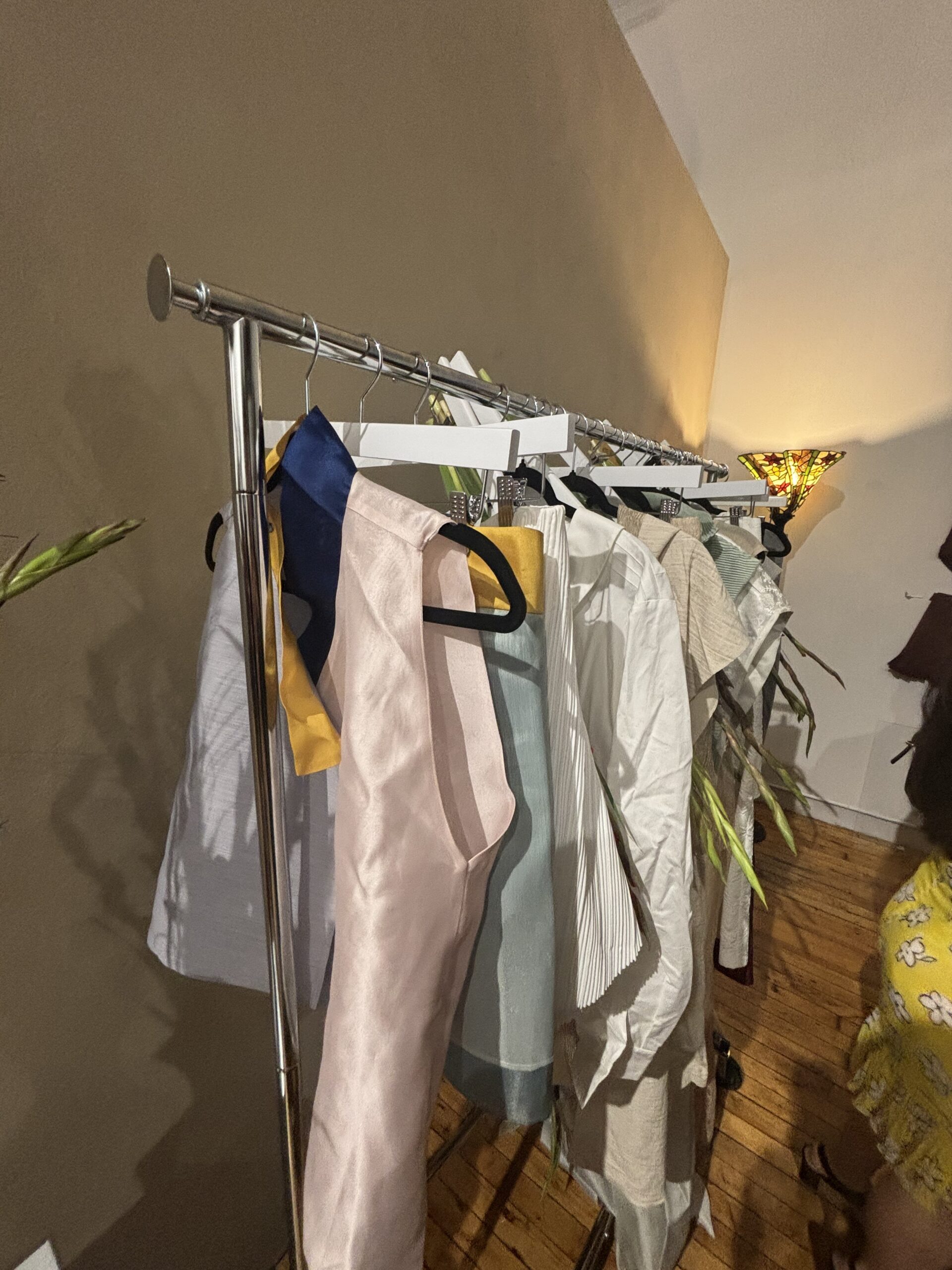
Amid a low-lit Art Nouveau soirée breathlessly filled with ostrich feathers, new collection pieces were hanging from the racks and walls. Slinkily dressed Princetonians and fashion PR persons laughed, talked loudly, and sipped dark red Asian-inspired cocktails. Jeanie started talking as if she were confiding a trade secret. All the displayed pieces were from her newest collection, and the pieces on the wall, specifically, were pieces still in “translation” between her and the manufacturers. “So that’s their interpretation of my designs.” Jeanie would go back and forth between manufacturers, sending over her designs to see, quite literally, what they made of it. She might receive perfect products in one go, but it was much more likely that she was returning the item in its garment bag with pins at the hip, or arrows in the designs, including enlarged illustrations of how a particular fold in the sleeve should angle. The piece would continue in a limbo of mutation until made perfect. Shifting, hemmed, disposed. Re-interpreted with each clarification. Born again of the same scraps. Jeanie was going through the iterative process with the hope of making it meaningful. This way, her heritage could truly be “something that always finds its way back” through a creative process.
Jeanie asked me which piece I found most noticeable. I pointed straight to the green silk top, reminiscent of dan, diamond-shaped and backless but for a reddish tassel tie falling vertically down. She said it was thematically tied to Victor Horta’s Hôtel Tassel, but also to Korean culture, particularly hanbok, which starred many intricate tassels in their designs. I loved it not only because it was objectively, undeniably beautiful–but also because it subtly evoked the traditional garment, neither appropriating nor attempting to “scream KOREAN.”
Because of the fabric and form Jeanie chose to create this new backless hanbok top, it didn’t come across as culturally entrepreneurial as K-town sweet shops or America’s commercialized tourist traps around Squid Game do: loud and cartoonish. On the contrary, it felt naturally derived from Korean culture, the product of a designer who works outside the “singularity placed on Asian dress or Korean dress.” Jeanie’s work does not evoke her heritage in the gaudy, often mainstream way. She walks the middle road of creatives who allow the Korean culture in their hearts to come forth in whatever regal forms, subverted cuts, traditional materials or shades within their work.
After leaving Jeanie, I lingered in front of the green tassel top. It brought the same heart-thawing sensation as the white dress did, and I knew that the top was a piece that even my ancestors from dynasties past could also easily appreciate with recognition and pride, if they could ever get over the scandalousness of the wearer’s exposed skin.


Leave a Reply