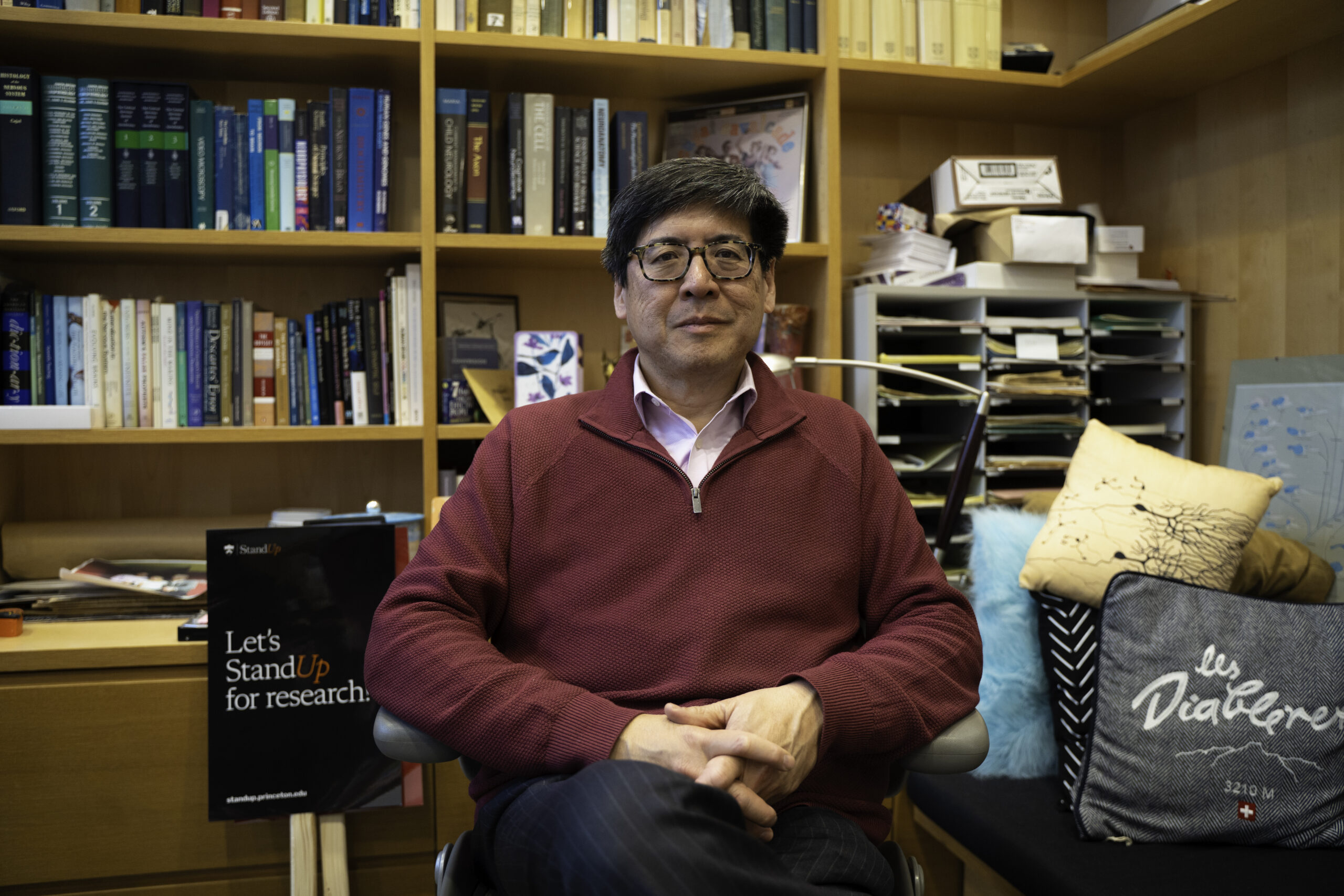
Tucked inside the Princeton Neuroscience Institute is a spacious meeting room, accessible only to professors and lab staff. On Tuesday, February 10, it was booked for the Wang lab. Words like dendrites and segmentation floated alongside food commentary and lighthearted banter as Sam Wang walked in. Dressed in typical Ivy League fashion—a crisp button up layered underneath a knitted sweater—he exuded the energy of a wholesome, almost fatherly figure.
A week before, Wang, a neuroscience professor at Princeton, announced his run for Congress in New Jersey’s 12th district. But today, Wang played scientist, not politician. As he sat down at the head of the table, the chatter softened. A lab member was presenting on a dendritic image analysis tool called DeepD3. Throughout the presentation, Wang kept up a constant stream of questions.
I met Wang in his office that morning. He brought his dog since he had no time to walk her. Betty, a golden American Coonhound with sweet eyes, nuzzled my hand. She was quiet but affectionate, peering up at us from the ground.
Before leading his own research group, Wang was a 15-year-old freshman at Caltech. There, he majored in physics. But post-undergrad, he switched his focus, pursuing a PhD in Neuroscience at Stanford. “I wanted to do something fundamental, and I wanted to make a discovery in my lifetime,” he explained—a sentiment that guides his scientific and political pursuits. After Stanford came postdoctoral fellowships at Duke and Bell Labs, a research and development branch of Lucent Technologies. After just one year in his postdoctoral fellowship at Duke, he took time off to work on Capitol Hill.
“I took a break in my postdoc after my first year because I was not satisfied with my progress,” Wang said, leaning back in his chair. He then explained that the Democrats had lost control of the House for the first time in 40 years. This galvanized him to apply to a fellowship in Congress designed for scientists. Subsequently, Wang was in Washington, witnessing the first large government shutdown arising from partisan conflict in 1995-1996. “There, I learned that politics can break,” he said. “I had these views about politics where everyone works together through discussion. But it started breaking that year, and it’s been becoming more broken for the past 30 years.”
After the close 2000 election between Al Gore and George W. Bush, Wang resolved to bring his scientific lens to issues of polarization and voter inequity. He founded the Princeton Election Consortium in 2004 and the Princeton Gerrymandering Project in 2017, focused on predicting election outcomes and equalizing voter power.
By 2016, Wang was a respected pollster, and in October, one of his twitter posts went viral: “It is totally over,” he wrote. “If Trump wins more than 240 electoral votes, I will eat a bug.” One month later, Wang was on CNN, staring down a honey drenched cricket.
“I go on and I say to the host, ‘Okay, I’ve got a bug here,’” Wang recalls. “‘You wanted me to eat a bug? Sure. But before I do that, I just want everyone to understand that we’re at this really fraught national moment.’ But then this is where the host is looking at me and just saying, ‘Are you going to eat the bug? Are you going to eat the bug?’” Wang sighs, exasperated. “And I think to myself, if it’s good enough for John the Baptist to eat a bug in the desert, it’s good enough for me. But now, nobody remembers that I was trying to get a message out. Everybody just remembers the bug. The CNN technicians on the other end of the mic turned up the microphone to really get the crunching sound as I ate it. Then, I became a meme.”
Here, I asked Wang why he decided to run for Congress. Between the government’s current hostile attitude towards scientists and the increasing sensationalism of American politics—as exemplified by the bug—how can he still be optimistic when it seems like his science-based approach to reforming politics is falling on deaf ears?
Wang paused.
“Both my parents died some years ago,” he said, speaking quietly. “The doctors in the ICU did everything they could. And I did everything I could, and in the case of my father, I was there… Because you don’t leave someone you love when they need you. This is a very difficult time right now. But, I love my country. This is not a time to say, ah, I’m just going to go do my science, walk my dogs. I like my science and I like my dogs, but right now, I think everyone needs to do everything they can.”
“Scientists are not typically very political, but the Stand Up for Science protests attracted hundreds of thousands of people… It’s a time when people need to rise up. We might fail; I didn’t succeed with my father. But it doesn’t change the burden of at least trying.”
Sam took a break after mentioning his father, leaving Betty and me alone in the room. We looked at each other. She hung her head, eyebrows furrowed as if she could feel Sam’s grief. In this silence, I thought about America and the kind of freedom it used to represent. I thought about Einstein, who was driven out of Germany to the United States and eventually to Princeton, his arrival marking the start of decades of physics advancements that transformed America into a scientific powerhouse. I thought about how, less than a century after Einstein’s warm welcome, many budding scientists on the cusp of discovery have been driven out of the country in search of safer havens abroad. And then I thought about the hope that now lies in scientist-turned-politicians like Wang, people emblematic of a logic and evidence based politics that we now so desperately need as a nation. And then I thought about the future.
Leia Pei is a contributing writer for Second Look.