EXT. LOS ANGELES — DAY
SEBASTIAN, 32, L.A. native. A prickly jazz pianist who dreams of saving the dying genre with his own old-school club.
MIA, 27, Nevada-raised. An aspiring but failing actress. Currently, a barista on the Warner Bros. lot.
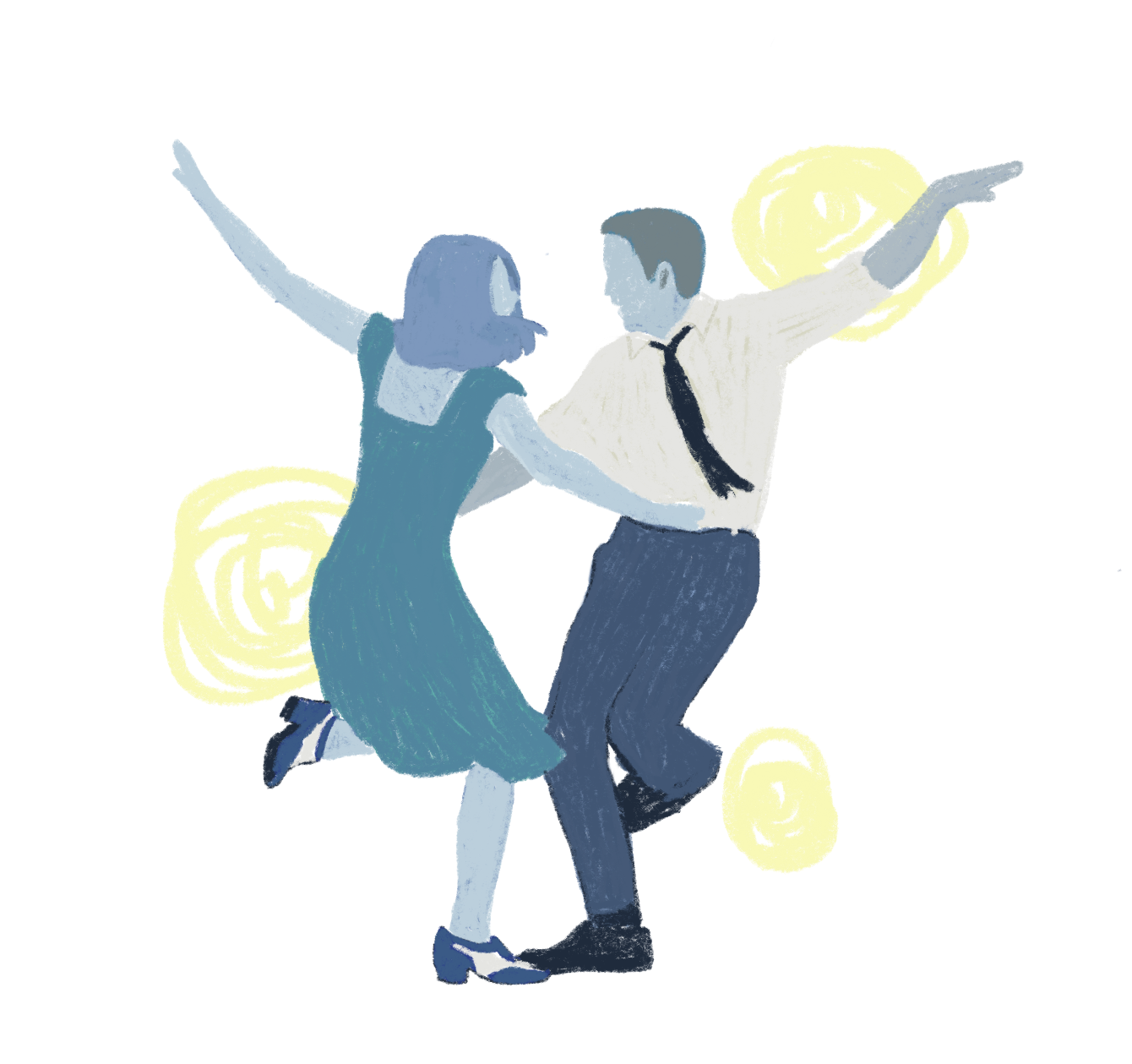
La La Land traces a familiar arc: two aspiring artists tap dance into love as they chase their dreams. Google classifies the film as a “Musical/Romance,” a somewhat spurious characterization given the eventual breakup of the central relationship. With deeper inspection, the expiration of romance suggests that love may hold the same obsolescence as our cinematic past: it can be staged, replayed, and longed for, but perhaps no longer lived.
La La Land arranges its romance by seasons, legible in flashing title cards at the onset of each act and reading like romantic shorthand: winter hardship, spring renewal, summer abundance, fall decay. By the final act, as Mia and Sebastian reach their respective paths of professional prosperity, their emotional bond thins, culminating in the breakup. The epilogue fashions the ultimate what could have been sequence. The audience glimpses the archetypal life expected to conclude a movie-musical: the protagonists seize their dreams and keep their love. Yet, it is a mere simulacrum of the coveted Hollywood ending. The perfect dream ends for Mia and Sebastian, and it ends for us, too. When they share a final smile, it is a salute across a chasm; they return to their separate lives as separate people.
The conclusion may feel like a betrayal of the genre’s formula because the director, Damien Chazelle, spent the previous two hours simulating the past and seducing us with the cinematic language of a bygone era. When Mia and Sebastian visit the Griffith Observatory, a nod to the 1955 classic Rebel Without a Cause that the couple watched moments before, Chazelle’s direction ignores the limitations of logic. In a fantastical scene, the protagonists quite literally fly up to the stars, dancing among them.
The imitation of Old Hollywood is anchored in the striking use of color. We see it in Mia’s wardrobe—the dandelion yellow during “A Lovely Night” or the opulent blue when Sebastian’s piano medley first flirts with her heart. When the couple sings the reprise of “City of Stars” in Sebastian’s apartment, Mia stands before curtains in a purple dress, drowned in a rich green light from above. In Chazelle’s own words, the purple-green contrast aims to deliberately reference a scene from Alfred Hitchcock’s Vertigo (1958). Chazelle, a professed fan of Old Hollywood movie-musicals, feigns the beauty of Hitchcock-era Technicolor throughout the whole film.
Today, the secret alchemy of Technicolor has fallen under the floorboards of history. Technical limitations and lack of training have made it largely hopeless to replicate. Digital film technology moved forward, leaving the old tools forgotten; the tools for Technicolor are no longer produced. We will never get another Vertigo, where Jimmy Stewart’s eyes flash an impossibly vibrant blue. We will never get another Wizard of Oz, where every frozen frame beams with the decadence of a radiant painting. Technicolor, for us, is little more than a vanished dream.
This cinematic extinction mirrors the loss of love between the two main characters, and Mia and Sebastian’s narrative is a collage of Old Hollywood phantasms. The very first title card states the CinemaScope aspect ratio, an invention of 1953. The primary-colored attire of guests at a house party shines like an embossed ‘50s advertisement. In simulated Technicolor, their relationship shares the same quality: an idealized dream lost to time and other passions. Just as the three-strip process of Technicolor required a precise physical convergence to produce its beauty, Mia and Sebastian briefly aligned in vivid synchronicity that the friction of reality could not sustain.
La La Land presaged the promised fantasies and equal betrayals of our post-imaginative world. In the decade that has passed since La La Land’s release, the studios that once honed artistry are being perverted for the sake of mass-consumption. Netflix is negotiating for Warner Bros. MGM was long ago abducted by Amazon. Both in front of and behind the camera, cinema’s beating hearts are being replaced by artificial digitalizations. Spike Lee struggles to find studios to produce his films; executives are unwilling to take a gamble on the visions of the field’s best artists. The need for editors to manually search footage for an imperfectly brilliant take is dwindling; AI can scrub away the sublime abstractions of humanity to forge a stilted scene of technical perfection. Studios optimize production, using analytics to shave off the rough edges of art until it is acceptable for passive consumption, a product with no capacity to echo through the membranes of a real human soul.
The dream seems lost. We fashion our mental fantasies in Technicolor as we escape this hyper-technologized, convenience-crazed reality—pallid and callous in comparison. We ponder the what could have been or the what used to be not because we believe in fantasy, but because we mourn its impossibility. Chazelle offers a film that functions like a dying star, most brilliant before it goes cold. As we watch Hollywood and art and love being irreparably swallowed by digitalization and algorithms, La La Land is illustrated like a dream haunted by its own decay. Even in this fictionalization, the what could have been never comes to be.
Technicolor and sublime abstraction have really been on Darena Garraway’s mind lately.