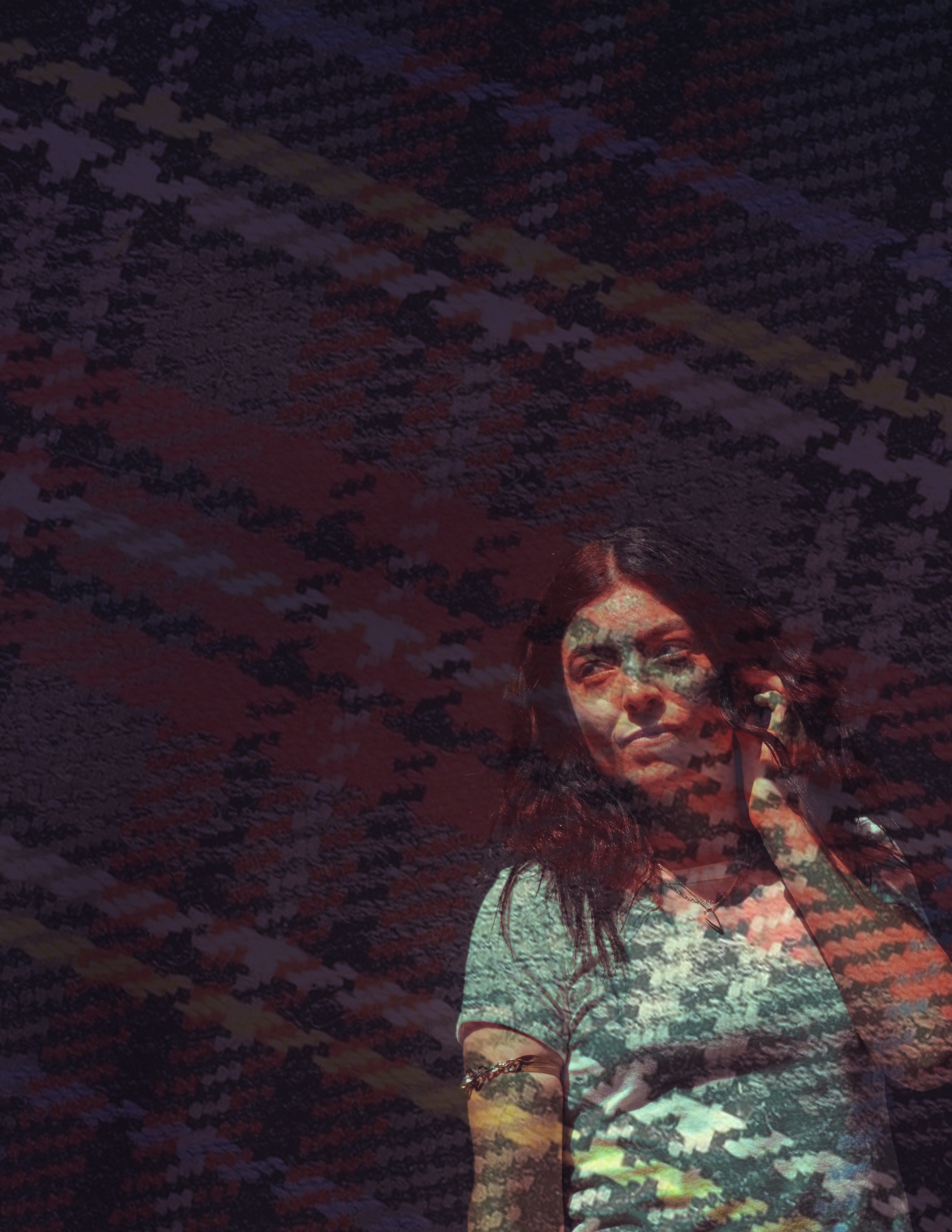
Why do we run to the ones we do?
I don’t belong to anyone
It hits me on a Tuesday in September that I don’t belong to my own life. Nothing has ever engulfed me — nothing has ever outstretched its arms and held me tightly to itself. Every memory, place, person, everything has wrapped me in a loose embrace that I can easily fall out of but still keep the sensation of its touch. I realize this in Philadelphia, standing in the nosebleeds of a sold-out arena, drowning in a dark blue light. It feels like I am seeing Jesus, but I am really just seeing Lorde.
The Xfinity Mobile Arena is dramatically cold. I’m wearing a white button-up as an ode to Lorde’s outfit in the “What Was That” music video, but I wish I had brought a jacket. It’s the first concert in a while that I haven’t been in the pit, and the absence of others’ body heat is loud. The last time I wasn’t in the pit was also at a Lorde concert, during the Solar Power tour. Lorde was headlining “All Things Go,” the local D.C. musical festival. I stood on an outdoor balcony with my best friend Audrey, and we screamed “Ayiyiyiyi!” when Lorde came out. Today, some people are topless, simply covering their breasts with gray duct tape, like Lorde did in the “Man of the Year” video. I wonder if they’re cold, too. The audience here feels sad — unlike the last Lorde concert, the audience does not buzz with drunk giggles. Clouds of smoke don’t blow over my head. Seems like everyone’s sober. Last time, everyone wore bright, sunny colors. Today, I’m with Grace, a girl I went to high school with, who ended up at Princeton, too. I’ve always liked Grace, but we weren’t close in high school. Last time, I went with Audrey, who bought a ticket for me without asking because she knew I’d want to go. The audience looks dark today, or maybe it’s the deep blue that pours over us all. Maybe it’s too cold to be excited. Maybe it’s because it’s a Lorde concert, and we are all here to cry.
For the past three months, Lorde’s new album has echoed throughout my life. I played her in my car — my beautiful teal Mini Cooper Francesca, which my parents are probably going to sell — in my room, on my long walks around my neighborhood, where I tried to memorize each house in case they looked different when I came back. During “David,” Lorde steps off the stage and descends into the pit, where, clad in a glowing jacket, she struts across the floor. The audience, enthralled, parts for her, and all I can think is that I am seeing Jesus part the Red Sea, until I notice the hundreds of phones that have been whipped out to snap close-ups of Lorde’s face, and I remember I am really just seeing Lorde walk through a pack of Philadelphians. Lorde faces a cameraman whose job it is to make sure that her every move gets projected onto enormous screens on either side of the stage. I stare at her face on the screen as she sings, “Said, ‘Why do we run to thе ones we do’ I don’t belong to anyone, ooh.” I thought “David” would be the song I cried to, but I have no urge to, anymore. I can’t see anyone else crying, and my friend, Grace, wears a wide smile as she clutches her chest and dramatically echoes Lorde’s every word. I don’t cry because suddenly “David” does not belong to me; it’s Lorde’s song. Lorde has been God to me, but to herself, she’s simply Ella Yelich-O’Connor. She wrote the song about herself, about her own life, about being groomed, about her own thoughts, and I’m just a fan who has occasionally wept to the song in the shower. If I acknowledge this truth, I fear that I’ll have to acknowledge the entire truth, which is that I am here now, without the past, and I have nothing holding me down. I’m frozen, hypnotized by Lorde’s lyrics. “I made you God ’cause it was all that I knew how to do,” she continues. Lorde is taunting me — think about everything good. Think about everything you had.
“But I don’t belong to anyone,” she finishes the verse.
Think about everything you don’t have anymore. I accept her challenge.
- My high school friends. We went to an all-girls school that had a uniform of a blue plaid skirt. For the last seven years of my life, I rotated between two plaid skirts. I had more skirts in my closet, but I never wore them because they were too long, and I didn’t want to roll my skirt an exorbitant amount. For the last seven years of my life, the one object my friends and I all had was this plaid. Our school wrapped around our waists. So many memories in those skirts — getting frozen yogurt after school, sitting in our principal’s office together eating Lifesaver mints, writing the names of the fallen soldiers —everyone who left our school — in the senior lounge. I know some of my friends gave their skirts to our school’s uniform thrift store. I still have mine, but I’ll never wear my plaid skirt again.
- My parents. I am unleashed now. I have a mom, but now, I don’t have a mother telling me to get back home before midnight. I can get home — my dorm — whenever I please. I can get a tattoo now without my parents’ approval. Their disappointment might still engulf me.
- Friends who share the same small world made up of all the same small places. D.C., as a teenager, is very small. Everyone knows everyone, and everyone goes to the same places. When we got froyo, we’d joke that our heads needed to be on a constant 360 swivel, ready to see whoever was soon approaching. I used to spend weekends at Compass Coffee, reading and doing homework. I never needed to ask anyone to come with me because I could guarantee you that my friends in the nightmare biology class would be there, huddled together over diagrams and term lists, and they’d always insist that I pull up a chair. I am no longer part of this orbit. People will not expect to see me at Compass Coffee. People will not expect me at Yogitopi. If I show up, I will be an anomaly. My presence is now a shock to the teenage D.C. world.
- My ex-girlfriend. I cannot call myself hers because I don’t belong to her anymore. I don’t belong to my fantasy that she could be someone — someone to take to the bakery on Sundays, someone I was terrified to lose, someone who wasn’t embarrassed to fart in front of me, someone I got naked for, someone I introduced to my parents, someone whose absence was supposed to destroy me. Mercifully, I will never again beg for her. I will never beg for her to tell me how she feels. I will never again let her tell me I exhaust her. I have so many questions for her — how’s your dog, do you think of me ever, does your younger sister still bully you, did you ask your mom to stop wearing my perfume like you said you would if we ever broke up, how is your day going, do you regret anything, can I still come to your mom and her boyfriend’s wedding — but I don’t care enough about the answers to go searching for them. I heard she still talks about us. She voluntarily wrote and read aloud a piece about me during her English class. The last text she sent me, she told me I was the most lovable person, and I wonder if that’s how I came across in her writing. I don’t miss her enough to think about her as much as I do.
- Minorhood. I turn 19 in two months, and 18 hasn’t hit me. I think I still look the same as when I was 17. The American court system does not see me the same. If I decide to buy a ski mask and a machete and then rob a bank, the courts have to send me to adult prison. “Charged as a minor” doesn’t exist anymore. Juvy doesn’t exist for me anymore. The facade of youth doesn’t cover me anymore; my mistakes are real. I wonder if I still get second chances.
I was really happy in June. When I go back to my room tonight, my mom won’t be across the hall. She will not ask me how my concert was. I look around the audience. If this were a concert at the Anthem or Capital One, I would know at least twenty other people in the audience. Now, I don’t know anyone except Grace here. I know I’ll be happy again, but I don’t know what’s going to make me happy here. I feel naked; every safety blanket has been ripped off me. Lorde is on the opposite side of the arena from the stage. The blue light is now black, and the only white light is on Lorde. She crawls onto a small platform that rises just above the heads of the audience members; she says something about how awesome the night has been, and then she plays a surprise song. Grace grabs my arm and screams along to “A World Alone.” My chest is heavy, and I touch my cheeks to remind myself that I am here, not there. I count five things I can see, four things I can touch, three things I can hear, two things I can smell, and one thing I can taste. All I taste is my own mouth. All I will ever belong to is myself, even though I will desperately crave more.
The final song Lorde plays is “Ribs”. The last meeting we had as a senior class, our 91-person grade ended up in a circle, swaying together and crying to “Ribs.” The first play I directed, I used “Ribs” as the exit music. My ex-girlfriend said she hated that song. Lorde belts out “I want it back,” and as thousands of voices echo her lyrics, I can no longer ignore that aching, unfed desire for what I will never have again — all that I don’t belong to anymore. My old life really is not eternal, so I cry.
Leave a Reply